Search
 Búsqueda por elementos
 Búsqueda por estructura


Thermo Scientific Chemicals
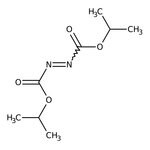
Azodicarboxilato de diisopropilo, 94 %, Thermo Scientific Chemicals
CAS: 2446-83-5 | C8H14N2O4 | 202.21 g/mol
Have Questions?
Cambiar vista

Número de catálogo L10386.22
también denominado L10386-22
Precio (USD)
-
Cantidad:
100 g
Identificadores químicos
CAS2446-83-5
IUPAC NameN-{[(propan-2-yloxy)carbonyl]imino}(propan-2-yloxy)formamide
Molecular FormulaC8H14N2O4
InChI KeyVVWRJUBEIPHGQF-UHFFFAOYSA-N
SMILESCC(C)OC(=O)N=NC(=O)OC(C)C
Ver más
Especificaciones Hoja de especificaciones
Hoja de especificacionesAppearance (Color)Clear, orange to reddish brown
FormLiquid
Assay (GC)≥ 92.0%
Este producto de marca Thermo Scientific Chemicals formó parte originalmente de la cartera de productos Alfa Aesar. Alguna información sobre documentos y etiquetas puede referirse a la marca original. El producto original Alfa Aesar / código de artículo original o la referencia SKU no ha cambiado como parte de la transición de la marca a Thermo Scientific Chemicals.
Aplicaciones
El azodicarboxilato de diisopropilo se utiliza como reactivo importante en la producción de muchos compuestos orgánicos. Se usa junto con trifenilfosfina en la reacción de Mitsunobu de alcoholes, ácidos y amidas. Actúa como reacivo en la preparación de cromenos que se asemejan a cannabinoides clásicos, polímeros ricos en guanidina a base de norborneno y colorantes orgánicos aceptores y donadores.
Solubilidad
No miscible con agua.
Notas
Almacenar en un lugar fresco. Sensible a la luz. Incompatible con agentes oxidantes fuertes, bases fuertes, alcoholes y sales metálicas. Se descompone de forma abrupta a o por encima de: 100 0C.
El azodicarboxilato de diisopropilo se utiliza como reactivo importante en la producción de muchos compuestos orgánicos. Se usa junto con trifenilfosfina en la reacción de Mitsunobu de alcoholes, ácidos y amidas. Actúa como reacivo en la preparación de cromenos que se asemejan a cannabinoides clásicos, polímeros ricos en guanidina a base de norborneno y colorantes orgánicos aceptores y donadores.
Solubilidad
No miscible con agua.
Notas
Almacenar en un lugar fresco. Sensible a la luz. Incompatible con agentes oxidantes fuertes, bases fuertes, alcoholes y sales metálicas. Se descompone de forma abrupta a o por encima de: 100 0C.
RUO - Para uso exclusivo en investigación
General References:
- Alternative to 'DEAD' (Diethyl azodicarboxyl ate, L19348), more stable at elevated temperatures. DIAD has been used in combination with Triphenyl phosphine, L02502, in Mitsunobu-type reactions of alcohols with acids, amides, etc. In the Mitsunobu esterification reaction yields improve with increasing acid strength. For a discussion, see: J. Org. Chem., 61, 2967 (1996).
- For use in the regioselective, stereospecific Mitsunobu azidation of 1,2- and 1,3-diols with Trimethyl silyl azide, L00173, see: J. Org. Chem., 64, 6049 (1999).
- An extremely mild route to isocyanates involves treatment of an aliphtic primary amine with CO2 to form the carbamate salt which reacts at low temperature with the Mitsunobu reagent from DIAD and PPh3, giving the isocyanate in high yield. 2,6-Dialkylanilines also undergo the reaction if Bu3P is used; the reaction failed with other anilines: Tetrahedron Lett., 40, 363 (1999).
- For reviews of the Mitsunobu reaction, see: Synthesis, 1 (1981); Org. React., 42, 335 (1992); Org. Prep. Proced. Int., 28, 127 (1996). For a brief feature on synthetic uses of Mitsunobu reagents, see: Synlett, 1221 (2003).
- Ryu, I.; Tani, A.; Fukuyama, T.; Ravelli, D.; Montanaro, S.; Fagnoni, M. Efficient C-H/C-N and C-H/C-CO-N Conversion via Decatungstate-Photoinduced Alkylation of Diisopropyl Azodicarboxylate. Org. Lett. 2013, 15 (10), 2554-2557.
- Hayashi, M.; Shibuya, M.; Iwabuchi, Y. Oxidation of Alcohols to Carbonyl Compounds with Diisopropyl Azodicarboxylate Catalyzed by Nitroxyl Radicals. J. Org. Chem. 2012, 76 (6), 3005-3009.