Search
 Búsqueda por elementos
 Búsqueda por estructura


Thermo Scientific Chemicals
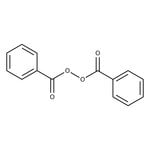
Peróxido de benzoilo, 97 % (peso seco), húmedo con un 25 % de agua, Thermo Scientific Chemicals
CAS: 94-36-0 | C14H10O4 | 242.23 g/mol
| Número de catálogo | Cantidad |
|---|---|
| L13174.30 también denominado L13174-30 | 250 g |
Número de catálogo L13174.30
también denominado L13174-30
Precio (USD)
-
Cantidad:
250 g
Identificadores químicos
CAS94-36-0
IUPAC Namebenzoyl benzenecarboperoxoate
Molecular FormulaC14H10O4
InChI KeyOMPJBNCRMGITSC-UHFFFAOYSA-N
SMILESO=C(OOC(=O)C1=CC=CC=C1)C1=CC=CC=C1
Ver más
Especificaciones Hoja de especificaciones
Hoja de especificacionesFormWet powder or granules
Assay from Supplier's CofA≥72 to ≤78%
CommentContact with metal may produce violent decomposition
Appearance (Color)White
Benzoyl peroxide is widely utilized as a radical initiator to induce polymerizations. It finds applications for acne treatment, for bleaching flour, hair and teeth and for cross-linking polyester resins. It also has major applications in antiseptic and bleaching properties. It serves as a catalyst for polyester thermoset resins and as a hardener to start the polymerization process.
This Thermo Scientific Chemicals brand product was originally part of the Alfa Aesar product portfolio. Some documentation and label information may refer to the legacy brand. The original Alfa Aesar product / item code or SKU reference has not changed as a part of the brand transition to Thermo Scientific Chemicals.
Aplicaciones
El peróxido de bezoilo se utiliza ampliamente como iniciador radical para inducir polimerizaciones. Se aplica para el tratamiento del acné, para blanquear la harina, el pelo y los dientes y para el entrecruzamiento de resinas de poliéster. También se aplica de forma importante en propiedades antisépticas y blanqueadoras. Sirve como catalizador para resinas termoendurecibles de poliéster y como endurecedor para iniciar el proceso de polimerización.
Solubilidad
Soluble en éter y cloroformo. Ligeramente soluble en etanol. Insoluble en agua.
Notas
Incompatible con oxidantes fuertes, agentes reductores, ácidos, bases, alcoholes y metales.
El peróxido de bezoilo se utiliza ampliamente como iniciador radical para inducir polimerizaciones. Se aplica para el tratamiento del acné, para blanquear la harina, el pelo y los dientes y para el entrecruzamiento de resinas de poliéster. También se aplica de forma importante en propiedades antisépticas y blanqueadoras. Sirve como catalizador para resinas termoendurecibles de poliéster y como endurecedor para iniciar el proceso de polimerización.
Solubilidad
Soluble en éter y cloroformo. Ligeramente soluble en etanol. Insoluble en agua.
Notas
Incompatible con oxidantes fuertes, agentes reductores, ácidos, bases, alcoholes y metales.
RUO – Research Use Only
General References:
- Free-radical initiator for a wide variety of homolytic reactions, e.g. halogenations with bromine or NBS.
- Semsarzadeh, M. A.; Alamdari, P. Co(acac)2 mediated controlled radical copolymerization of vinyl acetate and methyl acrylate initiated by benzoyl peroxide. Macromol. Res. 2015, 23 (2), 139-144.
- Gollnick, H. P. M.; Friedrich, M.; Peschen, M.; Pettker, R.; Pier, A.; Jostingmeyer, V. S.; Porombka, D.; Pulido, R.; Jackel, A. Safety and efficacy of adapalene 0.1% / benzoyl peroxide 2.5% in the long-term treatment of predominantly moderate acne with or without concomitant medication - results from the non-interventional cohort study ELANG. J Eur Acad Dermatol Venereol 2015, 29 (4), 15-22.