Search


Citations & References (3)
Thermo Scientific™
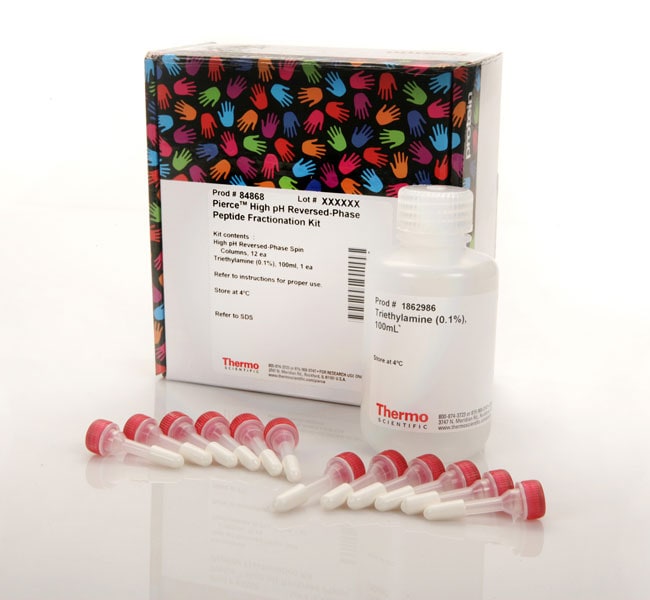
Pierce™ High pH Reversed-Phase Peptide Fractionation Kit
Increase protein identification from LC/MS analysis through orthogonal peptide fractionation of complex peptide samples using Thermo Scientific™ Pierce™ High pH Reversed-Phase Peptide Fractionation Kit.
| Catalog Number | Quantity |
|---|---|
| 84868 | 12 Reactions |
Catalog number 84868
Price (BRL)
2.874,62
Each
Quantity:
12 Reactions
Price (BRL)
2.874,62
Each
In order to enable deep proteome sequencing, it is often necessary to reduce the sample complexity by fractionation in an orthogonal dimension prior to LC/MS analysis. The Pierce High pH Reversed-Phase Peptide Fractionation Kit utilizes high pH reversed-phase chromatography to separate peptides by hydrophobicity, and provides excellent orthogonality to low pH reversed-phase LC-MS gradients. The kit has been designed to improve protein identification through the use of a proprietary reversed-phase resin in an easy-to-use spin column format with a high-pH fractionation protocol.
Thermo Scientific Pierce High pH Reversed-Phase Peptide Fractionation Kit increases protein identification from LC/MS analysis through orthogonal peptide fractionation of complex peptide samples.
- Easy-to-use - resin provided in single-use spin column format
- Improved protein identifications - protein identifications increased by ≥50% when compared to unfractionated samples
- Reproducible - elution profiles and fractional resolution vary by less than 20%
- Optimized - robust procedure for maximal protein identification and peptide recovery while minimizing fractional overlap
- Compatible - reagents validated with a variety of complex samples, including TMT™-labeled peptides
The kit has been designed to improve protein identification through the use of a proprietary reversed-phase resin in an easy-to-use spin column format with a high-pH fractionation protocol. In contrast to strong cation exchange (SCX) fractionation, the high-pH reversed-phase fractions do not require an additional desalting step before LC/MS analysis.
The High pH Reversed-phase Peptide Fractionation Kit includes a high pH buffer (0.1% triethylamine) and twelve spin columns containing pH-resistant reversed-phase resin. Each reversed-phase fractionation spin column enables fractionation of 10 to 100μg of peptide sample using a microcentrifuge.
Native, phosphorylated, Tandem Mass Tag™ (TMT)-labeled, and other complex peptide mixture samples can be fractionated using this kit. Combining the search results generated by the individual fractions helps improve protein sequence coverage and increases the number of identified proteins relative to unfractionated samples.
Applications:
- Reducing sample complexity to identify targets of interest
- Conducting systems biology studies
- Reducing sample complexity to improve quantitation studies
For Research Use Only. Not for use in diagnostic procedures.
Specifications
Final Product TypePeptides
For Use With (Equipment)Microcentrifuge
Quantity12 Reactions
Workflow StepFractionation
Detection MethodMass Spectrometry
FormatKit
Product LinePierce
Product TypePeptide Fractionation Kit
Starting MaterialPeptides, Protease-digested Protein
Unit SizeEach
Contents & Storage
Reversed-phase fractionation spin columns, 12 columns
Triethylamine (0.1%), 100 mL
Store in refrigerator (2–8°C).
Triethylamine (0.1%), 100 mL
Store in refrigerator (2–8°C).
Frequently asked questions (FAQs)
Can I purchase the Reversed-Phase Fractionation Spin Columns from the Pierce High pH Reversed-Phase Peptide Fractionation Kit (Cat. No. 84868) separately?
How much starting material is needed to fractionate my samples using the Pierce High pH Reversed Phase Fractionation Kit (Cat. No. 84868)?
I want to fractionate a complex mass spectrometry sample, but my sample is different from the one described in the manual for the Pierce High pH Reversed-Phase Peptide Fractionation Kit. Should I use a customized fractionation gradient?
After running the Pierce TMT11plex Yeast Digest Standard, I observe low signal to noise ratio and poor quantitation accuracy for the Tandem Mass Tag (TMT) reporter ions. What do you recommend?
I have a lower number of peptide/protein identification in my combined TMT-labeled samples compared to the unlabeled sample. What can I do?
Citations & References (3)
Citations & References
Abstract
Targeted Protein Degradation through Recruitment of the CUL4 Complex Adaptor Protein DDB1
Journal:ACS Chem Biol
PubMed ID:38192078
Targeted protein degradation has arisen as a powerful therapeutic modality for eliminating proteins. Thus far, most heterobifunctional proteolysis targeting chimeras (PROTACs) have utilized recruiters against substrate receptors of Cullin RING E3 ubiquitin ligases, such as cereblon and VHL. However, previous studies have surprisingly uncovered molecular glue degraders that exploit a
Generating high quality libraries for DIA MS with empirically corrected peptide predictions.
Journal:Nature communications
PubMed ID:32214105
Data-independent acquisition approaches typically rely on experiment-specific spectrum libraries, requiring offline fractionation and tens to hundreds of injections. We demonstrate a library generation workflow that leverages fragmentation and retention time prediction to build libraries containing every peptide in a proteome, and then refines those libraries with empirical data. Our method
Proteomics of prostate cancer serum and plasma using low and high throughput approaches
Journal:Clin Proteomics
PubMed ID:38475692
Despite progress, MS-based proteomics in biofluids, especially blood, faces challenges such as dynamic range and throughput limitations in biomarker and disease studies. In this work, we used cutting-edge proteomics technologies to construct label-based and label-free workflows, capable of quantifying approximately 2,000 proteins in biofluids. With 70µL of blood and a