Search


Citações e referências (7)
Gibco™
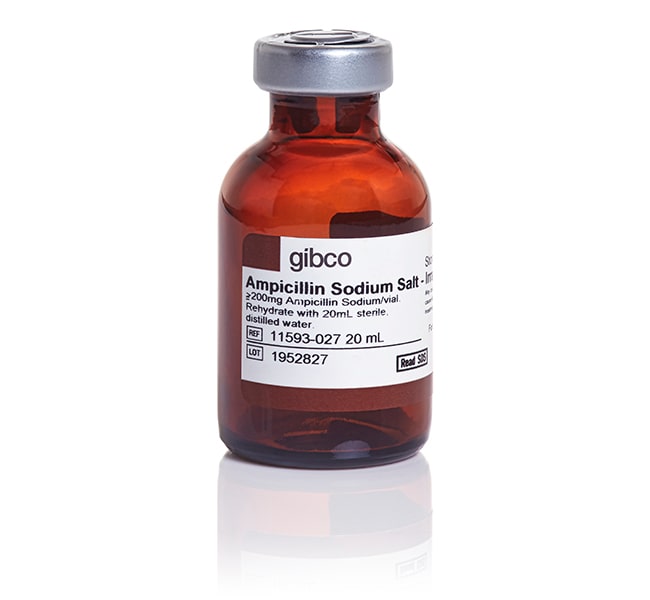
Ampicillin, sodium salt, irradiated
Ampicillin is an antibiotic in the broad-spectrum penicillin group. Ampicillin differs from penicillin only by the presence of an aminoLeia mais
| Número do catálogo | Quantity |
|---|---|
| 11593027 | 200 mg |
Número do catálogo 11593027
Preço (BRL)
344,68
Each
Quantity:
200 mg
Preço (BRL)
344,68
Each
Ampicillin is an antibiotic in the broad-spectrum penicillin group. Ampicillin differs from penicillin only by the presence of an amino group, which facilitates penetration through the outer membrane of some gram-negative bacteria. Ampicillin acts by interfering directly with the turnover of the bacterial cell wall and indirectly by triggering the release of enzymes that further alter the cell wall.
Gibco Ampicillin is used as a selective antibiotic generally at a concentration of 20–125 μg/mL. Ampicillin selection is based on hydrolysis and inactivation of its beta-lactam ring by beta-lactamase expressed by the bla gene. Sometimes, beta-lactamase produced by the bacteria is secreted into the medium resulting in inactivation of ampicillin in the culture medium. Ampicillin degradation on agar plates can lead to the formation of satellite colonies. Growth of these colonies can be halted by adding fresh ampicillin. To avoid beta-lactamase buildup, special care must be taken while handling cultures and determining the correct dose of antibiotic.
Ampicillin antibiotic in powder form is an economical choice that can be used in a wide range of gram-positive and gram-negative infections. This product is provided as a powder and should be made into a stock solution at a concentration of 10 mg/mL in water.
cGMP manufacturing
Gibco Ampicillin is manufactured at a cGMP compliant facility located in Grand Island, New York. The facility is registered with the FDA as a medical device manufacturer and is certified to ISO 13485 standards.
Gibco Ampicillin is used as a selective antibiotic generally at a concentration of 20–125 μg/mL. Ampicillin selection is based on hydrolysis and inactivation of its beta-lactam ring by beta-lactamase expressed by the bla gene. Sometimes, beta-lactamase produced by the bacteria is secreted into the medium resulting in inactivation of ampicillin in the culture medium. Ampicillin degradation on agar plates can lead to the formation of satellite colonies. Growth of these colonies can be halted by adding fresh ampicillin. To avoid beta-lactamase buildup, special care must be taken while handling cultures and determining the correct dose of antibiotic.
Ampicillin antibiotic in powder form is an economical choice that can be used in a wide range of gram-positive and gram-negative infections. This product is provided as a powder and should be made into a stock solution at a concentration of 10 mg/mL in water.
cGMP manufacturing
Gibco Ampicillin is manufactured at a cGMP compliant facility located in Grand Island, New York. The facility is registered with the FDA as a medical device manufacturer and is certified to ISO 13485 standards.
For Research Use Only. Not for use in diagnostic procedures.
Especificações
Concentration20 to 125 μg/mL
For Use With (Application)Bacterial Selection
Quantity200 mg
Shipping ConditionRoom Temperature
FormPowder
Product TypeAntibiotic
Unit SizeEach
Conteúdo e armazenamento
Storage conditions: 2 to 8°C
Shipping conditions: Ambient
Shipping conditions: Ambient
Frequently asked questions (FAQs)
What are the recommended concentrations of antibiotics to use for selection in prokaryotes and eukaryotes?
Can ampicillin be used for selection of eukaryotic cells if put under control of a eukaryotic/viral promoter?
How can I decontaminate my cultures?
What antibiotics do you offer to help control or eliminate cell culture contamination?
Citações e referências (7)
Citações e referências
Abstract
Human GBP1 is a microbe-specific gatekeeper of macrophage apoptosis and pyroptosis.
Journal:EMBO J
PubMed ID:31268602
'The guanylate binding protein (GBP) family of interferon-inducible GTPases promotes antimicrobial immunity and cell death. During bacterial infection, multiple mouse Gbps, human GBP2, and GBP5 support the activation of caspase-1-containing inflammasome complexes or caspase-4 which trigger pyroptosis. Whether GBPs regulate other forms of cell death is not known. The apicomplexan
Id1 Ablation Protects Hematopoietic Stem Cells from Stress-Induced Exhaustion and Aging.
Journal:Cell Stem Cell
PubMed ID:30082068
'Defining mechanisms that maintain tissue stem cells during homeostasis, stress, and aging is important for improving tissue regeneration and repair and enhancing cancer therapies. Here, we show that Id1 is induced in hematopoietic stem cells (HSCs) by cytokines that promote HSC proliferation and differentiation, suggesting that it functions in stress
Completeness of HIV-1 Envelope Glycan Shield at Transmission Determines Neutralization Breadth.
Journal:Cell Rep
PubMed ID:30355496
Densely arranged N-linked glycans shield the HIV-1 envelope (Env) trimer from antibody recognition. Strain-specific breaches in this shield (glycan holes) can be targets of vaccine-induced neutralizing antibodies that lack breadth. To understand the interplay between glycan holes and neutralization breadth in HIV-1 infection, we developed a sequence- and structure-based approach
Generation of Mutants of Nuclear-Encoded Plastid Proteins Using CRISPR/Cas9 in the Diatom Phaeodactylum tricornutum.
Journal:Methods Mol Biol
PubMed ID:29987734
Genome modifications in microalgae are becoming a widespread and mandatory tool for research in both fundamental and applied biology. Among genome editing methods in these photosynthetic organisms, CRISPR/Cas9 offers a specific, powerful and efficient tool for genome engineering by inducing mutations in targeted regions of the genome. Here we described
Cannabidiol directly targets mitochondria and disturbs calcium homeostasis in acute lymphoblastic leukemia.
Journal:Cell Death Dis
PubMed ID:31611561
Anticancer properties of non-psychoactive cannabinoid cannabidiol (CBD) have been demonstrated on tumors of different histogenesis. Different molecular targets for CBD were proposed, including cannabinoid receptors and some plasma membrane ion channels. Here we have shown that cell lines derived from acute lymphoblastic leukemia of T lineage (T-ALL), but not resting