Search

Thermo Scientific™
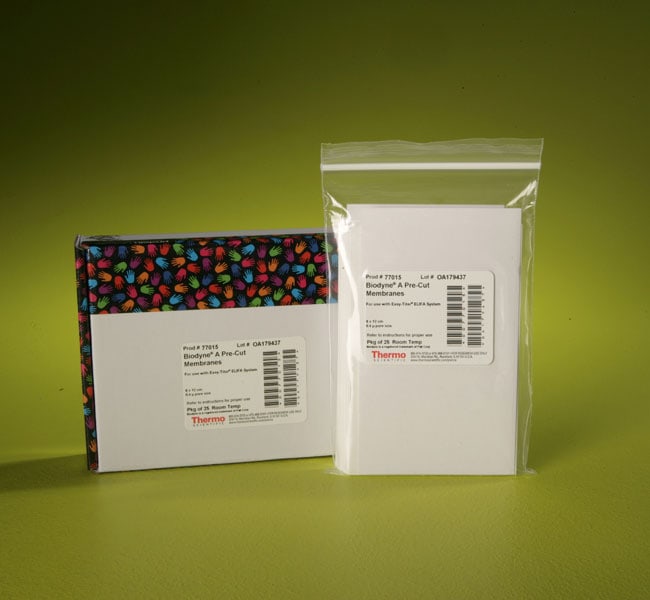
Biodyne™ A Nylon Membrane, 0.45 μm, 8 cm x 12 cm
Thermo Scientific Biodyne A Nylon Membranes are sheets of unmodified nylon that provide excellent binding characteristics for nucleic acid transfer,Leia mais
| Número do catálogo | Quantity |
|---|---|
| 77015 | 25 sheets |
Número do catálogo 77015
Preço (BRL)
5.077,35
Each
Quantity:
25 sheets
Preço (BRL)
5.077,35
Each
Thermo Scientific Biodyne A Nylon Membranes are sheets of unmodified nylon that provide excellent binding characteristics for nucleic acid transfer, blotting and detection methods.
Features of Biodyne A Nylon Membranes:
• Versatile and durable—achieve strong DNA binding by baking or UV-crosslinking without damaging the membrane
• Easy to use—pre-cut 8 x 12 cm sheets are the ideal size for standard mini-gel transfers and microplate dot-blots
• High signal-to-noise ratio—lower background than nitrocellulose and most other nylon transfer membranes
Biodyne A Nylon Membrane is manufactured with a matrix pore size of 0.4 micron, and is supplied in packages of 8 x 12 cm sheets. It contains both negatively and positively charged groups, enabling it to bind many kinds of macromolecules. The membrane is resistant to heat and solvents and will not shrink, crack or tear.
Properties of Biodyne A Nylon Membrane:
• Composition: unmodified Nylon 66
• Surface: 50% amine and 50% carboxyl groups, pI 6.5
• Properties: provides excellent resolution, high sensitivity and extremely low background
More Product Data
• Transfer EMSA gels using the Pierce G2 Fast Blotter
Related Products
Biodyne™ B Nylon Membrane, 0.45 μm, 8 cm x 12 cm
Features of Biodyne A Nylon Membranes:
• Versatile and durable—achieve strong DNA binding by baking or UV-crosslinking without damaging the membrane
• Easy to use—pre-cut 8 x 12 cm sheets are the ideal size for standard mini-gel transfers and microplate dot-blots
• High signal-to-noise ratio—lower background than nitrocellulose and most other nylon transfer membranes
Biodyne A Nylon Membrane is manufactured with a matrix pore size of 0.4 micron, and is supplied in packages of 8 x 12 cm sheets. It contains both negatively and positively charged groups, enabling it to bind many kinds of macromolecules. The membrane is resistant to heat and solvents and will not shrink, crack or tear.
Properties of Biodyne A Nylon Membrane:
• Composition: unmodified Nylon 66
• Surface: 50% amine and 50% carboxyl groups, pI 6.5
• Properties: provides excellent resolution, high sensitivity and extremely low background
More Product Data
• Transfer EMSA gels using the Pierce G2 Fast Blotter
Related Products
Biodyne™ B Nylon Membrane, 0.45 μm, 8 cm x 12 cm
For Research Use Only. Not for use in diagnostic procedures.
Especificações
Quantity25 sheets
Dimensions (LxW)12 cm x 8 cm
FormatSheet
Length (Metric)12 cm
MaterialNylon
Pore Size0.45 μm
Product LineBiodyne
Width (Metric)8 cm
Unit SizeEach
Conteúdo e armazenamento
Note: Always wear gloves when handling membranes because oils from fingers may prevent proper wetting. Also, proteins and other contaminants from hands may bind to the membranes and cause background.