Search




Citações e referências (13)
Invitrogen™
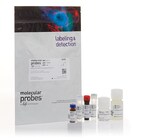
Vybrant™ FLICA Caspase Apoptosis Assay Kits for flow cytometry
Detect apoptosis via flow cytometry with Vybrant FLICA Caspase Assays that detect poly and caspase-3/7/8 activities.
Have Questions?
Alterar visualização

| Número do catálogo | Enzyme |
|---|---|
| V35119 | Caspase 8 |
| V35117 | Poly Caspases |
| V35118 | Caspase 3/7 |
Número do catálogo V35119
Preço (BRL)
2.620,09
25 assays
Enzyme:
Caspase 8
Preço (BRL)
2.620,09
25 assays
Quickly detect caspase-mediated apoptosis by flow cytometry with Vybrant FAM caspase assay kits for poly-caspases and caspases 3 and 7. The Vybrant FAM caspase assay kits use fluorescent inhibitor of caspases (FLICA) methodology to detect and report caspase activity. Specifically, these caspase assay kits contain engineered FLICA substrates FAM-VAD-FMK (for poly-caspases), FAM-DEVD-FMK (for caspase-3/7), and FAM-LETD-FMK (for caspase-8). They also include Hoechst 33342 and propidium iodide stains, enabling simultaneous evaluation of membrane permeability and cell cycle by flow cytometry.
The Vybrant FAM caspase assay kits for flow cytometry employ a novel approach to detecting active caspases: the kits take advantage of FLICA methodology, which is an affinity label. This affinity label associates a fluoromethyl ketone (FMK) moiety, which can react covalently with a cysteine, with a caspase-specific amino acid sequence. Different amino acid recognition sequences are used to detect different caspases: valine-alanine-aspartic acid (VAD) for poly caspases (including caspase-1, -3, -4, -5, -6, -7, -8, and -9), aspartic acid-glutamic acid-valine-aspartic acid (DEVD) for caspase-3/7, and leucine-glutamic acid-threonine-aspartic acid (LETD) for caspase-8. A carboxyfluorescein (FAM) group is attached as a reporter.
The FLICA reagent is thought to interact with the enzymatic reactive center of an activated caspase via the recognition sequence, and then to attach covalently through the FMK moiety. The FLICA inhibitor is cell permeant and noncytotoxic. Unbound FLICA molecules diffuse out of the cell and are washed away; the remaining fluorescent signal is a direct measure of the amount of active caspase present at the time the inhibitor was added. The approximate excitation and emission peaks of the FLICA, propidium iodide, and Hoechst 33342 reagents are 488 nm/530 nm, 535 nm/6617 nm, and 350 nm/461 nm, respectively. The detection reagents included within the individual Vybrant FAM Poly Caspases Assay, Caspase-3 and -7 Assay, and Caspase-8 Assay apoptosis kits are 488/530 FAM-VAD-FMK reagent, 488/530 FAM-DEVD-FMK, and 488/530 FAM-LETD-FMK, respectively.
For Research Use Only. Not for use in diagnostic procedures.
Especificações
EnzymeCaspase 8
Excitation/EmissionFAM-LETD-FMDK: 488/530
PI: 535/617
Hoechst 33342: 350/461
PI: 535/617
Hoechst 33342: 350/461
Flow Cytometer Laser LinesUV, 488
For Use With (Equipment)Flow Cytometer
Label TypeOther Label(s) or Dye(s)
Label or DyeFAM, Hoechst 33342, Propidium Iodide
Product LineVybrant
Product TypeCaspase Assay Kit
Quantity25 Assays
Shipping ConditionRoom Temperature
Detection MethodFluorescence
FormatTube
Unit Size25 assays
Conteúdo e armazenamento
1 vial of FAM-LETD-FMK caspase-8 reagent (FLICA reagent), 1 vial Hoechst 33342, 1 vial of propidium iodide, 1 vial of DMSO, 1 bottle of apoptosis fixative solution, and 1 bottle of apoptosis wash buffer (10X solution). Store in refrigerator (2–8°C) and protect from light.
Citações e referências (13)
Citações e referências
Abstract
Galectin-3 binds to CD45 on diffuse large B-cell lymphoma cells to regulate susceptibility to cell death.
Journal:Blood
PubMed ID:23065155
Diffuse large B-cell lymphoma (DLBCL) is the most common non-Hodgkin lymphoma and an aggressive malignancy. Galectin-3 (gal-3), the only antiapoptotic member of the galectin family, is overexpressed in DLBCL. While gal-3 can localize to intracellular sites, gal-3 is secreted by DLBCL cells and binds back to the cell surface in
Reovirus infection or ectopic expression of outer capsid protein micro1 induces apoptosis independently of the cellular proapoptotic proteins Bax and Bak.
Journal:J Virol
PubMed ID:20980509
Mammalian orthoreoviruses induce apoptosis in vivo and in vitro; however, the specific mechanism by which apoptosis is induced is not fully understood. Recent studies have indicated that the reovirus outer capsid protein µ1 is the primary determinant of reovirus-induced apoptosis. Ectopically expressed µ1 induces apoptosis and localizes to intracellular membranes.
Interrelated roles for Mcl-1 and BIM in regulation of TRAIL-mediated mitochondrial apoptosis.
Journal:J Biol Chem
PubMed ID:16478725
The current study demonstrates a novel cross-talk mechanism between the TRAIL receptor death signaling pathway and the mitochondria. This newly identified pathway is regulated at the mitochondrial outer membrane by a complex between the prosurvival Bcl-2 member, Mcl-1 and the BH3-only protein, Bim. Under non-apoptotic conditions, Bim is sequestered by
Assay of caspase activation in situ combined with probing plasma membrane integrity to detect three distinct stages of apoptosis.
Journal:J Immunol Methods
PubMed ID:12072182
Activation of cysteine-aspartic acid specific proteases (caspases) in situ, in live cells, can be detected using fluorochrome-labeled inhibitors of caspases (FLICA), the reagents that covalently bind to the active center of these enzymes. In the present study, this assay was combined with a probe of plasma membrane capacity to exclude
Interactions of fluorochrome-labeled caspase inhibitors with apoptotic cells: a caution in data interpretation.
Journal:Cytometry A
PubMed ID:12938188
BACKGROUND: Fluorochrome-labeled inhibitors of caspases (FLICA, e.g., FAM-VAD-FMK, FITC-VAD-FMK) have been designed as affinity labels of the enzyme active center of caspases Their binding by apoptotic cells was interpreted as reflecting activation of caspases. We have recently observed, however, that their binding is more complex and may involve additional mechanisms.