Search



Citations & References (4)
Invitrogen™
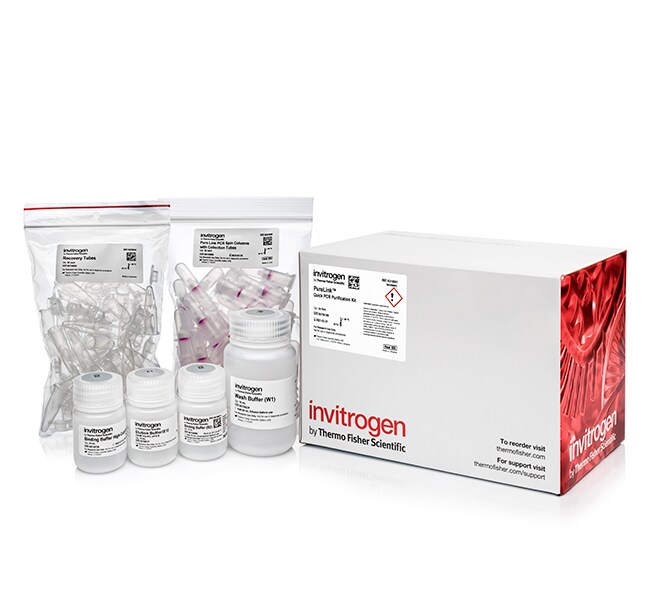
PureLink™ PCR Purification Kit
The PureLink PCR Purification Kit provides a more convenient, rapid, and high-yielding purification process compared to other companies' kits.
Have Questions?
Change view

| Catalog Number | Quantity |
|---|---|
| K310001 | 50 Preps |
| K310002 | 250 Preps |
Catalog number K310001
Price (CLP)
140.506
Each
Quantity:
50 Preps
Price (CLP)
140.506
Each
The PureLink PCR Purification Kit provides a more convenient, rapid, and high-yielding purification process compared to other companies' kits. After PCR amplification, purification of the PCR amplicons is required for many common downstream applications, including enzyme digestion, ligation, sequencing, and labeling experiments, to prevent enzymes (polymerase, restriction enzyme) and reaction components (dNTPs, primers, buffers, salts) from carrying over, contaminating, and negatively influencing the downstream experiments.
Advantages of the PureLink PCR Purification Kit include:
- 4X binding capacity compared to Company Q; 40 μg for the PureLink kit versus 10 μg from other companies' kits
- No need for tedious sample pH adjustments necessary with other kits
- Convenient and rapid protocol, completed in less than 10 minutes
- Optional size-selection buffers included for selectively purifying 300–600 bp fragments
The PureLink PCR Purification Kit is based on the selective binding of dsDNA to silica-based membrane in the presence of chaotropic salts. Simply mix the PCR product with Binding Buffer and apply to the PureLink Spin Column. The dsDNA binds to the silica-based membrane in the column. Remove impurities by thorough washing with Wash Buffer. To purify the DNA, elute the dsDNA in low-salt Elution Buffer or water.The purified PCR product is suitable for automated fluorescent DNA sequencing, restriction enzyme digestion, and cloning.
For Research Use Only. Not for use in diagnostic procedures.
Specifications
FormatKit
High-throughput CompatibilityHigh-throughput Compatible
Isolation TechnologySilica Spin Column
Product LinePureLink
Product TypePCR Purification Kit
Quantity50 Preps
Run Time10 min.
Sample TypePCR Products
Shipping ConditionRoom Temperature
TargetDNA from Enzymatic Reactions (e.g. PCR)
For Use With (Application)Next-Generation Sequencing (NGS), Cloning
Unit SizeEach
Contents & Storage
For better long-term performance, it is recommended to store the purification columns at 2°C to 8°C.
Frequently asked questions (FAQs)
Can I use the PureLink PCR Purification Kit to clean up restriction digested plasmid DNA?
Can I use the PureLink PCR Purification Kit to do a gel purification?
What are the minimum and maximum size ranges for DNA fragment cleanup using the PureLink PCR Clean-Up Kit?
What is nested and semi-nested PCR?
Can I sequence PCR products rather than plasmids, and what is the advantage?
Citations & References (4)
Citations & References
Abstract
A virulence and antimicrobial resistance DNA microarray detects a high frequency of virulence genes in Escherichia coli isolates from Great Lakes recreational waters.
Journal:Appl Environ Microbiol
PubMed ID:16751532
'Escherichia coli is generally described as a commensal species with occasional pathogenic strains. Due to technological limitations, there is currently little information concerning the prevalence of pathogenic E. coli strains in the environment. For the first time, using a DNA microarray capable of detecting all currently described virulence genes and
The incidence and clinical significance of nucleophosmin mutations in childhood AML.
Journal:Blood
PubMed ID:17440048
Frameshift mutations in exon 12 of the nucleophosmin gene (NPM1) result in aberrant cytoplasmic localization of the NPM protein (NPMc(+)) and occur in 25% to 35% of adult acute myeloid leukemia (AML). In adults with AML, NPMc(+) has been associated with normal karyotype, FLT3/ITD mutations, high remission induction rates, and
Accuracy of six antimicrobial susceptibility methods for testing linezolid against staphylococci and enterococci.
Journal:J Clin Microbiol
PubMed ID:17634301
A challenge panel of enterococci (n = 50) and staphylococci (n = 50), including 17 and 15 isolates that were nonsusceptible to linezolid, respectively, were tested with the Clinical and Laboratory Standards Institute broth microdilution and disk diffusion reference methods. In addition, all 100 isolates were tested in parallel by
Occurrence of virulence and antimicrobial resistance genes in Escherichia coli isolates from different aquatic ecosystems within the St. Clair River and Detroit River areas.
Journal:Appl Environ Microbiol
PubMed ID:17085696
Although the number of Escherichia coli bacteria in surface waters can differ greatly between locations, relatively little is known about the distribution of E. coli pathotypes in surface waters used as sources for drinking or recreation. DNA microarray technology is a suitable tool for this type of study due to