Search


Citas y referencias (66)
Gibco™
Bac-to-Bac™ Baculovirus Expression System
El sistema de expresión de baculovirus Bac-to-Bac permite una producción eficaz de baculovirus recombinantes para la prueba de expresión enMás información
| Número de catálogo | Cantidad |
|---|---|
| 10359016 | 1 kit |
Número de catálogo 10359016
Precio (CLP)
1.856.400
Each
Cantidad:
1 kit
Precio (CLP)
1.856.400
Each
El sistema de expresión de baculovirus Bac-to-Bac permite una producción eficaz de baculovirus recombinantes para la prueba de expresión en células de insectos. El sistema se basa en la generación de baculovirus recombinantes mediante la transposición específica de sitio en E. coli en lugar de la recombinación homóloga en células de insecto. Características del sistema:
• Bácmido de expresión que ahorra tiempo: con el sistema Bac-to-Bac, el casete de expresión del vector pFastBac se recombina con el bacmid padre en las células competentes de E. coli DH10Bac para formar un bacilo de expresión. A continuación, el bácmido se transfecta en células de insectos para producir partículas recombinantes de baculovirus.
• Fácil detección de colonias: el bácmido parental en la E. coli DH10Bac contiene un segmento del gen lacZa. El gen lacZa se interrumpe tras la transposición del casete de expresión en el bacilo, lo que permite la selección azul/blanca de recombinantes para facilitar la identificación de colonias recombinantes.
Alta eficacia de transfección con el reactivo de transfección ExpiFectamine SF: los kits de expresión TOPO Bac-to-Bac ahora incluyen la última generación de reactivos de transfección ExpiFectamine SF para una transfección de ADN eficaz en células de insectos utilizando protocolos rápidos y flexibles. Más información sobre este reactivo ›
• Flexibilidad: el sistema Bac-to-Bac incluye un vector pFastBac que contiene un sitio de clonación múltiple de gran tamaño (MCS) para la clonación simplificada. Se ofrecen otros dos vectores adicionales por separado.: Vector pFastBac HT para la producción de proteínas recombinantes marcadas con histidina y vector pFastBac Dual para la expresión de dos proteínas simultáneamente utilizando los promotores p10 y poliedrina.
• Alta expresión de proteínas: el vector pFastBac utiliza el potente promotor de poliedrina para generar altos niveles de expresión en una variedad de líneas celulares de insectos como Sf9, Sf21 y células High Five.
• Bácmido de expresión que ahorra tiempo: con el sistema Bac-to-Bac, el casete de expresión del vector pFastBac se recombina con el bacmid padre en las células competentes de E. coli DH10Bac para formar un bacilo de expresión. A continuación, el bácmido se transfecta en células de insectos para producir partículas recombinantes de baculovirus.
• Fácil detección de colonias: el bácmido parental en la E. coli DH10Bac contiene un segmento del gen lacZa. El gen lacZa se interrumpe tras la transposición del casete de expresión en el bacilo, lo que permite la selección azul/blanca de recombinantes para facilitar la identificación de colonias recombinantes.
Alta eficacia de transfección con el reactivo de transfección ExpiFectamine SF: los kits de expresión TOPO Bac-to-Bac ahora incluyen la última generación de reactivos de transfección ExpiFectamine SF para una transfección de ADN eficaz en células de insectos utilizando protocolos rápidos y flexibles. Más información sobre este reactivo ›
• Flexibilidad: el sistema Bac-to-Bac incluye un vector pFastBac que contiene un sitio de clonación múltiple de gran tamaño (MCS) para la clonación simplificada. Se ofrecen otros dos vectores adicionales por separado.: Vector pFastBac HT para la producción de proteínas recombinantes marcadas con histidina y vector pFastBac Dual para la expresión de dos proteínas simultáneamente utilizando los promotores p10 y poliedrina.
• Alta expresión de proteínas: el vector pFastBac utiliza el potente promotor de poliedrina para generar altos niveles de expresión en una variedad de líneas celulares de insectos como Sf9, Sf21 y células High Five.
Para uso exclusivo en investigación. No apto para uso en procedimientos diagnósticos.
Especificaciones
Tipo de productoSistema de expresión de baculovirus
Cantidad1 kit
VectorpFastBac
Método de clonaciónEnzimas de restricción/MCS
Línea de productosBac-to-Bac
PromotorPoliedrina
Etiqueta de proteínaSin etiquetar
Unit SizeEach
Contenido y almacenamiento
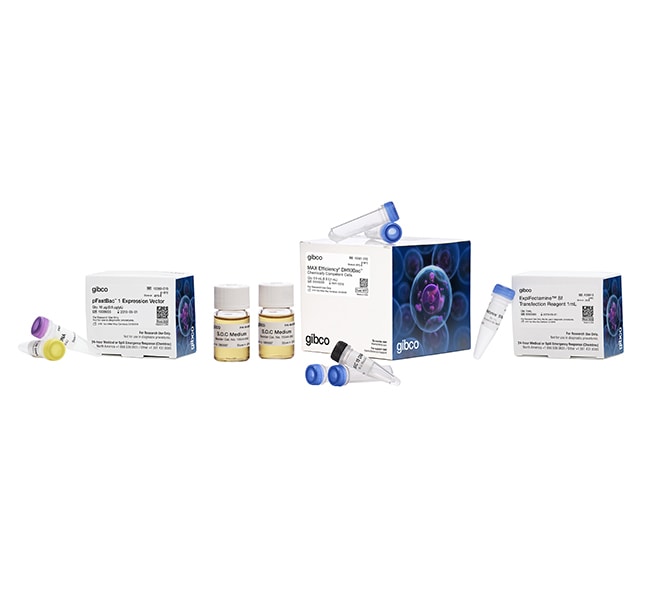
El sistema de expresión en baculovirus Bac-to-Bac incluye:
• Vector pFastBac1 (10 μg), conservar a -20°C
• vector de control pFastBac 1-Gus (4 ng), conservar a -20°C
• E. coliquímicamente competente MAX Efficiency DH10Bac (1 kit con 5 x 0.1 ml), conservar a -80°C
• Reactivo de transfección ExpiFectamine Sf (1 ml), almacenar a 4 °C, no congelar
• Vector pFastBac1 (10 μg), conservar a -20°C
• vector de control pFastBac 1-Gus (4 ng), conservar a -20°C
• E. coliquímicamente competente MAX Efficiency DH10Bac (1 kit con 5 x 0.1 ml), conservar a -80°C
• Reactivo de transfección ExpiFectamine Sf (1 ml), almacenar a 4 °C, no congelar
Preguntas frecuentes
I cannot grow this white colony in liquid culture. What should I do?
What has happened when I see blue colonies? How about colonies which are blue in the center and white on the edges?
I'm getting mostly white/wild-type plaques instead of blue/recombinant plaques. What am I doing wrong?
I've infected my cells and see large polyhedra in one cell and smaller polyhedra (more numerous) in a neighboring cell. Is this normal?
I'm worried that I am not getting plaques. How many days does it take to see plaques and what size are they typically?
Citations & References (66)
Citations & References
Abstract
The vomeronasal receptor V2R2 does not require escort molecules for expression in heterologous systems.
Journal:Chem Senses
PubMed ID:15647459
'In rodents, many behavioural responses are triggered by pheromones. These molecules are believed to bind and activate two families of G-protein coupled receptors, namely V1Rs and V2Rs, which are specifically expressed in the chemosensory neurons of the vomeronasal organ. V2Rs are homologous with Group 3 of G-protein-coupled receptors, which includes
Identification of Novel SH3 Domain Ligands for the Src Family Kinase Hck. WISKOTT-ALDRICH SYNDROME PROTEIN (WASP), WASP-INTERACTING PROTEIN (WIP), AND ELMO1.
Journal:J Biol Chem
PubMed ID:12029088
'The importance of the SH3 domain of Hck in kinase regulation, substrate phosphorylation, and ligand binding has been established. However, few in vivo ligands are known for the SH3 domain of Hck. In this study, we used mass spectrometry to identify approximately 25 potential binding partners for the SH3 domain
Allocation of helper T-cell epitope immunodominance according to three-dimensional structure in the human immunodeficiency virus type I envelope glycoprotein gp120.
Journal:J Biol Chem
PubMed ID:11551929
'The specificity and intensity of CD4(+) helper T-cell responses determine the effectiveness of immune effector functions. Promiscuously immunodominant helper T-cell epitopes in the human immunodeficiency virus (HIV) envelope glycoprotein gp120 could be important in the development of broadly protective immunity, but the underlying mechanisms of immunodominance and promiscuity remain poorly
Expression, purification, and characterization of an activated cytokine-suppressive anti-inflammatory drug-binding protein 2 (CSBP2) kinase from baculovirus-infected insect cells.
Journal:Protein Expr Purif
PubMed ID:9226723
'An activated form of the human cytokine-suppressive anti-inflammatory drug-binding protein 2 (CSBP2) kinase was expressed in Spodoptera frugiperda (SF9) cells from a baculovirus vector. To maximize expression and to facilitate purification of the recombinant protein, CSBP2 kinase was expressed as a carboxy-terminal fusion protein to glutathione S-transferase (GST). Under optimal
Kinesin Superfamily Motor Protein KIF17 and mLin-10 in NMDA Receptor-Containing Vesicle Transport
Journal:Science
PubMed ID:10846156
'Experiments with vesicles containing N-methyl-D-aspartate (NMDA)receptor 2B (NR2B subunit) show that they are transported alongmicrotubules by KIF17, a neuron-specific molecular motor in neuronaldendrites. Selective transport is accomplished by direct interaction of theKIF17 tail with a PDZ domain of mLin-10 (Mint1/X11), which is aconstituent of a large protein complex including mLin-2