Search


Citas y referencias (3)
Gibco™
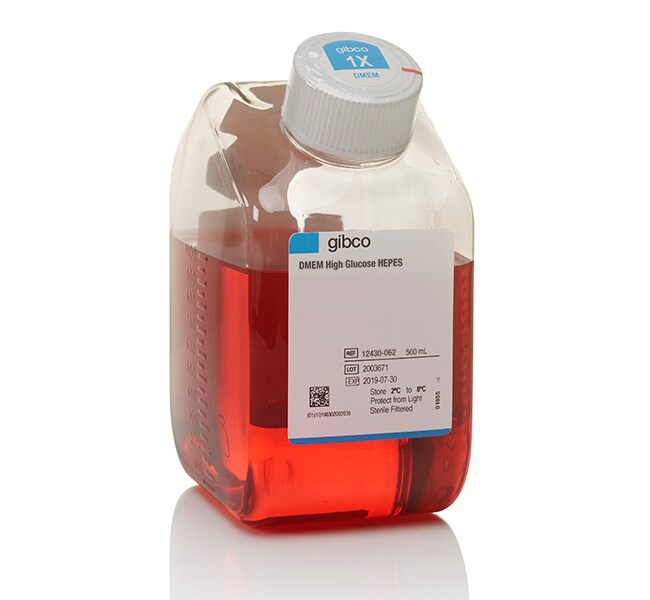
DMEM, alto contenido en glucosa, HEPES
El DMEM (medio Eagle modificado de Dulbecco) se utiliza ampliamente como un medio basal para favorecer el crecimiento de diferentesMás información
Have Questions?
Cambiar vista

| Número de catálogo | Cantidad |
|---|---|
| 12430054 | 500 mL |
| 12430062 | 10 x 500 mL |
| 12430047 | 1000 mL |
| 12430104 | 6 x 1000 mL |
Número de catálogo 12430054
Precio (CLP)
-
Cantidad:
500 mL
El DMEM (medio Eagle modificado de Dulbecco) se utiliza ampliamente como un medio basal para favorecer el crecimiento de diferentes células de mamífero. Las células cultivadas con éxito en DMEM incluyen fibroblastos primarios, neuronas, células gliales, HUVEC y células de músculo liso, así como líneas de células HeLa, 293, cos-7 y PC-12. Ofrecemos una variedad de modificaciones de DMEM para diversas aplicaciones de cultivos celulares. Busque la formulación adecuada mediante la herramienta de selección de medios.
Esta DMEM se ha modificado de la manera siguiente:
Está disponible la formulación completa.
Uso de DMEM
El medio DMEM es único en comparación con otros medios, ya que contiene 4 veces la concentración de aminoácidos y vitaminas del medio esencial mínimo de Eagle. DMEM se formuló originalmente con bajas cantidades de glucosa (1 g/l) y piruvato sódico, pero a menudo se utiliza con niveles de glucosa más altos, y con o sin piruvato sódico. DMEM no contiene proteínas, lípidos ni factores de crecimiento. Por lo tanto, el DMEM requiere suplementación, por lo general con un 10 % de suero fetal bovino (SFB). DMEM utiliza un sistema de tampones de bicarbonato sódico (3,7 g/l) y, por tanto, requiere un ambiente con un 5–10 % de CO2 para mantener el pH fisiológico.
Sistema cGMP de fabricación y calidad
DMEM se elabora en unas instalaciones que cumplen con las buenas prácticas de fabricación actuales ubicadas en Grand Island, Nueva York (EE. UU.). Las instalaciones se han registrado en la Agencia estadounidense de alimentos y medicamentos (FDA) como fabricante de dispositivos médicos y tienen la certificación según la norma ISO 13485. Para la continuidad de la cadena de suministro, ofrecemos un producto DMEM idéntico fabricado en nuestras instalaciones de Escocia (42430-082). Estas instalaciones también están registradas en la Agencia estadounidense de alimentos y medicamentos (FDA), calificadas como punto de fabricación de dispositivos médicos y están certificadas según la norma ISO 13485.
Esta DMEM se ha modificado de la manera siguiente:
| Con | Sin |
| • Alto contenido en glucosa | • Piruvato sódico |
| • L-glutamina | |
| • Ácido 4-(2-hidroxietil)piperazin-1-iletanosulfónico (HEPES) | |
| • Rojo de fenol |
Está disponible la formulación completa.
Uso de DMEM
El medio DMEM es único en comparación con otros medios, ya que contiene 4 veces la concentración de aminoácidos y vitaminas del medio esencial mínimo de Eagle. DMEM se formuló originalmente con bajas cantidades de glucosa (1 g/l) y piruvato sódico, pero a menudo se utiliza con niveles de glucosa más altos, y con o sin piruvato sódico. DMEM no contiene proteínas, lípidos ni factores de crecimiento. Por lo tanto, el DMEM requiere suplementación, por lo general con un 10 % de suero fetal bovino (SFB). DMEM utiliza un sistema de tampones de bicarbonato sódico (3,7 g/l) y, por tanto, requiere un ambiente con un 5–10 % de CO2 para mantener el pH fisiológico.
Sistema cGMP de fabricación y calidad
DMEM se elabora en unas instalaciones que cumplen con las buenas prácticas de fabricación actuales ubicadas en Grand Island, Nueva York (EE. UU.). Las instalaciones se han registrado en la Agencia estadounidense de alimentos y medicamentos (FDA) como fabricante de dispositivos médicos y tienen la certificación según la norma ISO 13485. Para la continuidad de la cadena de suministro, ofrecemos un producto DMEM idéntico fabricado en nuestras instalaciones de Escocia (42430-082). Estas instalaciones también están registradas en la Agencia estadounidense de alimentos y medicamentos (FDA), calificadas como punto de fabricación de dispositivos médicos y están certificadas según la norma ISO 13485.
Para su uso en investigación o procesos de fabricación posteriores. No apto para uso diagnóstico ni para la administración directa en seres humanos ni en animales.
Especificaciones
Línea de célulasHeLa, 293, Cos-7 y PC-12
Tipo de célulaFibroblastos primarios, neuronas, células gliales, HUVEC y células de músculo liso
Concentración1 X
Entorno de cultivoCO2
Para utilizar con (aplicación)Cultivo de células de mamíferos
FormatoBottle
Concentración de glucosa4500 mg/L
Calidad de fabricacióncGMP-compliant under the ISO 13485 standard
Línea de productosGibco
Tipo de productoDMEM (medio Eagle modificado de Dulbecco)
Cantidad500 mL
Duración de almacenamiento12 meses a partir de la fecha de fabricación
Condiciones de envíoTemperatura ambiente
ClasificaciónLibre de material de origen animal
Culture TypeMammalian Cell Culture
FormularioLíquido
Serum LevelSuplementos de suero estándar
EsterilidadEstéril con filtro
Sterilization MethodEstéril con filtro
Con aditivosAlto contenido en glucosa, Glutamina, Ácido 4-(2-hidroxietil)piperazin-1-iletanosulfónico (HEPES), Rojo de fenol
Sin aditivosSin piruvato sódico
Unit SizeEach
Contenido y almacenamiento
Condiciones de almacenamiento: De 2 a 8 °C. Proteger de la luz
Condiciones de envío: Ambiente
Vida útil: 12 meses a partir de la fecha de fabricación
Condiciones de envío: Ambiente
Vida útil: 12 meses a partir de la fecha de fabricación
Preguntas frecuentes
What is the manganese concentration in DMEM? Do you offer manganese-free DMEM?
How long can I keep my media after supplementing with serum?
My medium was shipped at room temperature but it is supposed to be stored refrigerated. Is it okay?
How can I remove mycoplasma contamination from my cell culture medium?
I see a decrease in growth of my culture. What should I do?
Citations & References (3)
Citations & References
Abstract
The connecting segment between both epidermal growth factor-like domains in blood coagulation factor IX contributes to stimulation by factor VIIIa and its isolated A2 domain.
Journal:J Biol Chem
PubMed ID:11925427
The light chain of activated factor IX comprises multiple interactions between both epidermal growth factor-like domains that contribute to enzymatic activity and binding of factor IXa to its cofactor factor VIIIa. To investigate the association between factor IXa-specific properties and surface-exposed structure elements, chimeras were constructed in which the interconnection
Thiazolidinedione activation of peroxisome proliferator-activated receptor gamma can enhance mitochondrial potential and promote cell survival.
Journal:J Biol Chem
PubMed ID:12082115
'Thiazolidinediones (TZDs) are widely used for treatment of type 2 diabetes mellitus. Peroxisome proliferator-activated receptor gamma (PPAR gamma) is the molecular target of TZDs and is believed to mediate the apoptotic effects of this class of drugs in a variety of cell types, including B and T lymphocytes. The finding
Activation of the proteolytic activity of ADAMTS4 (aggrecanase-1) by C-terminal truncation.
Journal:J Biol Chem
PubMed ID:11796708
'Proteolysis of the hyalectans (aggrecan, versican, brevican) in vivo appears to result from the activity of ADAMTS4 (aggrecanase-1, herein referred to as an hyalectanase). To examine the mode of activation of ADAMTS4, a human chondrosarcoma cell line, JJ012, has been stably transfected with the full-length c-DNA for human ADAMTS4. The