Search


Citas y referencias (2)
Invitrogen™
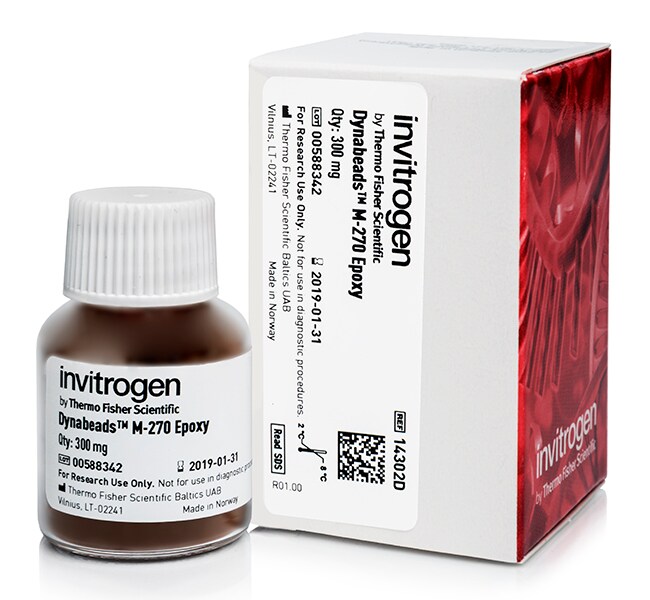
Epoxi Dynabeads™ M-270
Los gránulos de epoxi Dynabeads™ M-270 son gránulos superparamagnéticos de 2,8 μm que contienen grupos de epoxi de superficie. LosMás información
Have Questions?
Cambiar vista

| Número de catálogo | Cantidad |
|---|---|
| 14302D | 300 mg |
| 14301 | 60 mg |
Número de catálogo 14302D
Precio (CLP)
2.443.401
Each
Cantidad:
300 mg
Precio (CLP)
2.443.401
Each
Los gránulos de epoxi Dynabeads™ M-270 son gránulos superparamagnéticos de 2,8 μm que contienen grupos de epoxi de superficie. Los gránulos se unen de forma covalente a los grupos de aminoácidos primarios o de sulfhidrilos en proteínas y péptidos, por lo que constituyen la opción ideal para el acoplamiento de anticuerpos, péptidos, proteínas intactas y enzimas funcionales. Estos gránulos de pH neutro hidrófilos presentan una unión inespecífica extremadamente baja de proteínas y tintes, lo que reduce la necesidad de agentes bloqueantes. Además, los gránulos de epoxi Dynabeads™ M-270 no contienen detergente Tween™ y, por lo tanto, son ideales para su uso en análisis de espectrometría de masas (MS).
• Ideales para la inmunoprecipitación (IP) de proteínas y complejos de proteínas
• La separación magnética suave y rápida y los tiempos de incubación cortos permiten la identificación de complejos lábiles y transitorios
• El acoplamiento covalente de anticuerpos a los Dynabeads™ evita la coelución del anticuerpo con la proteína objetivo
Adaptable a varias aplicaciones
Una cinética de unión a superficie rápida y sus características de separación magnética rápida convierten a los gránulos de epoxi Dynabeads™ M-270 en la opción ideal para aplicaciones como inmunoprecipitación/purificación de proteínas y complejos de proteínas, acoplamiento de enzimas funcionales a la superficie del gránulo para ensayos posteriores e identificación de miembros de unión a proteínas. Las proteínas y los complejos de proteínas capturados se separan, se lavan y se eluyen con facilidad mediante el imán DynaMag™, así como las propiedades de separación magnética de Dynabeads™.
Procedimiento de acoplamiento
El acoplamiento covalente se realiza durante la noche mediante la incubación del ligando deseado (comúnmente anticuerpos, péptidos o proteínas) con los gránulos de epoxi Dynabeads™ M-270. La capacidad de unión varía en función del ligando utilizado, pero normalmente es de 5 a 10 μg de IgG por miligramo de gránulos. El acoplamiento se produce con pH neutro y una alta concentración de sal. La reacción del acoplamiento se puede realizar a una amplia gama de temperaturas para equipararse a las características de estabilidad del ligando.
Tras la finalización del paso de acoplamiento del ligando, se desactivan las fracciones reactivas en los gránulos de epoxi Dynabeads™ M-270 para evitar acoplamiento adicional. Una vez se ha completado la reacción del acoplamiento, estos gránulos de pH neutro, no porosos e hidrófilos presentan una unión inespecífica extremadamente baja.
Más información sobre™ productos Dynabeads
• Consulte Productos Dynabeads™ para toda una gama de aplicaciones.
• Consulte imanes para separaciones de Dynabeads™
• Ideales para la inmunoprecipitación (IP) de proteínas y complejos de proteínas
• La separación magnética suave y rápida y los tiempos de incubación cortos permiten la identificación de complejos lábiles y transitorios
• El acoplamiento covalente de anticuerpos a los Dynabeads™ evita la coelución del anticuerpo con la proteína objetivo
Adaptable a varias aplicaciones
Una cinética de unión a superficie rápida y sus características de separación magnética rápida convierten a los gránulos de epoxi Dynabeads™ M-270 en la opción ideal para aplicaciones como inmunoprecipitación/purificación de proteínas y complejos de proteínas, acoplamiento de enzimas funcionales a la superficie del gránulo para ensayos posteriores e identificación de miembros de unión a proteínas. Las proteínas y los complejos de proteínas capturados se separan, se lavan y se eluyen con facilidad mediante el imán DynaMag™, así como las propiedades de separación magnética de Dynabeads™.
Procedimiento de acoplamiento
El acoplamiento covalente se realiza durante la noche mediante la incubación del ligando deseado (comúnmente anticuerpos, péptidos o proteínas) con los gránulos de epoxi Dynabeads™ M-270. La capacidad de unión varía en función del ligando utilizado, pero normalmente es de 5 a 10 μg de IgG por miligramo de gránulos. El acoplamiento se produce con pH neutro y una alta concentración de sal. La reacción del acoplamiento se puede realizar a una amplia gama de temperaturas para equipararse a las características de estabilidad del ligando.
Tras la finalización del paso de acoplamiento del ligando, se desactivan las fracciones reactivas en los gránulos de epoxi Dynabeads™ M-270 para evitar acoplamiento adicional. Una vez se ha completado la reacción del acoplamiento, estos gránulos de pH neutro, no porosos e hidrófilos presentan una unión inespecífica extremadamente baja.
Más información sobre™ productos Dynabeads
• Consulte Productos Dynabeads™ para toda una gama de aplicaciones.
• Consulte imanes para separaciones de Dynabeads™
Para uso exclusivo en investigación. No apto para uso en procedimientos diagnósticos.
Especificaciones
Diámetro (métrico)2,8 μm
Volumen de elución mín5 μl
FormatoLiofilizado
Compatibilidad de alto rendimientoCompatible con alto rendimiento
Grado de pureza o calidadCalidad para investigación
Cantidad300 mg
Tipo de muestraCualquier tipo de muestra
Duración de almacenamiento24 meses a partir de la fecha de fabricación
Condiciones de envíoTemperatura ambiente
Funcionalidad de superficieEpoxi
Línea de productosDYNAL, Dynabeads
TipoGránulo de epoxi
Unit SizeEach
Contenido y almacenamiento
Contiene: 300 mg de epoxi Dynabeads™ M-270, ∼6,7 × 10⁷ gránulos/mg, suministrados como polvo liofilizado
Almacenamiento: 2 °C a 8 °C
Almacenamiento: 2 °C a 8 °C
Preguntas frecuentes
My Dynabeads magnetic beads are not pelleting well with the magnet. Do you have any suggestions for me?
I have a long double-stranded DNA fragment I would like to isolate. What product do you recommend?
Can I use Dynabeads magnetic beads to isolate single-stranded DNA templates?
What is the magnetic susceptibility for Dynabeads magnetic beads?
How can I determine coupling efficiency of Dynabeads magnetic beads?
Citations & References (2)
Citations & References
Abstract
AFFIRM--a multiplexed immunoaffinity platform that combines recombinant antibody fragments and LC-SRM analysis.
Journal:
PubMed ID:25337893
Targeted measurements of low abundance proteins in complex mixtures are in high demand in many areas, not the least in clinical applications measuring biomarkers. We here present the novel platform AFFIRM (AFFInity sRM) that utilizes the power of antibody fragments (scFv) to efficiently enrich for target proteins from a complex
A Broad-Spectrum Infection Diagnostic that Detects Pathogen-Associated Molecular Patterns (PAMPs) in Whole Blood.
Journal:EBioMedicine
PubMed ID:27333027
Blood cultures, and molecular diagnostic tests that directly detect pathogen DNA in blood, fail to detect bloodstream infections in most infected patients. Thus, there is a need for a rapid test that can diagnose the presence of infection to triage patients, guide therapy, and decrease the incidence of sepsis.