Search


Citas y referencias (4)
Invitrogen™
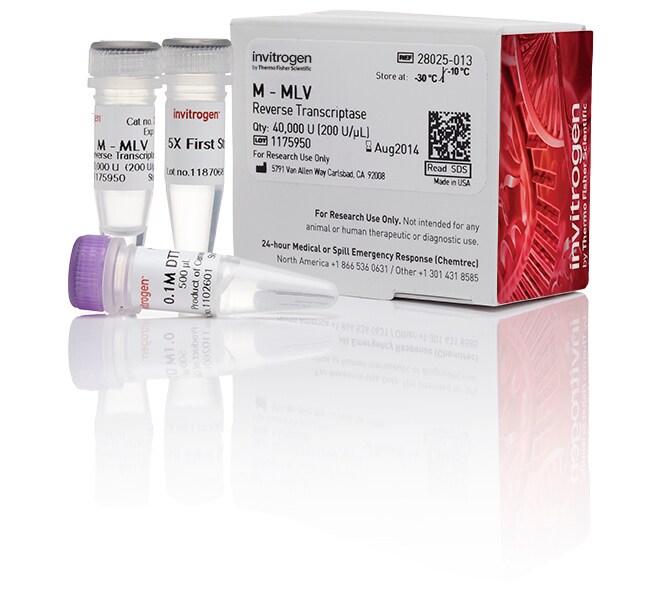
Transcriptasa inversa M-MLV (200 U/μ l)
La transcriptasa inversa del virus murino Moloney de leucemia (M-MLV) es una ADN polimerasa recombinante que sintetiza una cadena deMás información
Have Questions?
Cambiar vista

| Número de catálogo | N.º de reacciones |
|---|---|
| 28025013 | 200 reacciones |
| 28025021 | 1.000 reacciones |
Número de catálogo 28025013
Precio (CLP)
391.270
Each
N.º de reacciones:
200 reacciones
Precio (CLP)
391.270
Each
La transcriptasa inversa del virus murino Moloney de leucemia (M-MLV) es una ADN polimerasa recombinante que sintetiza una cadena de ADN complementario a partir de ADN, ARN monocatenario o un híbrido ARN-ADN. En comparación con AMV RT, transcriptasa inversa reversa del virus murina Moloney de leucemia murina Moloney (M-MLV RT) no dispone posee actividad de endonucleasas de ADN y tiene una actividad de ARNasa H más baja. Características de esta enzima:
• Actividad termoestabilizadora óptima: a 37°C
• Tamaño de ADNc: M-MLV puede usarse para sintetizar la primera cadena de ADNc hasta 7 kb
• Aplicaciones: síntesis de la primera cadena de ADNc, extensión de cebador, secuenciación de ADNbc, bibliotecas de ADNc,
y RT-PCR Fuente
Purificada a partir de E. coli que expresa el gen pol de M-MLV en un plasmídico
Análisis de rendimiento y calidad
Pureza de SDS-PAGE; endodesoxirribonucleasa, exodesoxirribonucleasa y ribonucleasa; y rendimiento y longitud del producto de ADNc
Definición de la unidad
Una unidad de M-MLV RT es la cantidad de enzima necesaria para incorporar 1 nmolo de desoxirribonucleótido en el material precipitado al ácido en 10 min a 37 °C utilizando poli(A)oligo(dT)25 como cebador de molde.
Condiciones de reacción unitarias
50 mm de Tris-HCl (pH 8,3), 40 mm de KCl, 6 mm de MgCl2, 1 mm de DTT, 0,5 mm [3H]dTTP, 0,1 mm de poli(A), 0,1 mm de oligo(DT)25, 0,1 mg/ml de BSA y enzima en 50 µl durante 10 min a 37 °C.
• Actividad termoestabilizadora óptima: a 37°C
• Tamaño de ADNc: M-MLV puede usarse para sintetizar la primera cadena de ADNc hasta 7 kb
• Aplicaciones: síntesis de la primera cadena de ADNc, extensión de cebador, secuenciación de ADNbc, bibliotecas de ADNc,
y RT-PCR Fuente
Purificada a partir de E. coli que expresa el gen pol de M-MLV en un plasmídico
Análisis de rendimiento y calidad
Pureza de SDS-PAGE; endodesoxirribonucleasa, exodesoxirribonucleasa y ribonucleasa; y rendimiento y longitud del producto de ADNc
Definición de la unidad
Una unidad de M-MLV RT es la cantidad de enzima necesaria para incorporar 1 nmolo de desoxirribonucleótido en el material precipitado al ácido en 10 min a 37 °C utilizando poli(A)oligo(dT)25 como cebador de molde.
Condiciones de reacción unitarias
50 mm de Tris-HCl (pH 8,3), 40 mm de KCl, 6 mm de MgCl2, 1 mm de DTT, 0,5 mm [3H]dTTP, 0,1 mm de poli(A), 0,1 mm de oligo(DT)25, 0,1 mg/ml de BSA y enzima en 50 µl durante 10 min a 37 °C.
Para uso exclusivo en investigación. No apto para uso en procedimientos diagnósticos.
Especificaciones
Tipo de producto finalPrimera cadena de ADNc
FormatoTubo
N.º de reacciones200 reacciones
Temperatura óptima de reacción37 °C
Cantidad200 reacciones; 40.000 unidades
Formato de reacciónComponentes separados
Tipo de reactivoTranscripción reversa
Transcriptasa inversaM-MLV
Actividad de la ribonucleasa HSí
Condiciones de envíoHielo húmedo
Tamaño (producto final)Hasta 7 kb
Material de partidaARN
TécnicaTranscripción reversa
Concentración200 U/μl
Velocidad de reacción50 min
Unit SizeEach
Contenido y almacenamiento
• M-mLV RT, 200 μl (200 U/μl)
• Tampón de primera cadena 5X, 1 ml
• DTT, 500 μl (100 mM)
Almacenar a –20 °C.
Preguntas frecuentes
How much of the first-strand cDNA reaction should I load for PCR?
What is the highest temperature that MMLV, SuperScript II, SuperScript III, or SuperScript IV RTs can be used?
Can I use elevated temperatures for reverse transcription with Moloney Murine Leukemia Virus (M-MLV) reverse transcriptase?
Citations & References (4)
Citations & References
Abstract
Raloxifene Upregulated Mesangial Cell MMP-2 Activity via ER-ß Through Transcriptional Regulation.
Journal:Cell Biochem Biophys
PubMed ID:23471663
'Raloxifene, a second-generation selective estrogen receptor modulator, exerts estrogen-like effects in specific tissues. In this present study, we examined the effect of raloxifene on mesangial cell matrix metalloproteinase-2 (MMP-2) activity in streptozotocin-induced diabetic mice. Raloxifene increased the MMP-2 level in a dose-dependent and receptor-mediated manner. An antibody against estrogen receptor-ß
Single cell rt-PCR identification of odorant receptors expressed by olfactory neurons.
Journal:Methods Mol Biol
PubMed ID:23585038
'Mammals have between 400 and 1,300 functional odorant receptor (OR) genes in their genomes. Each olfactory sensory neuron in the nose expresses only one single type of OR out of this vast repertoire. The OR expressed by an olfactory sensory neuron determines its functional activity and wiring to the olfactory
Fast-mode duplex qPCR for BCR-ABL1 molecular monitoring: innovation, automation, and harmonization.
Journal:Am J Hematol
PubMed ID:22566190
Reverse transcription quantitative polymerase chain reaction (RTqPCR)is currently the most sensitive tool available for the routine monitoring of disease level in patients undergoing treatment for BCRABL1 associated malignancies. Considerable effort has been invested at both the local and international levels to standardise the methodology and reporting criteria used to assess
Transforming growth factor-ß is required for vasculogenic mimicry formation in glioma cell line U251MG.
Journal:Cancer Biol Ther
PubMed ID:22104964
Both vasculogenic mimicry (VM) and transforming growth factor-ß (TGFß) are positively correlated with malignancy in glioma. Accordingly, we supposed that TGFß might be related with VM, and aimed to detect whether TGFß could influence VM formation in two glioma cell lines U251MG and SHG44, which were different in malignancy. We