Search


Citas y referencias (3)
Thermo Scientific™
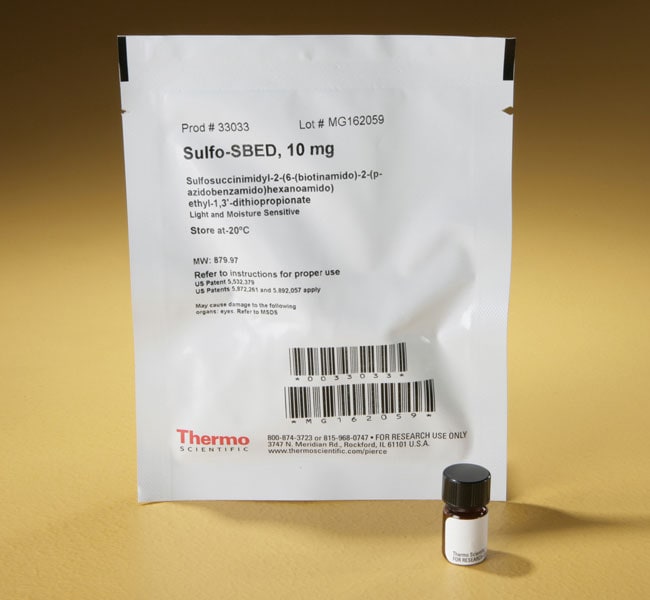
Sulfo-SBED Biotin Label Transfer Reagent, No-Weigh™ Format
El reactivo de transferencia de etiquetas de biotina Thermo Scientific Pierce Sulfo-SBED es un reactivo multifuncional para etiquetar una proteínaMás información
Have Questions?
Cambiar vista

| Número de catálogo | Cantidad |
|---|---|
| 33033 | 10 mg |
| A39260 | 10 x 1 mg |
Número de catálogo 33033
Precio (CLP)
501.038
Each
Cantidad:
10 mg
Precio (CLP)
501.038
Each
El reactivo de transferencia de etiquetas de biotina Thermo Scientific Pierce Sulfo-SBED es un reactivo multifuncional para etiquetar una proteína purificada y, a continuación, transferir covalentemente la etiqueta de biotina adjunta a interactores específicos de esa proteína.
Sulfo-SBED es la abreviatura de Sulfo-N-hidroxisuccinidil-2-(6-[biotinamido]-2-(p-azido benzamido)-hexanoamido) etil-1,3'-ditiopropionato. Es un entrecruzador químico heterobifuncional capaz de acoplarse covalentemente a aminas primarias en un extremo y a casi cualquier grupo funcional de proteínas en el otro extremo A diferencia de los entrecruzadores típicos, el Sulfo-SBED también incluye un grupo de biotina y un agente separador de disulfuro separable. Estas características permiten entrecruzar secuencialmente proteínas que interactúan y transferir la etiqueta de afinidad de la biotina de una proteína (es decir, una proteína de «cebo» purificada) a otra (posiblemente proteína de «presa» desconocida). La transferencia de etiquetas es un poderoso método in vitro para descubrir la interacción de proteínas. Un número creciente de publicaciones incluyen el uso del reactivo de transferencia de etiquetas Sulfo-SBED Biotin para identificar elementos de unión de interacción de proteínas previamente desconocidos y para caracterizar más plenamente los dominios de unión de proteínas específicos de otras interacciones de proteínas.
Sulfo-SBED es la abreviatura de Sulfo-N-hidroxisuccinidil-2-(6-[biotinamido]-2-(p-azido benzamido)-hexanoamido) etil-1,3'-ditiopropionato. Es un entrecruzador químico heterobifuncional capaz de acoplarse covalentemente a aminas primarias en un extremo y a casi cualquier grupo funcional de proteínas en el otro extremo A diferencia de los entrecruzadores típicos, el Sulfo-SBED también incluye un grupo de biotina y un agente separador de disulfuro separable. Estas características permiten entrecruzar secuencialmente proteínas que interactúan y transferir la etiqueta de afinidad de la biotina de una proteína (es decir, una proteína de «cebo» purificada) a otra (posiblemente proteína de «presa» desconocida). La transferencia de etiquetas es un poderoso método in vitro para descubrir la interacción de proteínas. Un número creciente de publicaciones incluyen el uso del reactivo de transferencia de etiquetas Sulfo-SBED Biotin para identificar elementos de unión de interacción de proteínas previamente desconocidos y para caracterizar más plenamente los dominios de unión de proteínas específicos de otras interacciones de proteínas.
Protocolo típico para el experimento de transferencia de etiquetas:
• Añada unos cuantos microlitros de reactivo Sulfo-SBED disuelto a 0,5-1 ml de proteína de cebo purificada en PBS.
• Incube la mezcla durante 30-120 minutos en hielo o a temperatura ambiente en la oscuridad.
• Desale o dialice (con luz tenue) para eliminar el exceso de Sulfo-SBED no reaccionado de la proteína de cebo etiquetada.
• Añada la proteína de cebo etiquetada al lisado celular o a otra solución que contenga los supuestos interactores de proteínas diana (presa).
• Cuando se hayan formado complejos de interacción, exponga la solución a la luz ultravioleta (365 nm) durante varios minutos.
• Analice los productos mediante uno de los siguientes métodos:
• Inmunotransferencia (Western Blotting): Separe entrecruzamientos en DTT, separe proteínas por SDS-PAGE y detectee bandas biotiniladas por Western blotting con estreptavidina-HRP.
• Purificación y espectrometría de masas o secuenciación: Purifique por afinidad proteínas biotiniladas o fragmentos de péptidos después de la digestión con tripsina y realice MS o secuenciación para caracterizar las proteínas involucradas.
Productos relacionados:
Kit de transferencia de etiquetas Sulfo-SBED Biotin - Aplicación de Western Blotting
For Research Use Only. Not for use in diagnostic procedures.
Especificaciones
FormatoPolvo
Método de etiquetadoEtiquetado químico, transferencia de etiquetas
Tipo de productoEntrecruzador
Cantidad10 mg
Fracción reactivaSulfo-NHS éster, aril azida
SolubilidadAgua
Línea de productosPierce
Unit SizeEach
Contenido y almacenamiento
Tras su recepción, almacenar a 4 °C.
Preguntas frecuentes
What makes Sulfo-SBED Biotin Label Transfer Reagent useful for investigation of protein interactions?
Should the Sulfo-SBED coupling reaction be protected from light?
Which reaction should take place first during Sulfo-SBED crosslinking?
What is the appropriate wavelength for the conjugation of the photoactivatable group in Sulfo-SBED Biotin Label Transfer Reagent ?
Is the Sulfo-SBED crosslinker soluble in organic solutions as well as aqueous solutions?
Citations & References (3)
Citations & References
Abstract
Retagging identifies dendritic cell-specific intercellular adhesion molecule-3 (ICAM3)-grabbing non-integrin (DC-SIGN) protein as a novel receptor for a major allergen from house dust mite.
Journal:J Biol Chem
PubMed ID:22205703
Dendritic cells (DCs) have been shown to play a key role in the initiation and maintenance of immune responses to microbial pathogens as well as to allergens, but the exact mechanisms of their involvement in allergic responses and Th2 cell differentiation have remained elusive. Using retagging, we identified DC-SIGN as
Structural basis of molecular recognition of the Leishmania small hydrophilic endoplasmic reticulum-associated protein (SHERP) at membrane surfaces.
Journal:J Biol Chem
PubMed ID:21106528
The 57-residue small hydrophilic endoplasmic reticulum-associated protein (SHERP) shows highly specific, stage-regulated expression in the non-replicative vector-transmitted stages of the kinetoplastid parasite, Leishmania major, the causative agent of human cutaneous leishmaniasis. Previous studies have demonstrated that SHERP localizes as a peripheral membrane protein on the cytosolic face of the endoplasmic
The interaction between cell adhesion molecule L1, matrix metalloproteinase 14, and adenine nucleotide translocator at the plasma membrane regulates L1-mediated neurite outgrowth of murine cerebellar neurons.
Journal:J Neurosci
PubMed ID:22423112
We have identified the adenine nucleotide translocator (ANT) isoforms ANT1 and ANT2 that are present in the plasma membrane of mouse cerebellar neurons as novel binding partners of the cell adhesion molecule L1. The direct interaction between ANT and L1 is mediated by sites within the fibronectin type III domains