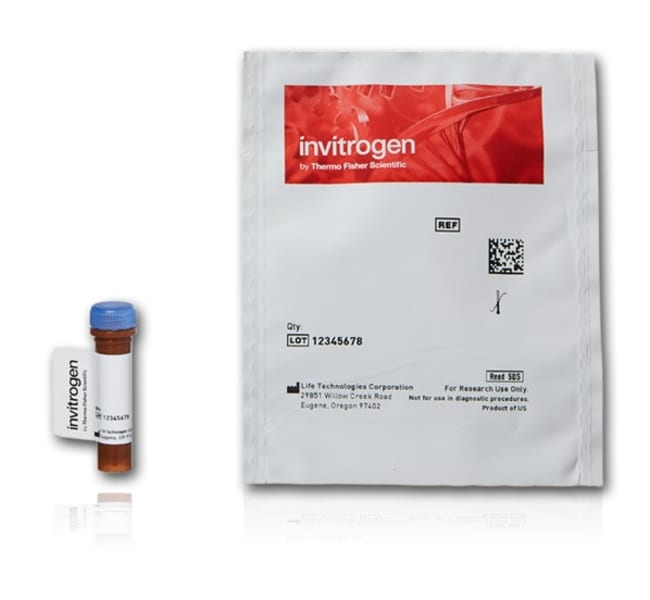
Alexa Fluor™ 594 Azide (Alexa Fluor™ 594 Carboxamido-(6-Azidohexanyl), Triethylammonium Salt), mixed isomers
Invitrogen™

Alexa Fluor™ 594 Azide (Alexa Fluor™ 594 Carboxamido-(6-Azidohexanyl), Triethylammonium Salt), mixed isomers

La azida rojo fluorescente Alexa Fluor® 594 reacciona con alquinos terminales mediante una reacción clic catalizada con cobre. La químicaMás información
Have Questions?
Número de catálogoCantidad
A102700,5 mg
Número de catálogo A10270
Precio (CLP)
719.344
Each
Añadir al carro de la compra
Cantidad:
0,5 mg
Precio (CLP)
719.344
Each
Añadir al carro de la compra
La azida rojo fluorescente Alexa Fluor® 594 reacciona con alquinos terminales mediante una reacción clic catalizada con cobre. La química de clic describe una clase de reacciones químicas que utilizan porciones bioortogonales o biológicamente únicas para etiquetar y detectar una molécula de interés mediante un procedimiento de dos pasos. El procedimiento de reacción de dos pasos implica una formación de triazol catalizado con cobre de una azida y un alquino. Las reacciones clic tienen varias características: la reacción entre las porciones de detección es eficiente; no se requieren temperaturas extremas ni disolventes; el producto de reacción es estable; los componentes de la reacción son bioinertes; y, tal vez lo más importante, no se producen reacciones secundarias: las etiquetas de detección y etiquetado reaccionan selectivamente y específicamente entre sí. A diferencia de las reacciones químicas tradicionales que utilizan ésteres de succinidil o maleimidas que se dirigen a las aminas y sulfhidrilos: grupos funcionales que no son únicos: las moléculas etiquetadas con la química de clic pueden aplicarse a muestras biológicas complejas y detectarse con una sensibilidad sin precedentes debido a un fondo extremadamente bajo.
Para uso exclusivo en investigación. No apto para uso en procedimientos diagnósticos.
Especificaciones
Reactividad químicaAlquino
Método de detecciónFluorescente
Emisión617
Excitación590
FormatoSólido
Etiqueta o tinteAlexa Fluor™ 594
Tipo de productoAzida
Cantidad0,5 mg
Fracción reactivaAmina, azida
Condiciones de envíoTemperatura ambiente
SolubilidadDMF (dimetilformamida), DMSO (dimetilsulfóxido)
Tipo de sistemaClick-iT™
ColorRojo, rojo
Tipo de etiquetaColorantes Alexa Fluor
Línea de productosAlexa Fluor, Molecular Probes
Unit SizeEach
Contenido y almacenamiento
Almacenar a ≤ - 20 °C, desecado y protegido de la luz.

Preguntas frecuentes

I am observing no signal or very low specific signal for my click-labeled samples. What can I do to improve the signal?

The click reaction is only effective when copper is in the appropriate valency. Azides and alkynes will not react with each other without copper. Make sure that the click reaction mixture is used immediately after preparation when the copper (II) concentration is at its highest.
Do not use additive buffer that has turned yellow; it must be colorless to be active.
Cells need to be adequately fixed and permeabilized for the TdT enzyme and click reagents to have access to the nucleus. Tissue samples require digestion with proteinase K or other proteolytic enzymes for sufficient TdT access.
Some reagents can bind copper and reduce its effective concentration available to catalyze the click reaction. Do not include any metal chelator (e.g., EDTA, EGTA, citrate, etc.) in any buffer or reagent prior to the click reaction. Avoid buffers or reagents that include other metal ions that may be o xidized or reduced. It may be help to include extra wash steps on the cell or tissue sample before performing the click reaction.
You can repeat the click reaction with fresh reagents to try to improve signal. Increasing the click reaction time longer than 30 minutes will not improve a low signal. Performing a second, 30 minute incubation with fresh click reaction reagents is more effective at improving labeling.
Your cells may not be apoptotic. Prepare a DNase I-treated positive control to verify that the TdT enzymatic reaction and click labeling reaction are working correctly.

Find additional tips, troubleshooting help, and resources within our Labeling Chemistry Support Center.

I am observing high non-specific background when I image my Click-iT EdU TUNEL-labeled samples. What is causing this and what can I do to reduce the background?

The click reaction is very selective between an azide and alkyne. No other side reactions are possible in a biological system. Any non-specific background is due to non-covalent binding of the dye to various cellular components. The Select FX Signal Enhancer is not effective at reducing non-specific charge-based binding of dyes following the click reaction; we do not recommend its use with the Click-iT detection reagents. The best method to reduce background is to increase the number of BSA washes. You should always do a no-dye or no-click reaction control under the same processing and detection conditions to verify that the background is actually due to the dye and not autofluorescence. You should also perform the complete click reaction on a no-TdT enzyme control sample to verify the specificity of the click reaction signal.

Find additional tips, troubleshooting help, and resources within our Cell Analysis Support Center.

I notice that when I post-stain my cells with DAPI after performing the click reaction to detect EdU incorporation, my DAPI signal is lower compared to my no-click reaction control samples. What causes the reduction in DAPI signal?

The copper in the click reaction denatures DNA to a small extent (although not as much as is required for efficient BrdU detection), which can affect the binding affinity of DNA dyes including DAPI and Hoechst stain. This effect should only be apparent with the classic EdU kits and not the Click-iT Plus EdU kits, which use a lower copper concentration.

Find additional tips, troubleshooting help, and resources within our Cell Viability, Proliferation, Cryopreservation, and Apoptosis Support Center.

I am observing no signal or very low signal for my click-labeled samples. What can I do to improve the signal?

The click reaction is only effective when copper is in the appropriate valency. Except for the DIBO alkyne-azide reaction, azides and alkynes will not react with each other without copper. Make sure that the click reaction mixture is used immediately after preparation when the copper (II) concentration is at its highest.
Do not use additive buffer that has turned yellow; it must be colorless to be active.
Cells need to be adequately fixed and permeabilized for the click reagents to have access to intracellular components that have incorporated the click substrate(s).
Some reagents can bind copper and reduce its effective concentration available to catalyze the click reaction. Do not include any metal chelator (e.g., EDTA, EGTA, citrate, etc.) in any buffer or reagent prior to the click reaction. Avoid buffers or reagents that include other metal ions that may be oxidized or reduced. It may be help to include extra wash steps on the cell or tissue sample before performing the click reaction.
You can repeat the click reaction with fresh reagents to try to improve signal. Increasing the click reaction time longer than 30 minutes will not improve a low signal. Performing a second, 30 minute incubation with fresh click reaction reagents is more effective at improving labeling.
Low signal can also be due to low incorporation of EdU, EU, or other click substrates. Other click substrates (e.g., AHA, HPG, palmitic acid, azide, etc.) incorporated into cellular components may have been lost if not adequately cross-linked in place or if the wrong fixative was used. For click substrates that are incorporated into the membrane or lipids, you should avoid the use of alcohol or acetone fixatives and permeabilizing agents.
The incorporated click substrate must be accessible at the time of the click reaction; labeling of incorporated amino acid analogs may be lower in native proteins relative to denatured proteins.
You may need to optimize the metabolic labeling conditions including analog incubation time or concentration. Cells that are healthy, not too high of a passage number and not too crowded may incorporate the analog better. You may create a positive control by including extra doses of the click substrate during multiple time points during an incubation time that spans or closely spans the doubling time of the cell type of interest.

Find additional tips, troubleshooting help, and resources within our Cell Analysis Support Center.

I am observing high background when I analyze my click-labeled samples. What is causing this and what can I do to reduce the background?

The click reaction is very selective between an azide and alkyne. No other side reactions are possible in a biological system. Any non-specific background is due to non-covalent binding of the dye to various cellular components. The Select FX Signal Enhancer is not effective at reducing non-specific charge-based binding of dyes following the click reaction; we do not recommend its use with the Click-iT detection reagents. The best method to reduce background is to increase the number of BSA washes. You should always do a no-dye or no-click reaction control under the same processing and detection conditions to verify that the background is actually due to the dye and not autofluorescence. You can also perform the complete click reaction on a carrier solvent-only, no EdU or no-EU control to verify the specificity of the click reaction signal.

Find additional tips, troubleshooting help, and resources within our Cell Viability, Proliferation, Cryopreservation, and Apoptosis Support Center.

Citations & References (13)

Citations & References
Abstract
In vivo monitoring of cardiomyocyte proliferation to identify chemical modifiers of heart regeneration.
Authors:Choi WY, Gemberling M, Wang J, Holdway JE, Shen MC, Karlstrom RO, Poss KD,
Journal:Development
PubMed ID:23293297
'Adult mammalian cardiomyocytes have little capacity to proliferate in response to injury, a deficiency that underlies the poor regenerative ability of human hearts after myocardial infarction. By contrast, zebrafish regenerate heart muscle after trauma by inducing proliferation of spared cardiomyocytes, providing a model for identifying manipulations that block or enhance ... More
Toscana virus NSs protein promotes degradation of double-stranded RNA-dependent protein kinase.
Authors:Kalveram B, Ikegami T,
Journal:J Virol
PubMed ID:23325696
'Toscana virus (TOSV), which is transmitted by Phlebotomus spp. sandflies, is a major etiologic agent of aseptic meningitis and encephalitis in the Mediterranean. Like other members of the genus Phlebovirus of the family Bunyaviridae, TOSV encodes a nonstructural protein (NSs) in its small RNA segment. Although the NSs of Rift ... More
Smaug1 mRNA-silencing foci respond to NMDA and modulate synapse formation.
Authors:Baez MV, Luchelli L, Maschi D, Habif M, Pascual M, Thomas MG, Boccaccio GL,
Journal:J Cell Biol
PubMed ID:22201125
'Mammalian Smaug1/Samd4A is a translational repressor. Here we show that Smaug1 forms mRNA-silencing foci located at postsynapses of hippocampal neurons. These structures, which we have named S-foci, are distinct from P-bodies, stress granules, or other neuronal RNA granules hitherto described, and are the first described mRNA-silencing foci specific to neurons. ... More
Dosage-sensitive regulation of cohesin chromosome binding and dynamics by Nipped-B, Pds5, and Wapl.
Authors:Gause M, Misulovin Z, Bilyeu A, Dorsett D,
Journal:Mol Cell Biol
PubMed ID:20696838
'The cohesin protein complex holds sister chromatids together to ensure proper chromosome segregation upon cell division and also regulates gene transcription. Partial loss of the Nipped-B protein that loads cohesin onto chromosomes, or the Pds5 protein required for sister chromatid cohesion, alters gene expression and organism development, without affecting chromosome ... More
Expanding the chemical scope of RNA:methyltransferases to site-specific alkynylation of RNA for click labeling.
Authors:Motorin Y, Burhenne J, Teimer R, Koynov K, Willnow S, Weinhold E, Helm M,
Journal:Nucleic Acids Res
PubMed ID:21037259
'This work identifies the combination of enzymatic transfer and click labeling as an efficient method for the site-specific tagging of RNA molecules for biophysical studies. A double-activated analog of the ubiquitous co-substrate S-adenosyl-l-methionine was employed to enzymatically transfer a five carbon chain containing a terminal alkynyl moiety onto RNA. The ... More