Search


Citas y referencias (3)
Invitrogen™
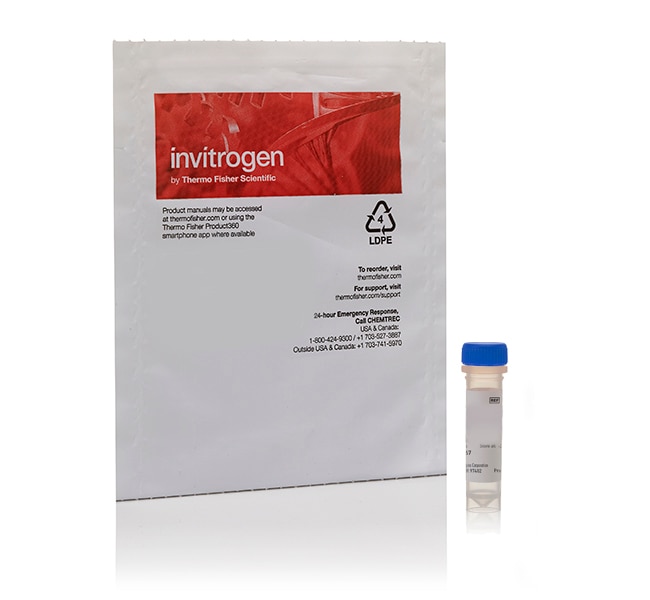
Avidin, NeutrAvidin™, Alexa Fluor™ 350 conjugate
Avidina, NeutrAvidin™, conjugado Alexa Fluor™ 350
| Número de catálogo | Cantidad |
|---|---|
| A11236 | 1 mg |
Número de catálogo A11236
Precio (CLP)
307.019
Each
Cantidad:
1 mg
Precio (CLP)
307.019
Each
Nuestro conjugado Alexa Fluor 350 de proteína de unión de biotina NeutrAvidin: una forma de avidina que ha sido procesada para eliminar carbohidratos y reducir su punto isoeléctrico. Puede disminuir sustancialmente el fondo debido a una unión no específica. El método utilizado para desglicosilar la avidina conserva su unión específica. Este reactivo fluorescente azul brillante (absorción/emisión máxima de ∼ 346/442 nm) es ideal para detectar objetivos biotinilados en aplicaciones de microscopía de fluorescencia y citometría de flujo.
Para uso exclusivo en investigación. No apto para uso en procedimientos diagnósticos.
Especificaciones
Etiqueta o tinteColorantes Alexa Fluor
Cantidad1 mg
Condiciones de envíoTemperatura ambiente
ConjugadoAlexa Fluor 350
Línea de productosAlexa Fluor, NeutrAvidin
Unit SizeEach
Contenido y almacenamiento
Almacenar en el congelador (de -5 a -30 °C) y proteger de la luz.
Citations & References (3)
Citations & References
Abstract
A novel p21-activated kinase binds the actin and microtubule networks and induces microtubule stabilization.
Journal:J Cell Biol
PubMed ID:11733543
'Coordination of the different cytoskeleton networks in the cell is of central importance for morphogenesis, organelle transport, and motility. The Rho family proteins are well characterized for their effects on the actin cytoskeleton, but increasing evidence indicates that they may also control microtubule (MT) dynamics. Here, we demonstrate that a
Concentration and separation of proteins in microfluidic channels on the basis of transverse IEF.
Journal:Anal Chem
PubMed ID:11321320
'The use of microfluidic channels formed by two electrodes made of gold or palladium to perform transverse isoelectric focusing (IEF) is presented as a means for continuous concentration and fractionation of proteins. The microchannels were 40 mm long with an electrode gap of 1.27 mm and a depth of 0.354
iSLIM: a comprehensive approach to mapping and characterizing gene regulatory networks.
Journal:Nucleic Acids Res
PubMed ID:23258699
Mapping gene regulatory networks is a significant challenge in systems biology, yet only a few methods are currently capable of systems-level identification of transcription factors (TFs) that bind a specific regulatory element. We developed a microfluidic method for integrated systems-level interaction mapping of TF-DNA interactions, generating and interrogating an array