Search


Citas y referencias (19)
Invitrogen™
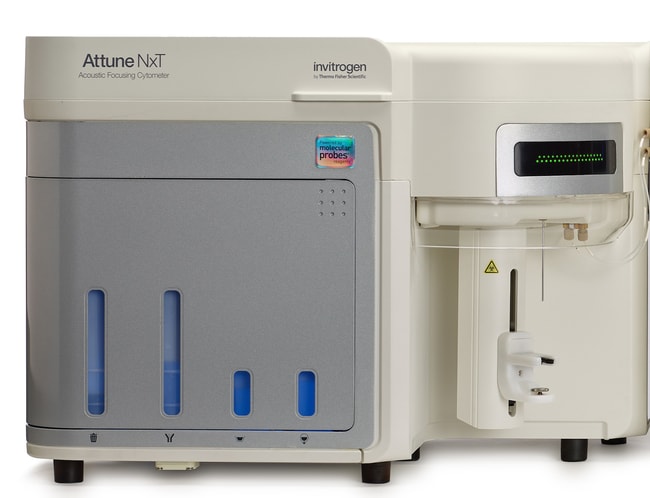
Citómetro de flujo Attune™ NxT, azul/rojo/amarillo
Diseñadas y desarrolladas para eliminar las barreras habituales asociadas con la citometría de flujo, las capacidades evolutivas del citómetro de flujo Attune NxT
| Número de catálogo | Cantidad |
|---|---|
| A28993 | 1 unidad |
Número de catálogo A28993
Precio (CLP)
-
Cantidad:
1 unidad
The 2020 Attune NxT Flow Cytometer has expanded functionalities to drive your research forward. Designed and developed to remove common barriers associated with flow cytometry, the evolutionary capabilities of the Attune NxT Flow Cytometer offer adaptable optical configuration options so you can get the most out of your multicolor analysis.
- New CytKick and CytKick Max autosampler—more efficiency for high-throughput assays
- New 21 CFR part 11 compliant software for regulated laboratories on Windows 10 operating system
- Improved workflow for run protocol and instrument settings management
El citómetro de flujo Attune NxT 2020 tiene funciones ampliadas que impulsarán su investigación. Diseñadas y desarrolladas para eliminar las barreras habituales asociadas con la citometría de flujo, las capacidades evolutivas del citómetro de flujo Attune NxT ofrecen opciones de configuración óptica adaptables para que pueda sacar el máximo partido a su análisis multicolor.
• Nuevo software compatible con CytKick y CytKick Max: más eficacia de automuestreo para ensayos de alto rendimiento
• Nuevo software compatible con 21 CFR parte 11 para laboratorios regulados en el sistema operativo Windows 10
• Flujo de trabajo mejorado para la gestión de protocolos de ejecución y ajustes de instrumentos
Flujo rápido
La innovadora combinación de tecnología de focalización acústica junto con la focalización hidrodinámica tradicional da lugar a velocidades de adquisición hasta 10 veces más rápidas que otros citómetros de flujo. Esta tecnología reduce el tiempo necesario para obtener resultados.
• 35.000 eventos/sec. verdaderos (+10 % tasa de coincidencia)
• Velocidad electrónica máxima de 65.000 eventos/sec.
• Analizar muestras pequeñas o limitadas más rápido que nunca
• Realizar eficazmente ensayos tradicionalmente largos
El citómetro de flujo Attune NxT es ideal para estudios de inmunofenotipado y de señalización, análisis de ciclo celular, detección de eventos infrecuentes, análisis de células madre, estudios de cáncer y apoptosis, ensayos microbiológicos y mucho más.
Adecuado para su laboratorio actual y del futuro
El diseño modular del instrumento proporciona la flexibilidad necesaria para satisfacer las necesidades de capacidad futuras con una variedad de opciones de actualización. Compre lo que necesite ahora y actualice más tarde de forma sencilla. El pequeño espacio de superficie que ocupa el instrumento requiere un espacio mínimo en la mesa, lo que permite su uso incluso en una campana de cultivo celular.
• Flexibilidad: de 1 a 4 láseres, 14 colores y 16 parámetros
• Actualizables en campo: elija agregar láseres adicionales cuando prefiera
• Filtros de paso de banda personalizables para opciones ampliadas de fluorocromo
Ajuste sus datos
El citómetro de flujo Attune NxT ejecuta fácilmente la mayoría de las muestras, incluidos los cardiomiocitos. El sistema está diseñado con un sistema accionado por jeringa resistente a obstrucciones para empujar la muestra con una fuerza de hasta 75 psi.
• Flexibilidad en las concentraciones de muestras y tipos de muestras
• Eliminación de pasos de concentración que requieren mucho tiempo con un kit de filtro sin lisis ni lavados
• Análisis de muestras diluidas, incluido LCR, células madre, médula ósea de ratón, sangre de ratón y aspirados con aguja fina
• Adquisición de un gran volumen de muestras en un tiempo mínimo
• Nuevo software compatible con CytKick y CytKick Max: más eficacia de automuestreo para ensayos de alto rendimiento
• Nuevo software compatible con 21 CFR parte 11 para laboratorios regulados en el sistema operativo Windows 10
• Flujo de trabajo mejorado para la gestión de protocolos de ejecución y ajustes de instrumentos
Flujo rápido
La innovadora combinación de tecnología de focalización acústica junto con la focalización hidrodinámica tradicional da lugar a velocidades de adquisición hasta 10 veces más rápidas que otros citómetros de flujo. Esta tecnología reduce el tiempo necesario para obtener resultados.
• 35.000 eventos/sec. verdaderos (+10 % tasa de coincidencia)
• Velocidad electrónica máxima de 65.000 eventos/sec.
• Analizar muestras pequeñas o limitadas más rápido que nunca
• Realizar eficazmente ensayos tradicionalmente largos
El citómetro de flujo Attune NxT es ideal para estudios de inmunofenotipado y de señalización, análisis de ciclo celular, detección de eventos infrecuentes, análisis de células madre, estudios de cáncer y apoptosis, ensayos microbiológicos y mucho más.
Adecuado para su laboratorio actual y del futuro
El diseño modular del instrumento proporciona la flexibilidad necesaria para satisfacer las necesidades de capacidad futuras con una variedad de opciones de actualización. Compre lo que necesite ahora y actualice más tarde de forma sencilla. El pequeño espacio de superficie que ocupa el instrumento requiere un espacio mínimo en la mesa, lo que permite su uso incluso en una campana de cultivo celular.
• Flexibilidad: de 1 a 4 láseres, 14 colores y 16 parámetros
• Actualizables en campo: elija agregar láseres adicionales cuando prefiera
• Filtros de paso de banda personalizables para opciones ampliadas de fluorocromo
Ajuste sus datos
El citómetro de flujo Attune NxT ejecuta fácilmente la mayoría de las muestras, incluidos los cardiomiocitos. El sistema está diseñado con un sistema accionado por jeringa resistente a obstrucciones para empujar la muestra con una fuerza de hasta 75 psi.
• Flexibilidad en las concentraciones de muestras y tipos de muestras
• Eliminación de pasos de concentración que requieren mucho tiempo con un kit de filtro sin lisis ni lavados
• Análisis de muestras diluidas, incluido LCR, células madre, médula ósea de ratón, sangre de ratón y aspirados con aguja fina
• Adquisición de un gran volumen de muestras en un tiempo mínimo
Para uso exclusivo en investigación. No apto para uso en procedimientos diagnósticos.
Especificaciones
Para utilizar con (equipo)Citómetro de focalización acústica Attune™
FormatoTubo, placa de 384 pocillos, placa de 96 pocillos
Frecuencia50/60 Hz
Características del láserLáser de excitación azul (488 nm), láser de excitación rojo (638 nm), láser de excitación amarillo (561 nm)
Línea de productosAttune
Cantidad1 unidad
Condiciones de envíoTemperatura ambiente
Unit SizeEach
Contenido y almacenamiento
• Citómetro de flujo Attune NxT
• Ordenador minitorre con Windows 10 de 64 bits con software de citometría Attune
• Cable de alimentación con adaptadores
• Cable USB
• Solución de apagado Attune
• Solución de lavado Attune
• Líquido de focalización Attune
• Solución de limpieza de celdas de flujo Attune NxT
• Microesferas de seguimiento de rendimiento Attune
• Tarjeta de referencia rápida
• Ordenador minitorre con Windows 10 de 64 bits con software de citometría Attune
• Cable de alimentación con adaptadores
• Cable USB
• Solución de apagado Attune
• Solución de lavado Attune
• Líquido de focalización Attune
• Solución de limpieza de celdas de flujo Attune NxT
• Microesferas de seguimiento de rendimiento Attune
• Tarjeta de referencia rápida
Preguntas frecuentes
My Attune NxT Flow Cytometer performance test keeps failing. What steps can I take to minimize the number of failed performance tests?
Can I use the Attune Nxt Flow Cytometer to detect bacteria?
Of all the Attune NxT filters you offer, I don't see one that matches our application. Can I use a filter other than what you offer?
With the Attune Nxt Flow Cytometer, if I wish to only start with a single laser, can I expand to more lasers and channels?
What makes the Attune Nxt Flow Cytometer better than standard flow cytometers?
Citations & References (19)
Citations & References
Abstract
BRCA1 Directs the Repair Pathway to Homologous Recombination by Promoting 53BP1 Dephosphorylation.
Journal:Cell Rep
PubMed ID:28076794
'BRCA1 promotes homologous recombination (HR) by activating DNA-end resection. By contrast, 53BP1 forms a barrier that inhibits DNA-end resection. Here, we show that BRCA1 promotes DNA-end resection by relieving the 53BP1-dependent barrier. We show that 53BP1 is phosphorylated by ATM in S/G2 phase, promoting RIF1 recruitment, which inhibits resection. 53BP1
DRP-1 is required for BH3 mimetic-mediated mitochondrial fragmentation and apoptosis.
Journal:Cell Death Dis
PubMed ID:28079887
'The concept of using BH3 mimetics as anticancer agents has been substantiated by the efficacy of selective drugs, such as Navitoclax and Venetoclax, in treating BCL-2-dependent haematological malignancies. However, most solid tumours depend on MCL-1 for survival, which is highly amplified in multiple cancers and a major factor determining chemoresistance.
Enhanced CRISPR/Cas9-mediated precise genome editing by improved design and delivery of gRNA, Cas9 nuclease, and donor DNA.
Journal:J Biotechnol
PubMed ID:27845164
'While CRISPR-based gene knock out in mammalian cells has proven to be very efficient, precise insertion of genetic elements via the cellular homology directed repair (HDR) pathway remains a rate-limiting step to seamless genome editing. Under the conditions described here, we achieved up to 56% targeted integration efficiency with up
Development of a Bacillus subtilis cell-free transcription-translation system for prototyping regulatory elements.
Journal:Metab Eng
PubMed ID:27697563
'Cell-free transcription-translation systems were originally applied towards in vitro protein production. More recently, synthetic biology is enabling these systems to be used within a systematic design context for prototyping DNA regulatory elements, genetic logic circuits and biosynthetic pathways. The Gram-positive soil bacterium, Bacillus subtilis, is an established model organism of
Evaluation of Receptor-Ligand Mechanisms of Dual-Targeted Particles to an Inflamed Endothelium.
Journal:Bioeng Transl Med
PubMed ID:28066821
'Vascular-targeted carriers (VTCs) are designed as leukocyte mimics, decorated with ligands that target leukocyte adhesion molecules (LAMs) and facilitate adhesion to diseased endothelium. VTCs require different design considerations than other targeted particle therapies; adhesion of VTCs in regions with dynamic blood flow requires multiple ligand-receptor (LR) pairs that provide particle