Search


Citas y referencias (12)
Thermo Scientific™
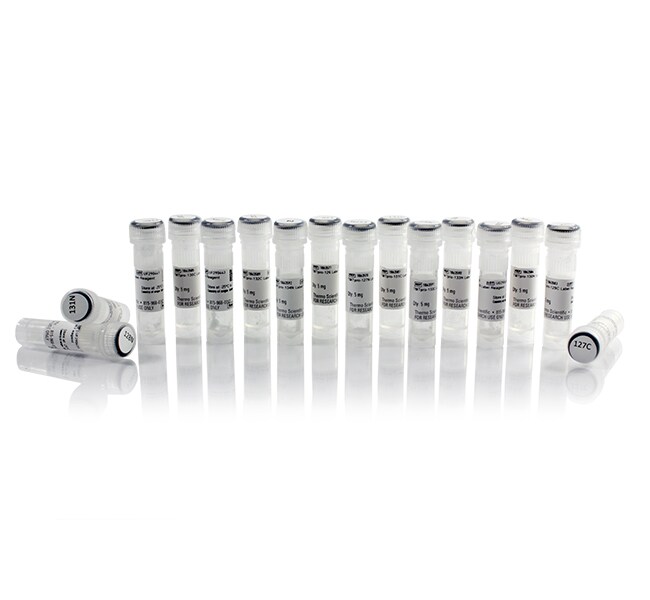
Conjunto de reactivos de marcado TMTpro™ 16-plex
El juego de reactivos de etiqueta Thermo Scientific TMTpro 16plex permite multiplexar hasta 16 muestras para la identificación y cuantificaciónMás información
Have Questions?
Cambiar vista

| Número de catálogo | Cantidad |
|---|---|
| A44520 | 1 x 5 mg (/etiqueta) |
| A44521 | 1 x 0,5 mg (por etiqueta) |
| A44522 | 6 x 0,5 mg (por etiqueta) |
| A58334 | 96 reacciones |
Número de catálogo A44520
Precio (CLP)
10.458.874
Each
Cantidad:
1 x 5 mg (/etiqueta)
Precio (CLP)
10.458.874
Each
El juego de reactivos de etiqueta Thermo Scientific TMTpro 16plex permite multiplexar hasta 16 muestras para la identificación y cuantificación de proteínas mediante espectrometría de masas en tándem (MS/MS).
Características del juego de reactivos de etiqueta TMTpro 16plex:
• Multiplexing: análisis múltiple concurrente MS de hasta 16 muestras derivadas de células, tejidos o fluidos biológicos
• Resistente: la capacidad de multiplexado aumenta, lo que reduce los valores cuantitativos que faltan entre las muestras y supone una mayor confianza entre las réplicas
• Eficiente: los reactivos aminorreactivos de éster NHS activado garantizan el etiquetado eficiente de todos los péptidos independientemente de la secuencia de proteínas o la especificidad de la enzima proteolítica
• Compatible: optimizado para su uso con plataformas MS/MS Thermo Scientific de alta resolución, como los instrumentos Q Exactive y Orbitrap Fusion Tribrid, incluyendo los espectrómetros de masas Orbitrap Eclipse Tribrid y Orbitrap Exploris 480 con análisis de datos totalmente compatibles con Proteome Discoverer 2.3
Los reactivos de etiquetas TMTpro son la próxima generación de etiquetas de masas en tándem, diseñadas para aumentar el nivel de multiplexación de las muestras sin comprometer la identificación ni la cuantificación de las proteínas. La estructura de la etiqueta TMTpro se parece a la de la etiqueta TMT en que las etiquetas siguen siendo isobáricas y aminorreactivas, pero difieren en la región más larga del espaciador y en la región indicadora de masas de isobutil prolina. Después de la fragmentación MS/MS, cada etiqueta TMTpro genera una masa indicadora única (es decir, TMTpro 126-134Da) en la región de masa baja del espectro MS/MS de alta resolución que se utiliza para la cuantificación relativa de los niveles de expresión de proteínas.
Entre las ventajas de las etiquetas TMTpro se incluyen el aumento de la cuantificación relativa multiplex, el aumento del rendimiento de las muestras y la reducción de los valores cuantitativos que faltan entre las muestras. Los reactivos de etiqueta TMTpro 16plex son adecuados para análisis de múltiples muestras de proteínas, como experimentos de respuesta de dosis de inhibidores, experimentos de curso temporal, ensayos de desplazamiento térmico o réplicas biológicas. Cuando se combina con los instrumentos y software Orbitrap de alta resolución líderes del sector, los reactivos TMTpro proporcionan soluciones totales integradas para el análisis cuantitativo de la expresión de proteínas.
Para el análisis de alta resolución de péptidos etiquetados con TMTpro, la columna de LC recomendada para la fuente de Nanospray Flex es la columna de LC Acclaim PepMap 100 C18 (n.º de cat. 164942 o 164939). Para la fuente el EASY-Spray, la columna de LC recomendada es la columna de LC C18 EASY-Spray (n.º de ref. ES802 o ES803). Estos productos están sujetos a una licencia de etiqueta de uso limitado.
Características del juego de reactivos de etiqueta TMTpro 16plex:
• Multiplexing: análisis múltiple concurrente MS de hasta 16 muestras derivadas de células, tejidos o fluidos biológicos
• Resistente: la capacidad de multiplexado aumenta, lo que reduce los valores cuantitativos que faltan entre las muestras y supone una mayor confianza entre las réplicas
• Eficiente: los reactivos aminorreactivos de éster NHS activado garantizan el etiquetado eficiente de todos los péptidos independientemente de la secuencia de proteínas o la especificidad de la enzima proteolítica
• Compatible: optimizado para su uso con plataformas MS/MS Thermo Scientific de alta resolución, como los instrumentos Q Exactive y Orbitrap Fusion Tribrid, incluyendo los espectrómetros de masas Orbitrap Eclipse Tribrid y Orbitrap Exploris 480 con análisis de datos totalmente compatibles con Proteome Discoverer 2.3
Los reactivos de etiquetas TMTpro son la próxima generación de etiquetas de masas en tándem, diseñadas para aumentar el nivel de multiplexación de las muestras sin comprometer la identificación ni la cuantificación de las proteínas. La estructura de la etiqueta TMTpro se parece a la de la etiqueta TMT en que las etiquetas siguen siendo isobáricas y aminorreactivas, pero difieren en la región más larga del espaciador y en la región indicadora de masas de isobutil prolina. Después de la fragmentación MS/MS, cada etiqueta TMTpro genera una masa indicadora única (es decir, TMTpro 126-134Da) en la región de masa baja del espectro MS/MS de alta resolución que se utiliza para la cuantificación relativa de los niveles de expresión de proteínas.
Entre las ventajas de las etiquetas TMTpro se incluyen el aumento de la cuantificación relativa multiplex, el aumento del rendimiento de las muestras y la reducción de los valores cuantitativos que faltan entre las muestras. Los reactivos de etiqueta TMTpro 16plex son adecuados para análisis de múltiples muestras de proteínas, como experimentos de respuesta de dosis de inhibidores, experimentos de curso temporal, ensayos de desplazamiento térmico o réplicas biológicas. Cuando se combina con los instrumentos y software Orbitrap de alta resolución líderes del sector, los reactivos TMTpro proporcionan soluciones totales integradas para el análisis cuantitativo de la expresión de proteínas.
Para el análisis de alta resolución de péptidos etiquetados con TMTpro, la columna de LC recomendada para la fuente de Nanospray Flex es la columna de LC Acclaim PepMap 100 C18 (n.º de cat. 164942 o 164939). Para la fuente el EASY-Spray, la columna de LC recomendada es la columna de LC C18 EASY-Spray (n.º de ref. ES802 o ES803). Estos productos están sujetos a una licencia de etiqueta de uso limitado.
For Research Use Only. Not for use in diagnostic procedures.
Especificaciones
Tipo de producto finalPéptido
Para utilizar con (equipo)Espectrómetro de masas
Etiqueta o tinteEtiquetas Tandem Mass Tag™ (TMT)
Cantidad1 x 5 mg (/etiqueta)
Condiciones de envíoHielo seco
Paso del flujo de trabajoEtiquetado de proteínas
Método de detecciónEspectrometría de masas
Línea de productosTMT
Tipo de productoIsobaric Label Reagent Set
Material de partidapéptidos
Unit SizeEach
Preguntas frecuentes
What is the shelf life for the TMTpro 16plex Label Reagent Set?
Can the TMT and TMTpro reagents be mixed?
Can TMTpro label reagents dissolved in anhydrous acetonitrile be dried down and stored for later use?
What size formats is the TMTpro 16plex Label Reagent Set available in?
If I already have TMTpro 16-plex tags, what do I need to order to get a total of 18-plex TMTpro tags?
Citations & References (12)
Citations & References
Abstract
Automated 16-Plex Plasma Proteomics with Real-Time Search and Ion Mobility Mass Spectrometry Enables Large-Scale Profiling in Naked Mole-Rats and Mice.
Journal:Journal of proteome research
PubMed ID:33499602
Performing large-scale plasma proteome profiling is challenging due to limitations imposed by lengthy preparation and instrument time. We present a fully automated multiplexed proteome profiling platform (AutoMP3) using the Hamilton Vantage liquid handling robot capable of preparing hundreds to thousands of samples. To maximize protein depth in single-shot runs, we
Discovering the Radiation Biomarkers in the Plasma of Total-Body Irradiated Leukemia Patients.
Journal:Radiation research
PubMed ID:38315067
The increased risk of acute large-scale radiological exposure for the world's population underlines the need for optimal radiation biomarkers. Ionizing radiation triggers a complex response by the genome, proteome, and metabolome, all of which have been reported as suitable indicators of radiation-induced damage in vivo. This study analyzed peripheral blood samples
Improved Proteomics-Based Drug Mechanism-of-Action Studies Using 16-Plex Isobaric Mass Tags.
Journal:Journal of proteome research
PubMed ID:33621079
Multiplexed quantitative proteomics enabled complex workflows to study the mechanisms by which small molecule drugs interact with the proteome such as thermal proteome profiling (TPP) or multiplexed proteome dynamics profiling (mPDP). TPP measures changes in protein thermal stability in response to drug treatment and thus informs on direct targets and
Establishing Quality Control Procedures for Large-Scale Plasma Proteomics Analyses.
Journal:Journal of the American Society for Mass Spectrometry
PubMed ID:37163770
Proteomics research has been transformed due to high-throughput liquid chromatography (LC-MS/MS) tandem mass spectrometry instruments combined with highly sophisticated automated sample preparation and multiplexing workflows. However, scaling proteomics experiments to large sample cohorts (hundreds to thousands) requires thoughtful quality control (QC) protocols. Robust QC protocols can help with reproducibility, quantitative
Proteomic Profiling of Cerebrospinal Fluid by 16-Plex TMT-Based Mass Spectrometry.
Journal:Methods in molecular biology (Clifton, N.J.)
PubMed ID:34905163
Mass spectrometry (MS) has become a mainstream platform for comprehensive profiling of proteome, especially with the improvement of multiplexed tandem mass tag labeling coupled with two-dimensional liquid chromatography and tandem mass spectrometry (TMT-LC/LC-MS/MS). Recently, we have established a robust method for direct profiling of undepleted cerebrospinal fluid (CSF) proteome with