Search


Citas y referencias (8)
Invitrogen™
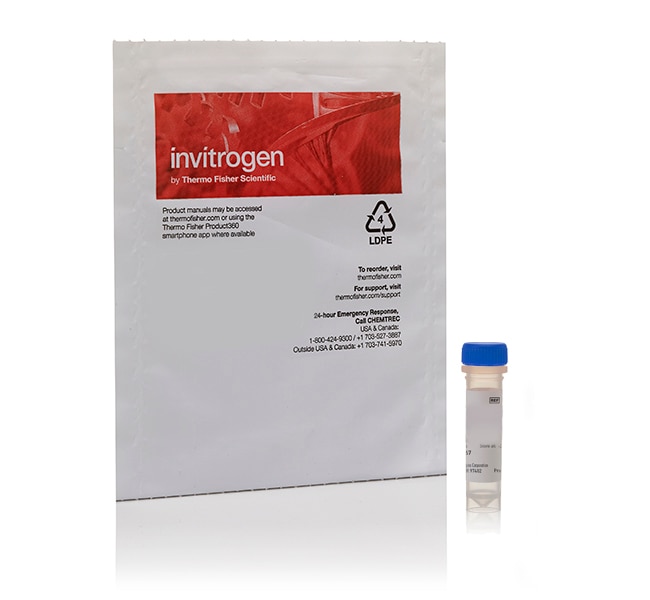
Biotin Alkyne (PEG4 carboxamide-Propargyl Biotin)
El hapteno y la biotina azida son reactivos de terminales mediante una reacción de clic catalizada por cobre. La biotinaMás información
| Número de catálogo | Cantidad |
|---|---|
| B10185 | 1 mg |
Número de catálogo B10185
Precio (CLP)
778.672
Each
Cantidad:
1 mg
Precio (CLP)
778.672
Each
El hapteno y la biotina azida son reactivos de terminales mediante una reacción de clic catalizada por cobre. La biotina se puede detectar posteriormente con estreptavidina, avidina o la proteína de unión de biotina NeutrAvidin®.
Para uso exclusivo en investigación. No apto para uso en procedimientos diagnósticos.
Especificaciones
Reactividad químicaAzida
FormatoSólido
Etiqueta o tinteBiotina
Peso molecular528,66 Da
Tipo de productoAlquino de biotina
Cantidad1 mg
Grupo reactivoAlquino
Fracción reactivaAlquino
Condiciones de envíoTemperatura ambiente
SolubilidadDMSO (dimetilsulfóxido)
ColorBiotina
Tipo de etiquetaBiotina y otros haptenos
Línea de productosMolecular Probes
Unit SizeEach
Contenido y almacenamiento
Almacénelo a ≤-20 °C y manténgalo desecado.
Citations & References (8)
Citations & References
Abstract
Identification of protein targets of 4-hydroxynonenal using click chemistry for ex vivo biotinylation of azido and alkynyl derivatives.
Journal:Chem Res Toxicol
PubMed ID:18232660
'Polyunsaturated fatty acids (PUFA) are primary targets of free radical damage during oxidative stress. Diffusible electrophilic alpha,beta-unsaturated aldehydes, such as 4-hydroxynonenal (HNE), have been shown to modify proteins that mediate cell signaling (e.g., IKK and Keap1) and alter gene expression pathways responsible for inducing antioxidant genes, heat shock proteins, and
Direct in-gel fluorescence detection and cellular imaging of O-GlcNAc-modified proteins.
Journal:J Am Chem Soc
PubMed ID:18683930
'We report an advanced chemoenzymatic labeling strategy for direct fluorescence detection of O-GlcNAc proteins in gels that facilitates proteomic studies and greatly extend the reach of existing technologies. These new tools also enable the expression and dynamics of O-GlcNAc modifications to be monitored by imaging in cells and tissues.
Comparative methods for analysis of protein covalent modification by electrophilic quinoids formed from xenobiotics.
Journal:Bioconjug Chem
PubMed ID:19301905
'Conjugation of biotin and fluorophore tags is useful for assaying covalent protein modification. Oxidative bioactivation of selective estrogen receptor modulators (SERMs) yields reactive quinoid electrophiles that covalently modify proteins, and bioactivation is associated with carcinogenic and chemopreventive effects. Identification of the protein targets of electrophilic metabolites is of general importance
HACE1 reduces oxidative stress and mutant Huntingtin toxicity by promoting the NRF2 response.
Journal:
PubMed ID:24516159
Oxidative stress plays a key role in late onset diseases including cancer and neurodegenerative diseases such as Huntington disease. Therefore, uncovering regulators of the antioxidant stress responses is important for understanding the course of these diseases. Indeed, the nuclear factor erythroid 2-related factor 2 (NRF2), a master regulator of the
O-linked N-acetylglucosamine modification on CCAAT enhancer-binding protein beta: role during adipocyte differentiation.
Journal:J Biol Chem
PubMed ID:19478079
CCAAT enhancer-binding protein (C/EBP)beta is a basic leucine zipper transcription factor family member, and can be phosphorylated, acetylated, and sumoylated. C/EBPbeta undergoes sequential phosphorylation during 3T3-L1 adipocyte differentiation. Phosphorylation on Thr(188) by MAPK or cyclin A/cdk2 primes the phosphorylations on Ser(184)/Thr(179) by GSK3beta, and these phosphorylations are required for the