Search


Citas y referencias (6)
Invitrogen™
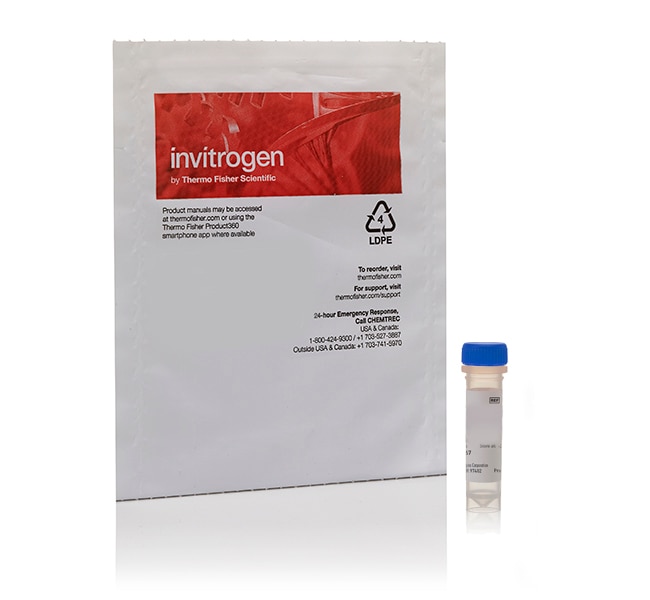
ChromaTide™ Alexa Fluor™ 488-5-UTP
Pueden usarse nucleidos dUTP, OBEA-dCTP y UTP etiquetados con colorante Molecular Probes™ ChromaTide™ para sintetizar sondas de ADN etiquetadas sinMás información
| Número de catálogo | Cantidad |
|---|---|
| C11403 | 25 μl |
Número de catálogo C11403
Precio (CLP)
776.447
Each
Cantidad:
25 μl
Precio (CLP)
776.447
Each
Pueden usarse nucleidos dUTP, OBEA-dCTP y UTP etiquetados con colorante Molecular Probes™ ChromaTide™ para sintetizar sondas de ADN etiquetadas sin necesidad de nucleidos etiquetados con radioisótopos peligrosos y costosos. Estos nucleidos pueden incorporarse mediante técnicas estándar de biología molecular; a continuación, las sondas etiquetadas pueden utilizarse en protocolos de hibridación in situ, micromatrices o transferencia. Los nucleidos etiquetados con colorante ChromaTide™ están disponibles en diferentes colores fluorescentes para facilitar el análisis multicolor.
Especificaciones de los nucleidos etiquetados con ChromaTide™:
• Ex/Em del colorante: Alexa Fluor™ 488-5-UTP (490/520 nm)
• Longitud del enlazador alquinilamino: 5 átomos
Métodos para incorporar nucleidos ChromaTide™ en sondas
• Translación de mellas (nick translation)
• Etiquetado de primers aleatorios
• Etiquetado final con desoxinucleotidil transferasa terminal
• Transcripción inversa
• Amplificación de PCR
Consulte Métodos para la incorporación enzimática de dUTP ChromaTide™ para obtener directrices específicas para cada uno de estos métodos.
Los colorantes fluorescentes Alexa Fluor™ y BODIPY™ generan excelentes sondas
Las sondas generadas con nucleidos etiquetados pueden usarse para técnicas multicolores como la hibridación in situ y la hibridación en matrices. Nuestros conjugados de colorantes patentados BODIPY™ y Alexa Fluor™ son excepcionalmente brillantes, fotoestables y esencialmente insensibles al pH. El estrecho perfil de emisión de los colorantes BODIPY™ ayuda a asegurar una superposición espectral mínima. Los colorantes Alexa Fluor™ son muy solubles en agua, al igual que las sondas de ADN fabricadas a partir de ellos, lo que los convierte en las etiquetas preferidas para la hibridación fluorescente in situ.
Los enlazadores largos mejoran el rendimiento
Los nucleidos dUTP y UTP ChromaTide™ se modifican en la posición C-5 de la uridina a través de un único enlazador alquinilamino, que proporciona un espaciador entre el nucleótido y el colorante para reducir las interacciones entre ellos. El número en el nombre del producto, por ejemplo, “12” en fluoresceína-12 dUTP, indica la longitud neta del separador, en átomos. Estos espaciadores dan como resultado conjugados más brillantes y una mayor accesibilidad a los reactivos de detección secundaria.
Para obtener una lista completa de nuestros reactivos ChromaTide™: Nucleidos etiquetados con aha y Molecular Probes ChromaTide™: Tabla 8.5.
Para obtener información adicional sobre estos reactivos de etiquetado, lea la Sección 8.2: Etiquetado de oligonucleótidos y ácidos nucleicos del Manual de Molecular Probes™.
Para uso exclusivo en investigación. No diseñado para uso diagnóstico o terapéutico en humanos ni en animales.
Especificaciones de los nucleidos etiquetados con ChromaTide™:
• Ex/Em del colorante: Alexa Fluor™ 488-5-UTP (490/520 nm)
• Longitud del enlazador alquinilamino: 5 átomos
Métodos para incorporar nucleidos ChromaTide™ en sondas
• Translación de mellas (nick translation)
• Etiquetado de primers aleatorios
• Etiquetado final con desoxinucleotidil transferasa terminal
• Transcripción inversa
• Amplificación de PCR
Consulte Métodos para la incorporación enzimática de dUTP ChromaTide™ para obtener directrices específicas para cada uno de estos métodos.
Los colorantes fluorescentes Alexa Fluor™ y BODIPY™ generan excelentes sondas
Las sondas generadas con nucleidos etiquetados pueden usarse para técnicas multicolores como la hibridación in situ y la hibridación en matrices. Nuestros conjugados de colorantes patentados BODIPY™ y Alexa Fluor™ son excepcionalmente brillantes, fotoestables y esencialmente insensibles al pH. El estrecho perfil de emisión de los colorantes BODIPY™ ayuda a asegurar una superposición espectral mínima. Los colorantes Alexa Fluor™ son muy solubles en agua, al igual que las sondas de ADN fabricadas a partir de ellos, lo que los convierte en las etiquetas preferidas para la hibridación fluorescente in situ.
Los enlazadores largos mejoran el rendimiento
Los nucleidos dUTP y UTP ChromaTide™ se modifican en la posición C-5 de la uridina a través de un único enlazador alquinilamino, que proporciona un espaciador entre el nucleótido y el colorante para reducir las interacciones entre ellos. El número en el nombre del producto, por ejemplo, “12” en fluoresceína-12 dUTP, indica la longitud neta del separador, en átomos. Estos espaciadores dan como resultado conjugados más brillantes y una mayor accesibilidad a los reactivos de detección secundaria.
Para obtener una lista completa de nuestros reactivos ChromaTide™: Nucleidos etiquetados con aha y Molecular Probes ChromaTide™: Tabla 8.5.
Para obtener información adicional sobre estos reactivos de etiquetado, lea la Sección 8.2: Etiquetado de oligonucleótidos y ácidos nucleicos del Manual de Molecular Probes™.
Para uso exclusivo en investigación. No diseñado para uso diagnóstico o terapéutico en humanos ni en animales.
Para uso exclusivo en investigación. No apto para uso en procedimientos diagnósticos.
Especificaciones
Método de etiquetadoEtiquetado directo
Etiqueta o tinteAlexa Fluor™ 488
Cantidad25 μl
Condiciones de envíoHielo seco
Concentración1 mM
Línea de productosAlexa Fluor, ChromaTide
Unit SizeEach
Contenido y almacenamiento
Almacenar en el congelador (de -5 a -30 °C) y proteger de la luz.
Preguntas frecuentes
I'm getting high background after labeling with ChromaTide nucleotides. What do you recommend I do?
The nucleic acid probe is not fluorescent after labeling with ChromaTide nucleotides. What do you recommend I try?
Can ChromaTide nucleotides be used for labeling nucleic acids in live cells?
How do I determine the incorporation efficiency of the ChromaTide Labeling Nucleotides after enzymatic incorporation?
What is the average dye to base incorporation rate when enzymatically incorporating ChromaTide nucleotides?
Citations & References (6)
Citations & References
Abstract
A brain-specific microRNA regulates dendritic spine development.
Journal:Nature
PubMed ID:16421561
'MicroRNAs are small, non-coding RNAs that control the translation of target messenger RNAs, thereby regulating critical aspects of plant and animal development. In the mammalian nervous system, the spatiotemporal control of mRNA translation has an important role in synaptic development and plasticity. Although a number of microRNAs have been isolated
Inheritance of a pre-inactivated paternal X chromosome in early mouse embryos.
Journal:Nature
PubMed ID:14661031
'In mammals, dosage compensation ensures equal X-chromosome expression between males (XY) and females (XX) by transcriptionally silencing one X chromosome in XX embryos. In the prevailing view, the XX zygote inherits two active X chromosomes, one each from the mother and father, and X inactivation does not occur until after
Genome-wide analysis demonstrates conserved localization of messenger RNAs to mitotic microtubules.
Journal:J Cell Biol
PubMed ID:18166649
RNA localization is of critical importance in many fundamental cell biological and developmental processes by regulating the spatial control of gene expression. To investigate how spindle-localized RNAs might influence mitosis, we comprehensively surveyed all messenger RNAs (mRNAs) that bound to microtubules during metaphase in both Xenopus laevis egg extracts and
Single-molecule analysis of 1D diffusion and transcription elongation of T7 RNA polymerase along individual stretched DNA molecules.
Journal:Nucleic Acids Res
PubMed ID:17526520
Using total internal reflection fluorescence microscopy, we directly visualize in real-time, the 1D Brownian motion and transcription elongation of T7 RNA polymerase along aligned DNA molecules bound to substrates by molecular combing. We fluorescently label T7 RNA polymerase with antibodies and use flow to convect them orthogonally to the DNA
Drosophila Squid/hnRNP helps Dynein switch from a gurken mRNA transport motor to an ultrastructural static anchor in sponge bodies.
Journal:Dev Cell
PubMed ID:17925228
In Drosophila oocytes, dorso-anterior transport of gurken mRNA requires both the Dynein motor and the heterogeneous nuclear ribonucleoprotein (hnRNP) Squid. We show that gurken transcripts are transported directly on microtubules by Dynein in nonmembranous electron-dense transport particles that also contain Squid and the transport cofactors Egalitarian and Bicaudal-D. At its