Search


Citas y referencias (19)
Invitrogen™
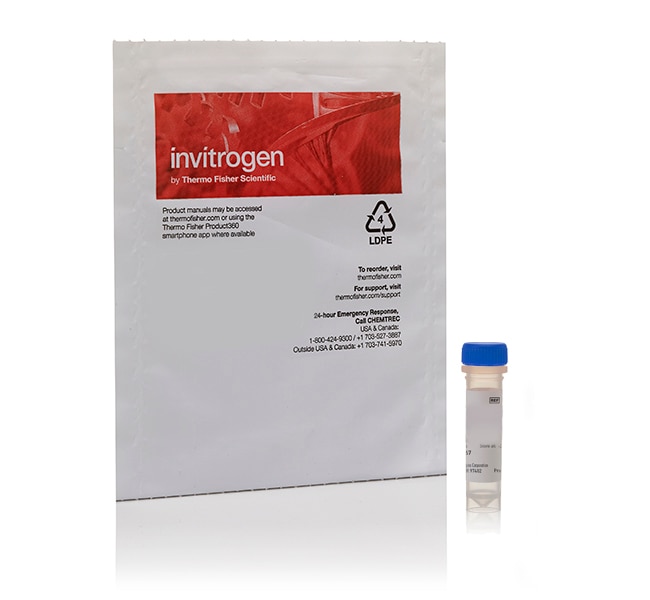
Epidermal Growth Factor, Biotinylated, complexed to Alexa Fluor™ 488 Streptavidin (Alexa Fluor™ 488 EGF complex)
Ofrecemos varios conjugados de factor de crecimiento epidérmico que sirven para la detección del receptor EGF en las células. ElMás información
| Número de catálogo | Cantidad |
|---|---|
| E13345 | 100 μg |
Número de catálogo E13345
Precio (CLP)
597.856
Each
Cantidad:
100 μg
Precio (CLP)
597.856
Each
Ofrecemos varios conjugados de factor de crecimiento epidérmico que sirven para la detección del receptor EGF en las células. El EGF etiquetado con fluorescencia ha permitido a los científicos investigar las interacciones receptor-membrana, estudiar la distribución de los receptores y calcular las constantes de frecuencia para la interacción del EGF con su receptor, entre muchas aplicaciones más. Los conjugados que incorporan fluoresceína (FITC), Oregon Green™ 514 y tetrametilrodamina se construyeron con el colorante directamente unido al EGF. Los conjugados de EGF con los colorantes Alexa Fluor™ y Texas Red™ son complejos de la molécula colorante: estreptavidina y EGF biotinilado. Los conjugados biotinilados utilizan biotina-XX, que contiene un agente separador largo para mejorar la afinidad del receptor EGF.
Especificaciones de los conjugados de factor de crecimiento epidérmico:
• Molécula EGF: 53 aminoácidos, PM=6,045 Da
• Etiqueta (Ex/Em): Biotina-XX con estreptavidina Alexa Fluor™ 488 (∼ 495/519 nm)
• Número de moléculas de fluoróforo en cada molécula EGF: ∼2-3
• La fluorescencia se suele monitorizar mediante un citómetro de flujo, un microscopio de fluorescencia o un fluorímetro.
Encuentre más sondas de unión de receptores y fagocitosis
Ofrecemos varias sondas etiquetadas con fluorescencia para estudiar la endocitosis mediada por receptores, los marcadores de membrana para endocitosis y exocitosis y los métodos para detectar ligandos fluorescentes internalizados. Probes for Following Receptor Binding and Phagocytosis—Section 16.1 (Sondas para seguir la unión de receptores y la fagocitosis, sección 16.1) en el manual de Molecular Probes™ para obtener más información sobre estos productos.
Para uso en investigación. No apto para uso diagnóstico o terapéutico en humanos ni en animales.
Especificaciones de los conjugados de factor de crecimiento epidérmico:
• Molécula EGF: 53 aminoácidos, PM=6,045 Da
• Etiqueta (Ex/Em): Biotina-XX con estreptavidina Alexa Fluor™ 488 (∼ 495/519 nm)
• Número de moléculas de fluoróforo en cada molécula EGF: ∼2-3
• La fluorescencia se suele monitorizar mediante un citómetro de flujo, un microscopio de fluorescencia o un fluorímetro.
Encuentre más sondas de unión de receptores y fagocitosis
Ofrecemos varias sondas etiquetadas con fluorescencia para estudiar la endocitosis mediada por receptores, los marcadores de membrana para endocitosis y exocitosis y los métodos para detectar ligandos fluorescentes internalizados. Probes for Following Receptor Binding and Phagocytosis—Section 16.1 (Sondas para seguir la unión de receptores y la fagocitosis, sección 16.1) en el manual de Molecular Probes™ para obtener más información sobre estos productos.
Para uso en investigación. No apto para uso diagnóstico o terapéutico en humanos ni en animales.
Para uso exclusivo en investigación. No apto para uso en procedimientos diagnósticos.
Especificaciones
Tipo de célulaCélula de mamífero
Método de detecciónFluorescente
Tipo de coloranteColorantes Alexa Fluor
FormularioSólido
Familia de proteínasEGF
Cantidad100 μg
Condiciones de envíoHielo húmedo
Línea de productosAlexa Fluor
Tipo de productoFactor de crecimiento
Unit SizeEach
Contenido y almacenamiento
Almacenar en el congelador (de – 5 a – 30 °C) y proteger de la luz.
Preguntas frecuentes
What is the molecular weight of Epidermal Growth Factor, Biotinylated, complexed to Alexa Fluor 488 Streptavidin (Alexa Fluor 488 EGF complex) (Cat. No. E13345)?
Citations & References (19)
Citations & References
Abstract
Systems survey of endocytosis by multiparametric image analysis.
Journal:Nature
PubMed ID:20190736
'Endocytosis is a complex process fulfilling many cellular and developmental functions. Understanding how it is regulated and integrated with other cellular processes requires a comprehensive analysis of its molecular constituents and general design principles. Here, we developed a new strategy to phenotypically profile the human genome with respect to transferrin
The Ankrd 13 family of UIM-bearing proteins regulates EGF receptor endocytosis from the plasma membrane.
Journal:Mol Biol Cell
PubMed ID:22298428
'The mechanism of ubiquitin-dependent endocytosis of cell surface proteins is not completely understood. Here we examine the role of the ankyrin repeat domain (Ankrd) 13A, 13B, and 13D proteins, which constitute a functionally unknown family of ubiquitin-interacting motif (UIM)-bearing proteins, in the process. Stimulation of human HeLa cells with epidermal
Rapidly inducible changes in phosphatidylinositol 4,5-bisphosphate levels influence multiple regulatory functions of the lipid in intact living cells.
Journal:J Cell Biol
PubMed ID:17088424
'Rapamycin (rapa)-induced heterodimerization of the FRB domain of the mammalian target of rapa and FKBP12 was used to translocate a phosphoinositide 5-phosphatase (5-ptase) enzyme to the plasma membrane (PM) to evoke rapid changes in phosphatidylinositol 4,5-bisphosphate (PtdIns(4,5)P(2)) levels. Rapa-induced PM recruitment of a truncated type IV 5-ptase containing only the
Beclin1-binding UVRAG targets the class C Vps complex to coordinate autophagosome maturation and endocytic trafficking.
Journal:Nat Cell Biol
PubMed ID:18552835
'Autophagic and endocytic pathways are tightly regulated membrane rearrangement processes that are crucial for homeostasis, development and disease. Autophagic cargo is delivered from autophagosomes to lysosomes for degradation through a complex process that topologically resembles endosomal maturation. Here, we report that a Beclin1-binding autophagic tumour suppressor, UVRAG, interacts with the
Hip1-related mutant mice grow and develop normally but have accelerated spinal abnormalities and dwarfism in the absence of HIP1.
Journal:Mol Cell Biol
PubMed ID:15121852
In mice and humans, there are two known members of the Huntingtin interacting protein 1 (HIP1) family, HIP1 and HIP1-related (HIP1r). Based on structural and functional data, these proteins participate in the clathrin trafficking network. The inactivation of Hip1 in mice leads to spinal, hematopoietic, and testicular defects. To investigate