Search


Citas y referencias (9)
Invitrogen™
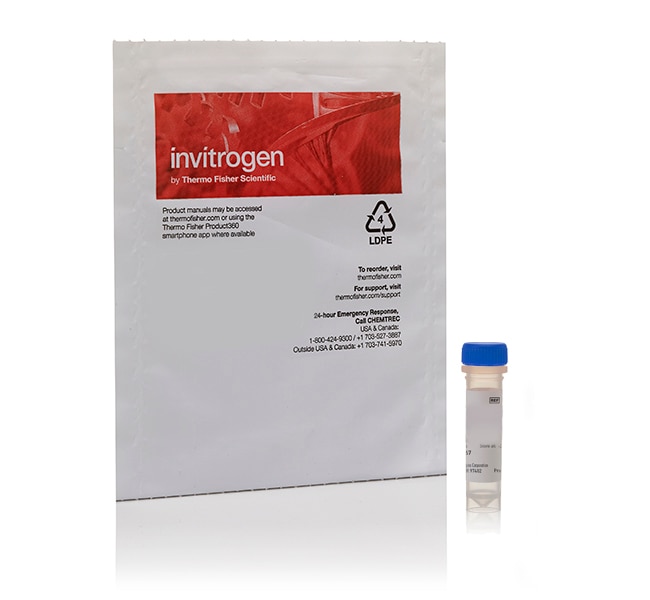
Qtracker™ 565 Vascular Labels
Los puntos cuánticos no dirigidos Qtracker™ están diseñados para ser inyectados en la vena de la cola de ratones paraMás información
| Número de catálogo | Cantidad |
|---|---|
| Q21031MP | 200 μl |
Número de catálogo Q21031MP
Precio (CLP)
916.344
Each
Cantidad:
200 μl
Precio (CLP)
916.344
Each
Los puntos cuánticos no dirigidos Qtracker™ están diseñados para ser inyectados en la vena de la cola de ratones para el estudio de la estructura vascular usando técnicas de obtención de imágenes de animales pequeños in vivo (SAIVI). Estos nanocristales muestran una intensa fluorescencia con emisión de desplazamiento rojo para aumentar la penetración de los tejidos, y tienen un revestimiento de superficie de PEG especialmente desarrollado para minimizar las interacciones inespecíficas y reducir la respuesta inmune del tejido. Debido a que el revestimiento de la superficie de PEG no contiene grupos funcionales reactivos, los puntos cuánticos no dirigidos Qtracker™ se conservan en circulación durante más tiempo y se pueden exponer durante hasta 3 horas con una sola inyección o durante periodos de tiempo más largos con inyecciones adicionales.
¿Necesita otro espectro de emisión o un seguimiento más prolongado? Consulte nuestros otros productos de seguimiento de células de mamífero.
Atributos principales:
• La etiqueta Qtracker™ 565 tiene Ex/Em (405-525/655) nm
• Diseñados para la adquisición de imágenes in vivo de animales pequeños
• Se introducen mediante inyección en la vena de la cola, se puede adquirir imágenes hasta 3 horas después de la inyección
• Disponibles en cuatro colores: emisión de 565 nm, 655 nm, 705 nm u 800 nm
Obtenga más información sobre SAIVI y sobre las aplicaciones de los nanocristales Qdot™.
Para uso exclusivo en investigación. No diseñado para uso terapéutico o de diagnóstico en animales o humanos.
¿Necesita otro espectro de emisión o un seguimiento más prolongado? Consulte nuestros otros productos de seguimiento de células de mamífero.
Atributos principales:
• La etiqueta Qtracker™ 565 tiene Ex/Em (405-525/655) nm
• Diseñados para la adquisición de imágenes in vivo de animales pequeños
• Se introducen mediante inyección en la vena de la cola, se puede adquirir imágenes hasta 3 horas después de la inyección
• Disponibles en cuatro colores: emisión de 565 nm, 655 nm, 705 nm u 800 nm
Obtenga más información sobre SAIVI y sobre las aplicaciones de los nanocristales Qdot™.
Para uso exclusivo en investigación. No diseñado para uso terapéutico o de diagnóstico en animales o humanos.
Para uso exclusivo en investigación. No apto para uso en procedimientos diagnósticos.
Especificaciones
Concentración2 μM
Tipo de coloranteNanocristales Qdot
Línea de productosQTRACKER, Qdot
Cantidad200 μl
Tipo de reactivoReactivos para imágenes vasculares
Condiciones de envíoTemperatura ambiente
TécnicaObtención de imágenes in vivo
Tipo de productoEtiqueta
Unit SizeEach
Contenido y almacenamiento
Contiene 200 μl de puntos cuánticos no dirigidos Qtracker™ (solución de 2 μM en 50 mM de tampón de borato, pH de 8,3). Almacenar de 2–6 °C. No la congele. Estable durante al menos 6 meses.
Preguntas frecuentes
When I label with Qtracker cell labeling reagents, I get a punctate label pattern. How do I make it more uniform?
How long after injection should I start imaging my mouse?
What happens to unconjugated dye in the mouse after small animal in vivo imaging?
What amount of Qtracker non-targeted reagent should I inject to image vasculature?
I want to track my cells with a nucleic acid stain, like DAPI or Hoechst dye. Do you recommend this?
Citations & References (9)
Citations & References
Abstract
Intracellular fluid flow in rapidly moving cells.
Journal:Nat Cell Biol
PubMed ID:19767741
'Cytosolic fluid dynamics have been implicated in cell motility because of the hydrodynamic forces they induce and because of their influence on transport of components of the actin machinery to the leading edge. To investigate the existence and the direction of fluid flow in rapidly moving cells, we introduced inert
A novel method to allow noninvasive, longitudinal imaging of the murine immune system in vivo.
Journal:Blood
PubMed ID:22271449
'In vivo imaging has revolutionized understanding of the spatiotemporal complexity that subserves the generation of successful effector and regulatory immune responses. Until now, invasive surgery has been required for microscopic access to lymph nodes (LNs), making repeated imaging of the same animal impractical and potentially affecting lymphocyte behavior. To allow
Variables influencing interactions of untargeted quantum dot nanoparticles with skin cells and identification of biochemical modulators.
Journal:Nano Lett
PubMed ID:17408303
Skin cells (NHEK) take up untargeted quantum dots (QD) with surface polyethylene glycol (PEG), amines, and carboxylic acids, but the mechanisms are unknown. Time courses of QD-NHEK interactions were determined and effects of QD surface coating, temperature, culture medium supplements and inhibitors of the cell cycle and endocytosis identified. The
Granule exocytosis is required for platelet spreading: differential sorting of a-granules expressing VAMP-7.
Journal:Blood
PubMed ID:22589474
There has been recent controversy as to whether platelet a-granules represent a single granule population or are composed of different subpopulations that serve discrete functions. To address this question, we evaluated the localization of vesicle-associated membrane proteins (VAMPs) in spread platelets to determine whether platelets actively sort a specific subpopulation
Surface coatings determine cytotoxicity and irritation potential of quantum dot nanoparticles in epidermal keratinocytes.
Journal:J Invest Dermatol
PubMed ID:16902417
Quantum dot (QD) nanoparticles have potential applications in nanomedicine as drug delivery vectors and diagnostic agents, but the skin toxicity and irritation potential of QDs are unknown. Human epidermal keratinocytes (HEKs) were used to assess if QDs with different surface coatings would cause differential effects on HEK cytotoxicity, proinflammatory cytokine