Search


Citas y referencias (5)
Invitrogen™
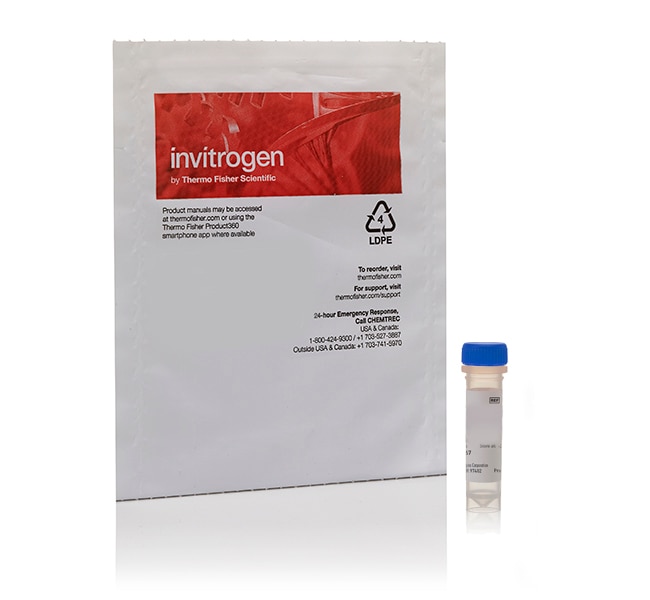
Qdot™ 545 ITK™ Amino (PEG) Quantum Dots
Los puntos cuánticos de amina (PEG) Qdot™ 545 ITK™ son el material de partida ideal para preparar conjugados personalizados deMás información
| Número de catálogo | Cantidad |
|---|---|
| Q21591MP | 250 µl |
Número de catálogo Q21591MP
Precio (CLP)
-
Cantidad:
250 µl
Los puntos cuánticos de amina (PEG) Qdot™ 545 ITK™ son el material de partida ideal para preparar conjugados personalizados de proteínas con etiquetas fluorescentes ultrabrillantes y fotoestables u otros biopolímeros. Estas sondas están funcionalizadas con PEG derivado de amina, que evita interacciones no específicas y proporciona una manipulación cómoda para la conjugación. Los puntos cuánticos de amina reaccionan eficientemente con isotiocianatos y ésteres de succinimidilo, o con ácidos carboxílicos nativos usando carbodiimidas solubles en agua como EDC. Estos derivados pueden utilizarse para diversas aplicaciones de etiquetado y seguimiento que requieren fluorescencia ultrabrillante y estable. Nuestros puntos cuánticos de amina Qdot™ ITK™ se proporcionan como soluciones de 8 μM y están disponibles en sondas Qdot™ de ocho colores.
Características importantes de los puntos cuánticos de amina Qdot™ ITK™:
• El punto cuántico de amina Qdot™ 545 ITK™ tiene un nivel máximo de emisión de ∼545 nm.
• Su fluorescencia es muy fotoestable y brillante.
• Se excita de forma eficaz con fuentes de excitación de una sola línea.
• La emisión es estrecha y con gran desplazamiento de stokes.
• Está disponible en varios colores.
• Es ideal para varias aplicaciones de etiquetado y seguimiento.
Características de los nanocristales Qdot™
Las sondas Qdot™ son ideales para aplicaciones de imagen y etiquetado que requieren señales fluorescentes brillantes o seguimiento en tiempo real. Los nueve colores disponibles de las sondas Qdot™, únicos entre los reactivos fluorescentes, pueden excitarse simultáneamente con una única fuente de luz (UV a azul-verde). Esta propiedad hace que estos reactivos sean excelentes para aplicaciones de multiplexado económicas y fáciles de usar. Las etiquetas Qdot™ se basan en nanotecnología de semiconductores y son similares en escala a las proteínas de tamaño moderado.
Acerca del kit de herramientas de innovador de reactivos Qdot™ ITK™
Estas sondas Qdot™ ITK™ son ideales para investigadores que desean preparar conjugados específicos (no almacenados) para sus aplicaciones y necesitan una funcionalidad de conjugación personalizable.
Hay disponibles otras formas de nanocristales Qdot™
Además de la forma derivada de carboxilo, ofrecemos puntos cuánticos de Qdot™ ITK™ con modificaciones de hidrocarburos carboxilo y alifáticos. También hemos desarrollado una amplia gama de conjugados y kits de marcado de nanocristales Qdot™. Consulte las características de los nanocristales Qdot™ o ™ la sección 6.6 sobre nanocristales Qdot—del manual de Molecular Probes™ para obtener más información.
Para uso exclusivo en investigación. No diseñado para uso terapéutico o de diagnóstico en animales o humanos.
Características importantes de los puntos cuánticos de amina Qdot™ ITK™:
• El punto cuántico de amina Qdot™ 545 ITK™ tiene un nivel máximo de emisión de ∼545 nm.
• Su fluorescencia es muy fotoestable y brillante.
• Se excita de forma eficaz con fuentes de excitación de una sola línea.
• La emisión es estrecha y con gran desplazamiento de stokes.
• Está disponible en varios colores.
• Es ideal para varias aplicaciones de etiquetado y seguimiento.
Características de los nanocristales Qdot™
Las sondas Qdot™ son ideales para aplicaciones de imagen y etiquetado que requieren señales fluorescentes brillantes o seguimiento en tiempo real. Los nueve colores disponibles de las sondas Qdot™, únicos entre los reactivos fluorescentes, pueden excitarse simultáneamente con una única fuente de luz (UV a azul-verde). Esta propiedad hace que estos reactivos sean excelentes para aplicaciones de multiplexado económicas y fáciles de usar. Las etiquetas Qdot™ se basan en nanotecnología de semiconductores y son similares en escala a las proteínas de tamaño moderado.
Acerca del kit de herramientas de innovador de reactivos Qdot™ ITK™
Estas sondas Qdot™ ITK™ son ideales para investigadores que desean preparar conjugados específicos (no almacenados) para sus aplicaciones y necesitan una funcionalidad de conjugación personalizable.
Hay disponibles otras formas de nanocristales Qdot™
Además de la forma derivada de carboxilo, ofrecemos puntos cuánticos de Qdot™ ITK™ con modificaciones de hidrocarburos carboxilo y alifáticos. También hemos desarrollado una amplia gama de conjugados y kits de marcado de nanocristales Qdot™. Consulte las características de los nanocristales Qdot™ o ™ la sección 6.6 sobre nanocristales Qdot—del manual de Molecular Probes™ para obtener más información.
Para uso exclusivo en investigación. No diseñado para uso terapéutico o de diagnóstico en animales o humanos.
Para uso exclusivo en investigación. No apto para uso en procedimientos diagnósticos.
Especificaciones
Reactividad químicaÁcido carboxílico, cetona, aldehído
Concentración8 μM
Emisión545
Etiqueta o tinteQdot™ 545
Tipo de productoPunto cuántico
Cantidad250 µl
Fracción reactivaAmina, amina primaria
Condiciones de envíoTemperatura ambiente
Tipo de etiquetaNanocristales Qdot
Línea de productosITK, Qdot
Unit SizeEach
Contenido y almacenamiento
Almacenar en el refrigerador (2–8° C).
Preguntas frecuentes
How large are the Qdot nanocrystals?
What is the best way to remove white precipitate from my ITK Qdot nanocrystals?
I see a white precipitate in my ITK Qdot nanocrystals; should I be concerned?
Why do my Qdot nanocrystals appear to be blinking?
My Qdot nanocrystals were brightly fluorescent before I mounted my samples; now I'm seeing a loss of fluorescence. Why is this happening?
Citations & References (5)
Citations & References
Abstract
Quantum dot targeting with lipoic acid ligase and HaloTag for single-molecule imaging on living cells.
Journal:ACS Nano
PubMed ID:23181687
'We present a methodology for targeting quantum dots to specific proteins on living cells in two steps. In the first step, Escherichia coli lipoic acid ligase (LplA) site-specifically attaches 10-bromodecanoic acid onto a 13 amino acid recognition sequence that is genetically fused to a protein of interest. In the second
Copper-free click chemistry for highly luminescent quantum dot conjugates: application to in vivo metabolic imaging.
Journal:Bioconjug Chem
PubMed ID:20222737
Quantum dots (QD) are inorganic nanocrystals with outstanding optical properties, specially suited for biological imaging applications. Their attachment to biomolecules in mild aqueous conditions for the design of bioconjugates is therefore highly desirable. 1,3-dipolar [3 + 2] cycloaddition between azides and terminal alkynes (
Real-time imaging of astrocyte response to quantum dots: in vivo screening model system for biocompatibility of nanoparticles.
Journal:Nano Lett
PubMed ID:17638392
Astrocytes are the principle macroglial brain cells. They are activated by different stressors and brain injuries. Quantum dots (QDs) can cause oxidative stress. This study shows a real-time imaging of primary cortical cultures and assessment of QD-induced activation of astrocytes in the brains of transgenic mice with the luciferase gene
The impact of different nanoparticle surface chemistry and size on uptake and toxicity in a murine macrophage cell line.
Journal:Toxicol Appl Pharmacol
PubMed ID:18708083
This study investigated the uptake, kinetics and cellular distribution of different surface coated quantum dots (QDs) before relating this to their toxicity. J774.A1 cells were treated with organic, COOH and NH2 (PEG) surface coated QDs (40 nM). Model 20 nm and 200 nm COOH-modified coated polystyrene beads (PBs) were also
Qdot nanobarcodes for multiplexed gene expression analysis.
Journal:Nano Lett
PubMed ID:16683851
We report a quantum dot (Qdot) nanobarcode-based microbead random array platform for accurate and reproducible gene expression profiling in a high-throughput and multiplexed format. Four different sizes of Qdots, with emissions at 525, 545, 565, and 585 nm are mixed with a polymer and coated onto the 8-mum-diameter magnetic microbeads