Search


Citas y referencias (36)
Invitrogen™
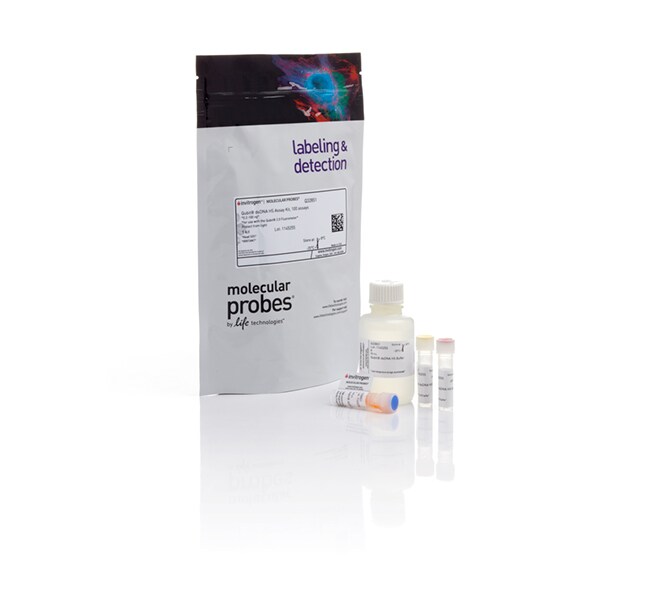
Kits de ensayos de ADNds Qubit™ de ensayo
Para la detección altamente selectiva de ADNbc sobre ARN, incluso en presencia de contaminantes. Los kits de ensayo de ADNbc de Qubit tienen una precisión de 10 pg/ul a 100 ng/ul y de 100 pg/ul a 1000 ng/ul, respectivamente.
Have Questions?
Cambiar vista

| Número de catálogo | Cantidad | ensayo | Intervalo de cuantificación |
|---|---|---|---|
| Q32851 | 100 ensayos | Cuantificación de ADNds, alta sensibilidad | 0,1-120 ng |
| Q32850 | 100 ensayos | Cuantificación de ADNds, rango amplio | De 4 a 2000 ng |
| Q32854 | 500 ensayos | Cuantificación de ADNds, alta sensibilidad | 0,1-120 ng |
| Q32853 | 500 ensayos | Cuantificación de ADNds, rango amplio | De 4 a 2000 ng |
Número de catálogo Q32851
Precio (CLP)
140.744
Each
Cantidad:
100 ensayos
ensayo:
Cuantificación de ADNds, alta sensibilidad
Intervalo de cuantificación:
0,1-120 ng
Precio (CLP)
140.744
Each
Obtenga una cuantificación exacta y precisa del ADNbc con los kits de ensayo Qubit de ADNbc HS (alta sensibilidad) y de ADNbc BR (gama amplia) de Qubit. Estos kits de cuantificación de ADNbc permiten la detección rápida y selectiva de muestras de ADN de baja y alta abundancia, y pueden distinguir ADNbc de ADNmc, ARN, proteínas y nucleótidos libres. Los contaminantes, como sales, disolventes o detergentes, se toleran bien.
Los kits de ensayos de ADNbc Qubit de ensayo BR y HS, diseñados para su uso con fluorímetros Qubit, son altamente selectivos para ADN bicatenario (ADNbc) sobre ADN monocatenario (ADNmc), ARN, proteínas y nucleótidos libres. Todos los kits proporcionan soluciones para el reactivo de ensayo concentrado, el tampón de dilución y los patrones de ADN prediluidos. Basta con diluir el reactivo mediante el tampón proporcionado, añadir la muestra (cualquier volumen entre 1 µl y 20 µl es aceptable) y leer la concentración con un fluorímetro de Qubit.
Kit de ensayos de ADNbc HS QBit
El kit de ensayos de ADNbc HS QBit (alta sensibilidad), cuando se utiliza con el fluorímetro QBit, proporciona un método preciso y selectivo para la cuantificación de muestras de ADN sensibles. Según el volumen de la muestra, el kit de ensayos está diseñado para ser exacto para concentraciones iniciales de muestras de ADN de 0,005 a 120 ng/µl, lo que proporciona un intervalo de detección de 0,1 a 120 ng.
Kit de ensayos de ADNbc BR de Qubit
El kit de ensayos de ADNbc BR de Qubit (gama amplia), cuando se utiliza con el fluorímetro de Qubit, proporciona un método preciso y selectivo para la cuantificación de muestras de ADN. Según el volumen de la muestra, el kit de ensayo está diseñado para ser exacto para concentraciones iniciales de muestras de ADN de 0,2 a 2000 ng/µl, lo que proporciona un intervalo de detección de 4 a 2000 ng.
Notas
• Los kits de ensayo Qubit dsDNA HS y BR se pueden utilizar con cualquier fluorímetro Qubit
• Utilícelo con tubos para PCR de pared fina, transparentes y 0,5 ml (n.º de referencia Q32856) para el fluorímetro Qubit 4 y las tiras de tubos de 8 x 200 µl (n.º de referencia Q33252) para el fluorímetro Qubit Flex
Kit de ensayos de ADNbc HS QBit
El kit de ensayos de ADNbc HS QBit (alta sensibilidad), cuando se utiliza con el fluorímetro QBit, proporciona un método preciso y selectivo para la cuantificación de muestras de ADN sensibles. Según el volumen de la muestra, el kit de ensayos está diseñado para ser exacto para concentraciones iniciales de muestras de ADN de 0,005 a 120 ng/µl, lo que proporciona un intervalo de detección de 0,1 a 120 ng.
Kit de ensayos de ADNbc BR de Qubit
El kit de ensayos de ADNbc BR de Qubit (gama amplia), cuando se utiliza con el fluorímetro de Qubit, proporciona un método preciso y selectivo para la cuantificación de muestras de ADN. Según el volumen de la muestra, el kit de ensayo está diseñado para ser exacto para concentraciones iniciales de muestras de ADN de 0,2 a 2000 ng/µl, lo que proporciona un intervalo de detección de 4 a 2000 ng.
Notas
• Los kits de ensayo Qubit dsDNA HS y BR se pueden utilizar con cualquier fluorímetro Qubit
• Utilícelo con tubos para PCR de pared fina, transparentes y 0,5 ml (n.º de referencia Q32856) para el fluorímetro Qubit 4 y las tiras de tubos de 8 x 200 µl (n.º de referencia Q33252) para el fluorímetro Qubit Flex
For Research Use Only. Not for use in diagnostic procedures.
Especificaciones
ensayoCuantificación de ADNds, alta sensibilidad
Excitación/emisión510/527
Para utilizar con (equipo)Fluorímetro Qubit
N.º de reacciones100 reacciones
Línea de productosQubit
Intervalo de cuantificación0,1-120 ng
Cantidad100 ensayos
Condiciones de envíoTemperatura ambiente
Método de detecciónFluorescencia
Unit SizeEach
Preguntas frecuentes
I'm seeing other kit-related problems besides the "Standards incorrect" message with my Qubit assay. What do you suggest I try?
The value is decreasing over time when using the Qubit Fluorometer. What could be causing this?
I'm trying to quantify some DNA labeled with a fluorophore. Will this work?
Does DNA length have an effect on the dsDNA assays?
What is the difference between the Quant-iT PicoGreen DNA, Quant-iT DNA, and Qubit DNA assays?
Citations & References (36)
Citations & References
Abstract
Tn5 transposase and tagmentation procedures for massively scaled sequencing projects.
Journal:Genome Res
PubMed ID:25079858
Massively parallel DNA sequencing of thousands of samples in a single machine-run is now possible, but the preparation of the individual sequencing libraries is expensive and time-consuming. Tagmentation-based library construction, using the Tn5 transposase, is efficient for generating sequencing libraries but currently relies on undisclosed reagents, which severely limits development
High transcript level of fatty acid-binding protein 11 but not of very low-density lipoprotein receptor is correlated to ovarian follicle atresia in a teleost fish (Solea senegalensis).
Journal:Biol Reprod
PubMed ID:17554079
'Transcripts encoding a fatty acid-binding protein (FABP), Fabp11, and two isoforms of very low-density lipoprotein receptor (Vldlr; vitellogenin receptor) were characterized from the ovary of Senegalese sole (Solea senegalensis). Phylogenetic analyses of vertebrate FABPs demonstrated that Senegalese sole Fabp11, as zebrafish (Danio rerio) homologous sequences, is part of a newly
[DNA extraction from coagulated human blood for application in genotyping techniques for human leukocyte antigen and immunoglobulin-like receptors].
Journal:Rev Soc Bras Med Trop
PubMed ID:20209349
'The objective of this study was to standardize a method for extracting high-quality DNA from samples of coagulated blood. Forty-eight samples of human coagulated blood were used for DNA extraction by means of the EZ-DNA commercial kit (Biological Industries, Beit Haemek, Israel), the Neoscience column kit (One Lambda Inc., San
Prevalence of Toxoplasma gondii infection in stray and household cats in regions of Seoul, Korea.
Journal:Korean J Parasitol
PubMed ID:20877509
'The principal objective of this study was to investigate the prevalence of toxoplasmosis in household and stray cats in Seoul, Republic of Korea. We collected blood samples from 72 stray and 80 household cats, and all samples were examined by ELISA and nested PCR. The overall positive rates of Toxoplasma
Detection of autotrophic verrucomicrobial methanotrophs in a geothermal environment using stable isotope probing.
Journal:Front Microbiol
PubMed ID:22912630
Genomic analysis of the methanotrophic verrucomicrobium