Search


Citas y referencias (22)
Invitrogen™
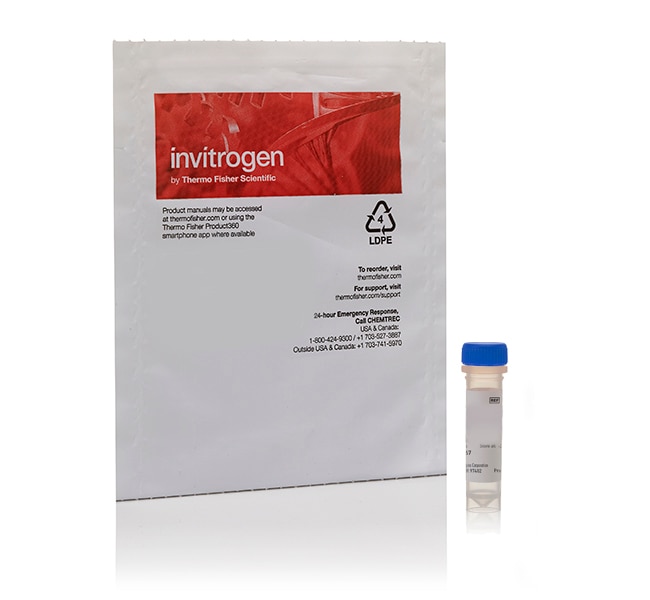
SYTO™ 17 Red Fluorescent Nucleic Acid Stain - 5 mM Solution in DMSO
Para uso con microscopía de fluorescencia
| Número de catálogo | Cantidad |
|---|---|
| S7579 | 250 μL |
Número de catálogo S7579
Precio (CLP)
409.711
Each
Cantidad:
250 μL
Precio (CLP)
409.711
Each
La tinción de ácido nucleico rojo fluorescente permeable en células SYTO 17 exhibe fluorescencia rojo brillante al enlazarse con los ácidos nucleicos. Debido a que el patrón de tinción de SYTO en las células vivas puede variar entre los diferentes tipos de células, ofrecemos el kit de muestreo para tinción de ácido nucleico rojo fluorescente SYTO (S-11340) para permitir a los investigadores encontrar el tinte más adecuado para su sistema.
Para uso exclusivo en investigación. No apto para uso en procedimientos diagnósticos.
Especificaciones
ColorRojo
DescripciónTinción de ácido nucleico SYTO™ 17 Red Fluorescent - Solución de 5 mm en DMSO
Método de detecciónFluorescente
Tipo de colorantePermeabilidad celular
Emisión634 nm
Intervalo de longitud de onda de excitación621 nm
Para utilizar con (equipo)Microscopio de fluorescencia
Línea de productosSYTO
Cantidad250 μL
Condiciones de envíoTemperatura ambiente
Volumen (métrico)250 μl
Tipo de etiquetaFluorescente
Tipo de productoTinción de ácidos nucleicos
Sub Cellular LocalizationÁcidos nucleicos
Unit SizeEach
Contenido y almacenamiento
Almacenar en el congelador de -5 °C a -30 °C y proteger de la luz.
Preguntas frecuentes
How do SYTO dyes bind to DNA?
Citations & References (22)
Citations & References
Abstract
Multiparameter detection of apoptosis using red-excitable SYTO probes.
Journal:Cytometry A
PubMed ID:18431792
'Functional assays allowing phenotypic characterization of different cell death parameters at a single-cell level are important tools for preclinical anticancer drug screening. Currently, the selection of cytometric assays is limited by the availability of fluorescent probes with overlapping spectral characteristics. Following on our earlier reports on green and orange fluorescent
Liver fatty acid-binding protein colocalizes with peroxisome proliferator activated receptor alpha and enhances ligand distribution to nuclei of living cells.
Journal:Biochemistry
PubMed ID:14992586
'Although it is hypothesized that long-chain fatty acyl CoAs (LCFA-CoAs) and long-chain fatty acids (LCFAs) regulate transcription in the nucleus, little is known regarding factors that determine the distribution of these ligands to nuclei of living cells. Immunofluorescence colocalization showed that liver fatty acid-binding protein (L-FABP; binds LCFA-CoA as well
Confocal laser scanning microscopy of urinary bladder after intravesical instillation of a fluorescent dye.
Journal:Urology
PubMed ID:12837458
'OBJECTIVES: To assess the potential of confocal laser scanning microscopy for imaging of the urinary bladder after intravesical instillation of a fluorescent dye. METHODS: The study was performed on the bladder of male Copenhagen rats. For confocal fluorescence microscopy (CFM), a standard confocal laser scanning microscope (Zeiss LSM 410) was
Induction of DNA damage response by the supravital probes of nucleic acids.
Journal:Cytometry A
PubMed ID:19373929
'The aim of this study was to assess the potential DNA damage response (DDR) to four supravitally used biomarkers Hoechst 33342 (Ho 42), DRAQ5, DyeCycle Violet (DCV), and SYTO 17. A549 cells were exposed to these biomarkers at concentrations generally applied to live cells and their effect on histone H2AX
Fiber cell denucleation in the primate lens.
Journal:Invest Ophthalmol Vis Sci
PubMed ID:9286256
'PURPOSE: To determine the morphologic and biochemical events preceding the breakdown of fiber cell nuclei in the primate lens. METHODS: Monkey lens slices were labeled with fluorescent probes and optically sectioned using a confocal microscope. The distribution of nuclear histones was visualized by immunofluorescence. DNA and cellular membranes were imaged