Search
 Elementsuche
 Struktursuche


Thermo Scientific Chemicals
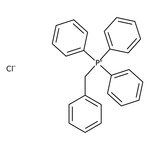
Benzyltriphenylphosphoniumchlorid, 99 %, Thermo Scientific Chemicals
CAS: 1100-88-5 | C25H22ClP | 388.87 g/mol
Have Questions?
Ansicht ändern


Katalognummer A14034.22
auch als A14034-22 bezeichnet
Preis (EUR)
91,70
Each
Menge:
100 g
Preis (EUR)
91,70
Each
Chemikalien-Kennzeichnungen
CAS1100-88-5
IUPAC Namebenzyltriphenylphosphanium chloride
Molecular FormulaC25H22ClP
InChI KeyUSFRYJRPHFMVBZ-UHFFFAOYSA-M
SMILES[Cl-].C(C1=CC=CC=C1)[P+](C1=CC=CC=C1)(C1=CC=CC=C1)C1=CC=CC=C1
Mehr anzeigen
Specifications Datenblatt
DatenblattAppearance (Color)White
FormPowder
Assay (Titration ex Chloride)≥98.5 to ≤101.5%
Water Content (Karl Fischer Titration)≤0.5%
Melting Point>300?C
Mehr anzeigen
Benzyltriphenylphosphonium chloride is used as the accelerator of the Bisphenol AF curing system for fluoroelastomer. Also used as phase-transfer catalysts in the synthesis of certain organic compounds. It is used as a reactant for the synthesis of chemical compounds.
This Thermo Scientific Chemicals brand product was originally part of the Alfa Aesar product portfolio. Some documentation and label information may refer to the legacy brand. The original Alfa Aesar product / item code or SKU reference has not changed as a part of the brand transition to Thermo Scientific Chemicals.
Anwendungen
Benzyltriphenylphosphoniumchlorid wird als Beschleuniger des Bisphenol-AF-Aushärtungssystems für Fluorelastomere verwendet. Wird auch als Phasentransfer-Katalysator bei der Synthese bestimmter organischer Verbindungen verwendet. Es wird als Reaktant für die Synthese chemischer Verbindungen verwendet.
Löslichkeit
Löslich in Wasser und Alkohol. Unlöslich in Aceton.
Hinweise
Hygroskopisch. Unter inertem Gas lagern. Nicht in der Nähe von starken Oxidationsmitteln, Wasser/Feuchtigkeit lagern.
Benzyltriphenylphosphoniumchlorid wird als Beschleuniger des Bisphenol-AF-Aushärtungssystems für Fluorelastomere verwendet. Wird auch als Phasentransfer-Katalysator bei der Synthese bestimmter organischer Verbindungen verwendet. Es wird als Reaktant für die Synthese chemischer Verbindungen verwendet.
Löslichkeit
Löslich in Wasser und Alkohol. Unlöslich in Aceton.
Hinweise
Hygroskopisch. Unter inertem Gas lagern. Nicht in der Nähe von starken Oxidationsmitteln, Wasser/Feuchtigkeit lagern.
RUO – Research Use Only
Allgemeine Referenzen:
- James McNulty; David McLeod. Amine- and sulfonamide-promoted Wittig olefination reactions in water. Chemistry: A European Journal. 2011, 17 (32), 8794-8798.
- G.I Mukhayer; S.S Davis. Interactions between large organic ions of opposite charge: VI. Coacervation in mixtures of sodium dodecyl sulfate and benzyltriphenylphosphonium chloride. Journal of Colloid and Interface Science. 1978, 66 (1), 110-117.
- Die Wittig-Olefination mit Carbonylverbindungen kann unter grundlegenden, 2-phasigen Bedingungen durchgeführt werden; das Phosphoniumsalz fungiert als eigener Phasentransferkatalysator: Synthesis, 295 (1973). Siehe auch Anhang 1.
- Benzyliden-Triphenylphosphorane (gebildet mit n-BuLi) werden durch Reaktion mit Schwefel gekoppelt, um Stilbene zu ergeben, wobei Triphenylphosphinsulfid eliminiert wird: Chem. Ber., 103, 2995 (1970).