Search
 Elementsuche
 Struktursuche




Thermo Scientific Chemicals
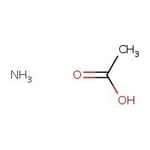
Ammoniumacetat, 97 %, Thermo Scientific Chemicals
CAS: 631-61-8 | C2H7NO2 | 77.083 g/mol
Have Questions?
Ansicht ändern


Katalognummer A16343.30
auch als A16343-30 bezeichnet
Preis (EUR)
26,50
Each
Menge:
250 g
Preis (EUR)
26,50
Each
Chemikalien-Kennzeichnungen
CAS631-61-8
IUPAC Nameammonium acetate
Molecular FormulaC2H7NO2
InChI KeyUSFZMSVCRYTOJT-UHFFFAOYSA-N
SMILES[NH4+].CC([O-])=O
Mehr anzeigen
Specifications Datenblatt
FormCrystals or powder or crystalline powder
Identification (FTIR)Conforms
Assay from Supplier's CofAAmmonia as ammonium acetate: ≥96.0% to ≤104.0%
Water Content (Karl Fischer Titration)≤5.0%
Appearance (Color)White
Ammonium acetate is widely utilized as a catalyst in the Knoevenagel condensation. It is the primary source of ammonia in the Borch reaction in organic synthesis. It is used with distilled water to make a protein precipitating reagent. It acts as a buffer for electrospray ionization (ESI) mass spectrometry of proteins and other molecules and as mobile phases for high performance liquid chromatography (HPLC). Sometimes, it is used as a biodegradable de-icing agent and an acidity regulator in food additives.
This Thermo Scientific Chemicals brand product was originally part of the Alfa Aesar product portfolio. Some documentation and label information may refer to the legacy brand. The original Alfa Aesar product / item code or SKU reference has not changed as a part of the brand transition to Thermo Scientific Chemicals.
Anwendungen
Ammoniumacetat wird häufig als Katalysator bei der Knoevenagel-Kondensation verwendet. Ist die primäre Ammoniakquelle in der Borch-Reaktion in der organischen Synthese. Wird mit destilliertem Wasser verwendet, um ein Proteinfällungsreagenz zu bilden. Dient als Puffer für die Elektrospray-Ionisation (ESI)-Massenspektronomie von Proteinen und anderen Molekülen und als mobile Phasen für die Hochleistungsflüssigchromatographie (HPLC). Wird manchmal als biologisch abbaubares Enteisungsmittel und als Säureregler in Lebensmittelzusatzstoffen verwendet.
Löslichkeit
Löslich in Wasser, Methanol, Aceton und flüssigem Ammoniak.
Hinweise
Hygroskopisch. Nicht kompatibel mit starken Oxidationsmitteln und starken Säuren.
RUO – Research Use Only
Allgemeine Referenzen:
- Xia, S.; Zhang, H. Density Functional Theory Study of Selective Deacylation of Aromatic Acetate in the Presence of Aliphatic Acetate under Ammonium Acetate Mediated Conditions. J. Org. Chem. 2014, 79 (13), 6135-6142.
- Zhang, J.; Yao, J.; Liu, J.; Xue, S.; Li, Y.; Wang, C. Four-component reaction between naphthols, substituted β-nitrostyrenes, substituted benzaldehydes and ammonium acetate in water-PEG-400: an approach to construct polysubstituted naphthofuranamines. RSC Adv. 2015, 5 (60), 48580-48585.