Search
 Element Search
 Structure Search


Thermo Scientific Chemicals
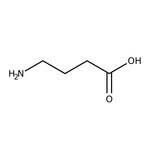
4-Aminobutyric acid, 99+%
4-Aminobutyric acid, 99+%, CAS # 56-12-2, also known as γ-Aminobutyric acid, is an amino acid that shows inhibitory activities against neurotransmitters, including GABA. | CAS: 56-12-2 | C4H9NO2 | 103.12 g/mol
Have Questions?
Change view


Catalog number 103285000
Price (EUR)
174,65
キャンペーン価格
194,00Save 19,35 (10%)
Each
Quantity:
500 g
Packaging:
Plastic Bottle
Price (EUR)
174,65
キャンペーン価格
194,00Save 19,35 (10%)
Each
Chemical Identifiers
CAS56-12-2
IUPAC Name4-aminobutanoic acid
Molecular FormulaC4H9NO2
InChI KeyBTCSSZJGUNDROE-UHFFFAOYSA-N
SMILESNCCCC(O)=O
View more
Specifications Specification Sheet
Specification SheetLoss on drying=<0.5 %
Heavy metals (as Pb)=<10 ppm
Sulfate (SO4)=<500 ppm
Appearance (Color)White to off-white
Appearance (Form)Crystalline powder
View more
This Thermo Scientific Chemicals brand product was originally part of the Acros Organics product portfolio. Some documentation and label information may refer to the legacy brand. The original Acros Organics product / item code or SKU reference has not changed as a part of the brand transition to Thermo Scientific Chemicals.
General Description
• 4-Aminobutyric acid is a γ-amino acid and monocarboxylic acid derived from butyric acid
• It is an amino acid that shows inhibitory activities against neurotransmitters, including GABA, and acts by binding GABA-A receptor and inhibiting the activity of signal-receiving neurons
• This compound, converted from neurotransmitter glutamate, is essential to regulate neuronal excitability
• It binds to GABA-A and GABA-B receptors, causing ion channel opening, hyperpolarization, and eventually inhibition of neurotransmission
Applications
• 4-Aminobutyric acid has been used in the preparation of GABA–BSA (bovine serum albumin)–GA (glutaraldehyde) conjugate, which is used as a control for immunohistochemical experiments
• It is used, in vivo, to detect GABA neurotransmitter by magnetic resonance spectroscopy
• This compound increases the production of short-chain fatty acids and decreases pH values in mouse colon
• Some in vivo experiments, using rats, mice, and pigs, demonstrated that 4-Aminobutyric acid can modulate intestinal fluid secretion, blood flow and ulceration
RUO – Research Use Only
General References:
- Mihic, S.; Harris, R. GABA and the GABAA receptor. Alcohol Health Res World. 1997, 21 (2), 127-31.
- Meyer, K.H.; Behringer, D.M.; Veh, R.W. Antibodies against neuroactive amino acids and neuropeptides. I. A new two-step procedure for their conjugation to carrier proteins and the production of an anti-Met-enkephalin antibody reactive with glutaraldehyde-fixed tissues. J Histochem Cytochem. 1991, 39, (6), 749-760.
- Puts, N.A.; Edden, R.A. In vivo magnetic resonance spectroscopy of GABA: a methodological review. Prog Nucl Magn Reson Spectrosc. 2012, 60, 29-41.
- Li, Y.; Xiang, Y.Y.; Lu, W.Y.; Liu, C.; Li, J. A novel role of intestine epithelial GABAergic signaling in regulating intestinal fluid secretion. Am J Physiol Gastrointest Liver Physiol. 2012, 303, (4), G453-460.