Search
 Element Search
 Structure Search
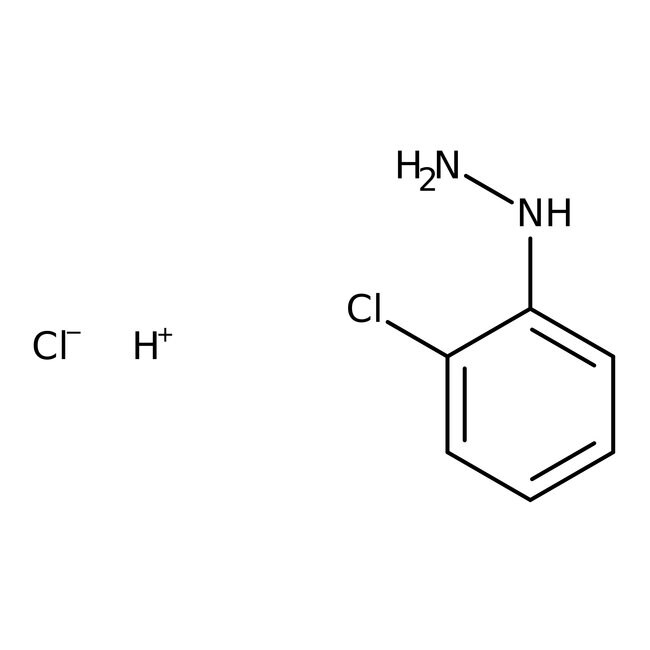

Thermo Scientific Chemicals
2-Chlorophenylhydrazine hydrochloride, 97%
CAS: 41052-75-9 | C6H8Cl2N2 | 179.04 g/mol
Have Questions?
Change view




Catalog number A14136.14
also known as A14136-14
Price (EUR)
89,00
Each
Quantity:
25 g
Price (EUR)
89,00
Each
Chemical Identifiers
CAS41052-75-9
Specifications Specification Sheet
Specification SheetAppearance (Color)White to cream to pale brown
FormCrystals or powder or crystalline powder
Assay (Titration ex Chloride)≥96.0 to ≤104.0%
Assay (Freebase GC)≥96.0%
2-Chlorophenylhydrazine hydrochloride is used to study intrinsic resistance of Mycobacterium smegmatis to fluoroquinolones, used for treatment of Mycobacterium tuberculosis. It may be used in pyrazoline synthesis. It can be used to produce N-azepan-2-ylidene-N'-(2-chloro-phenyl)-hydrazine with 7-methoxy-3,4,5,6-tetrahydro-2H-azepine at heating.
This Thermo Scientific Chemicals brand product was originally part of the Alfa Aesar product portfolio. Some documentation and label information may refer to the legacy brand. The original Alfa Aesar product / item code or SKU reference has not changed as a part of the brand transition to Thermo Scientific Chemicals.
Applications
2-Chlorophenylhydrazine hydrochloride is used to study intrinsic resistance of Mycobacterium smegmatis to fluoroquinolones, used for treatment of Mycobacterium tuberculosis. It may be used in pyrazoline synthesis. It can be used to produce N-azepan-2-ylidene-N′-(2-chloro-phenyl)-hydrazine with 7-methoxy-3,4,5,6-tetrahydro-2H-azepine at heating.
Solubility
Soluble in water.
Notes
Store away from oxidizing agents. Store in a cool, dry conditions in a well sealed container.
2-Chlorophenylhydrazine hydrochloride is used to study intrinsic resistance of Mycobacterium smegmatis to fluoroquinolones, used for treatment of Mycobacterium tuberculosis. It may be used in pyrazoline synthesis. It can be used to produce N-azepan-2-ylidene-N′-(2-chloro-phenyl)-hydrazine with 7-methoxy-3,4,5,6-tetrahydro-2H-azepine at heating.
Solubility
Soluble in water.
Notes
Store away from oxidizing agents. Store in a cool, dry conditions in a well sealed container.
RUO – Research Use Only
C Montero; G Mateu; R Rodriguez; H Takiff. Intrinsic resistance of Mycobacterium smegmatis to fluoroquinolones may be influenced by new pentapeptide protein MfpA. Antimicrobial Agents and Chemotherapy. 2001, 45 (12), 3387-3392.