Search
 Element Search
 Structure Search


Thermo Scientific Chemicals
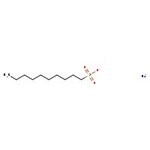
Sodium 1-decanesulfonate, 99%
CAS: 13419-61-9 | C10H21NaO3S | 244.325 g/mol
Have Questions?
Change view


Catalog number A14638.22
also known as A14638-22
Price (EUR)
536,65
Online Exclusive
596,00Save 59,35 (10%)
Each
Quantity:
100 g
Price (EUR)
536,65
Online Exclusive
596,00Save 59,35 (10%)
Each
Chemical Identifiers
CAS13419-61-9
IUPAC Namesodium decane-1-sulfonate
Molecular FormulaC10H21NaO3S
InChI KeyAIMUHNZKNFEZSN-UHFFFAOYSA-M
SMILES[Na+].CCCCCCCCCCS([O-])(=O)=O
View more
Specifications Specification Sheet
Specification SheetAppearance (Color)White
Assay (ex Sulphated Ash)≥98.5 to ≤101.5%
Identification (FTIR)Conforms
Loss on Drying≤1.5% (105?C/constant wt.)
FormPowder
Ion-associating reagent for HPLC, useful for analysis of peptides and proteins.Sodium 1-decanesulfonate is used as a base in coupling reactions such as Suzuki coupling. It is used as an ion-associating reagent for HPLC and involved in the analysis of peptides and proteins. It is used to study the mechanism of guanidine compounds on a porous graphite carbon and electro reduction of Zn2+ ions.
This Thermo Scientific Chemicals brand product was originally part of the Alfa Aesar product portfolio. Some documentation and label information may refer to the legacy brand. The original Alfa Aesar product / item code or SKU reference has not changed as a part of the brand transition to Thermo Scientific Chemicals.
Applications
Ion-associating reagent for HPLC, useful for analysis of peptides and proteins.Sodium 1-decanesulfonate is used as a base in coupling reactions such as Suzuki coupling. It is used as an ion-associating reagent for HPLC and involved in the analysis of peptides and proteins. It is used to study the mechanism of guanidine compounds on a porous graphite carbon and electro reduction of Zn2+ ions.
Solubility
Soluble in water.
Notes
Hygroscopic. Incompatible with strong oxidizing agents.
Ion-associating reagent for HPLC, useful for analysis of peptides and proteins.Sodium 1-decanesulfonate is used as a base in coupling reactions such as Suzuki coupling. It is used as an ion-associating reagent for HPLC and involved in the analysis of peptides and proteins. It is used to study the mechanism of guanidine compounds on a porous graphite carbon and electro reduction of Zn2+ ions.
Solubility
Soluble in water.
Notes
Hygroscopic. Incompatible with strong oxidizing agents.
RUO – Research Use Only
General References:
- Postenyi, Z.; Tekes, K.; Toth-Molnar, E.; Kalasz, H. HPLC analysis of blood-brain barrier penetration of 4-fluorodeprenyl. J. Pharm. Biomed. Anal. 2015, 102, 529-534.
- Kovalchuk, N. M.; Barton, A.; Trybala, A.; Starov, V. Mixtures of catanionic surfactants can be superspreaders: Comparison with trisiloxane superspreader. J. Colloid Interface Sci. 2015, 459, 250-256.