Search
 Element Search
 Structure Search


Thermo Scientific Chemicals
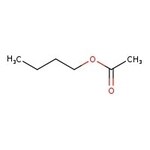
n-Butyl acetate, 99+%
CAS: 123-86-4 | C6H12O2 | 116.16 g/mol
Have Questions?
Change view




Catalog number A19412.0F
also known as A19412-0F
Price (EUR)
49,65
Online exclusive
55,50Save 5,85 (11%)
Each
Quantity:
2500 mL
Price (EUR)
49,65
Online exclusive
55,50Save 5,85 (11%)
Each
Chemical Identifiers
CAS123-86-4
IUPAC Namebutyl acetate
Molecular FormulaC6H12O2
InChI KeyDKPFZGUDAPQIHT-UHFFFAOYSA-N
SMILESCCCCOC(C)=O
View more
Specifications Specification Sheet
Specification SheetAssay (GC)≥99.0%
Appearance (Color)Clear colorless
Identification (FTIR)Conforms
FormLiquid
Refractive Index1.3930 -1.3960 @ 20?C
n-Butyl acetate is widely used as a solvent for cellulose nitrate, resins, polymers, oils and fats. It is used in paints, coatings, printing inks, aerosol sprays and cosmetics. It is used as a synthetic fruit flavoring agent in foods like candy, ice cream, cheeses and baked food items. In pharmaceutical and petroleum industries, it is used for extraction and as a processing solvent. It is an ingredient of cleaners, essences and fragrances. It is used as an analytical reagent to verify thalium, stannum and tungsten as well as in the determination of molybdenum and rhenium.
This Thermo Scientific Chemicals brand product was originally part of the Alfa Aesar product portfolio. Some documentation and label information may refer to the legacy brand. The original Alfa Aesar product / item code or SKU reference has not changed as a part of the brand transition to Thermo Scientific Chemicals.
Applications
n-Butyl acetate is widely used as a solvent for cellulose nitrate, resins, polymers, oils and fats. It is used in paints, coatings, printing inks, aerosol sprays and cosmetics. It is used as a synthetic fruit flavoring agent in foods like candy, ice cream, cheeses and baked food items. In pharmaceutical and petroleum industries, it is used for extraction and as a processing solvent. It is an ingredient of cleaners, essences and fragrances. It is used as an analytical reagent to verify thalium, stannum and tungsten as well as in the determination of molybdenum and rhenium.
Solubility
Miscible with ethanol, ethyl ether, alcohol, acetone, chloroform and most hydrocarbons. Slightly miscible with water.
Notes
Incompatible with strong oxidizing agents, strong reducing agents and strong bases.
n-Butyl acetate is widely used as a solvent for cellulose nitrate, resins, polymers, oils and fats. It is used in paints, coatings, printing inks, aerosol sprays and cosmetics. It is used as a synthetic fruit flavoring agent in foods like candy, ice cream, cheeses and baked food items. In pharmaceutical and petroleum industries, it is used for extraction and as a processing solvent. It is an ingredient of cleaners, essences and fragrances. It is used as an analytical reagent to verify thalium, stannum and tungsten as well as in the determination of molybdenum and rhenium.
Solubility
Miscible with ethanol, ethyl ether, alcohol, acetone, chloroform and most hydrocarbons. Slightly miscible with water.
Notes
Incompatible with strong oxidizing agents, strong reducing agents and strong bases.
RUO – Research Use Only
General References:
- Luis, P.; Van der Bruggen, B. The driving force as key element to evaluate the pervaporation performance of multicomponent mixtures. Sep. Purif. Technol. 2015, 148, 94-102.
- Mochalski, P.; Theurl, M.; Sponring, A.; Unterkofler, K.; Kirchmair, R.; Amann, A. Analysis of Volatile Organic Compounds Liberated and Metabolised by Human Umbilical Vein Endothelial Cells (HUVEC) In Vitro. Cell Biochem. Biophys. 2015, 71 (1), 323-329.