Search


Citations & References (7)
Invitrogen™
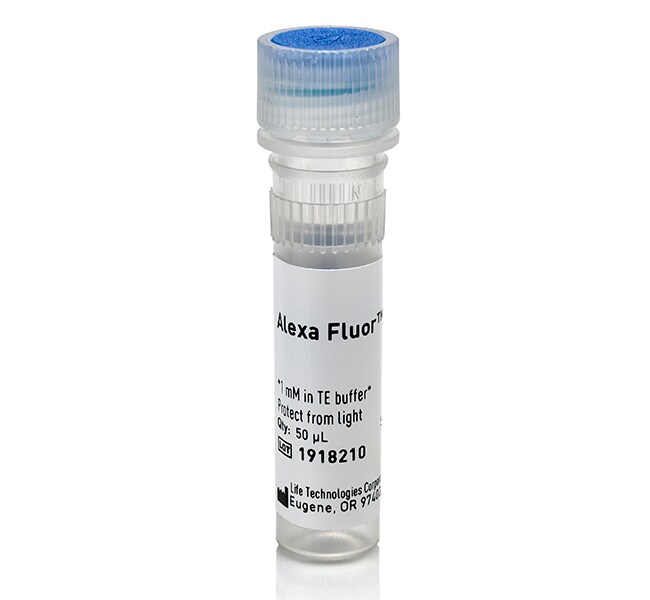
Alexa Fluor™ 647-aha-dUTP, 1 mM in TE buffer
Labeled 5-aminohexylacrylamido-dUTP (aha-dUTP) nucleotides are modified at the C-5 position of uridine with a unique hexylacrylamide linker, which serves asRead more
| Catalog Number | Quantity |
|---|---|
| A32763 | 50 μL |
Catalog number A32763
Price (EUR)
1.286,00
Each
Quantity:
50 μL
Price (EUR)
1.286,00
Each
Labeled 5-aminohexylacrylamido-dUTP (aha-dUTP) nucleotides are modified at the C-5 position of uridine with a unique hexylacrylamide linker, which serves as a spacer between the nucleotide and the dye. This spacer reduces interactions between the nucleotide and the dye, resulting in brighter conjugates and increased hapten accessibility for secondary detection reagents. Labeled nucleotides can be used to generate labeled nucleic acid hybridization probes for many molecular biology and molecular cytogenetics applications, including multicolor techniques.
For Research Use Only. Not for use in diagnostic procedures.
Specifications
Concentration1 mM
For Use With (Application)Molecular Biology
Label or DyeAlexa Fluor Dye
ModificationAHA (5-aminohexylacrylamido)
Product LineAlexa Fluor
Product TypeLabeled Nucleotide
Quantity50 μL
Shipping ConditionWet Ice
Unit SizeEach
Contents & Storage
Store in freezer (-5 to -30°C) and protect from light.
Frequently asked questions (FAQs)
Can dU-containing DNA produced by amplification with dUTP be cut by restriction enzymes?
Citations & References (7)
Citations & References
Abstract
A single-molecule barcoding system using nanoslits for DNA analysis.
Journal:Proc Natl Acad Sci U S A
PubMed ID:17296933
'Molecular confinement offers new routes for arraying large DNA molecules, enabling single-molecule schemes aimed at the acquisition of sequence information. Such schemes can rapidly advance to become platforms capable of genome analysis if elements of a nascent system can be integrated at an early stage of development. Integrated strategies are
VHL inactivation is an important pathway for the development of malignant sporadic pancreatic endocrine tumors.
Journal:Endocr Relat Cancer
PubMed ID:19690016
'A small subset of familial pancreatic endocrine tumors (PET) arises in patients with von Hippel-Lindau syndrome and these tumors may have an adverse outcome compared to other familial PET. Sporadic PET rarely harbors somatic VHL mutations, but the chromosomal location of the VHL gene is frequently deleted in sporadic PET.
Transcriptome for photobiological hydrogen production induced by sulfur deprivation in the green alga Chlamydomonas reinhardtii.
Journal:Eukaryot Cell
PubMed ID:18708561
'Photobiological hydrogen production using microalgae is being developed into a promising clean fuel stream for the future. In this study, microarray analyses were used to obtain global expression profiles of mRNA abundance in the green alga Chlamydomonas reinhardtii at different time points before the onset and during the course of
RNA expression profiling at the single molecule level.
Journal:Genome Res
PubMed ID:16809670
We developed a microarray platform for PCR amplification-independent expression profiling of minute samples. A novel scanning system combined with specialized biochips enables detection down to individual fluorescent oligonucleotide molecules specifically hybridized to their complementary sequence over the entire biochip surface of cm2 size. A detection limit of 1.3 fM target
Transcriptomic signatures of alterations in a myoblast cell line infected with four distinct strains of Trypanosoma cruzi.
Journal:Am J Trop Med Hyg
PubMed ID:20439965
We examined the extent to which different Trypanosoma cruzi strains induce transcriptomic changes in cultured L(6)E(9) myoblasts 72 hours after infection with Brazil (TC I), Y (TC II), CL (TC II), and Tulahuen (TC II) strains. Expression of 6,289 distinct, fully annotated unigenes was quantified with 27,000 rat oligonucleotide arrays