Search
 Element Search
 Structure Search


Thermo Scientific Chemicals
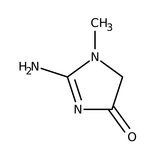
Creatinine, 98%
CAS: 60-27-5 | C4H7N3O | 113.12 g/mol
Have Questions?
Change view


Price (EUR)
27,30
Each
Chemical Identifiers
CAS60-27-5
IUPAC Name2-amino-1-methyl-4,5-dihydro-1H-imidazol-4-one
Molecular FormulaC4H7N3O
InChI KeyDDRJAANPRJIHGJ-UHFFFAOYSA-N
SMILESCN1CC(=O)N=C1N
View more
Specifications Specification Sheet
Specification SheetAssay (Non-aqueous acid-base Titration)≥97.5 to ≤102.5%
Identification (FTIR)Conforms
Appearance (Color)White
FormCrystals or powder or crystalline powder
Creatinine levels in blood and urine may be used to calculate the creatinine clearance (CrCl), which reflects the glomerular filtration rate (GFR), an important clinical index of renal function. It is a substrate for creatininase.
This Thermo Scientific Chemicals brand product was originally part of the Alfa Aesar product portfolio. Some documentation and label information may refer to the legacy brand. The original Alfa Aesar product / item code or SKU reference has not changed as a part of the brand transition to Thermo Scientific Chemicals.
Applications
Creatinine levels in blood and urine may be used to calculate the creatinine clearance (CrCl), which reflects the glomerular filtration rate (GFR), an important clinical index of renal function. It is a substrate for creatininase.
Solubility
Soluble in water (90 mg/ml at 20°C), alcohol (slightly), and ethanol (slightly). Insoluble in acetone, and chloroform.
Notes
Store in a cool, dry conditions, in well sealed conditions. Store away from oxidizing agents.
Creatinine levels in blood and urine may be used to calculate the creatinine clearance (CrCl), which reflects the glomerular filtration rate (GFR), an important clinical index of renal function. It is a substrate for creatininase.
Solubility
Soluble in water (90 mg/ml at 20°C), alcohol (slightly), and ethanol (slightly). Insoluble in acetone, and chloroform.
Notes
Store in a cool, dry conditions, in well sealed conditions. Store away from oxidizing agents.
RUO – Research Use Only
General References:
- Cockcroft D.W.; Gault M.H. Prediction of Creatinine Clearance from Serum Creatinine. Nephron. 1976, 17, 31-41.
- Schwartz GJ; Brion LP; Spitzer A. The use of plasma creatinine concentration for estimating glomerular filtration rate in infants, children, and adolescents. Europe PMC. 1987, 34 (3), 571-590.
- Reacts with aromatic aldehydes in a route to derivatives of N-methylphenylalanine: Org. Synth. Coll., 3, 586 (1955):