Search


Citations & References (9)
Invitrogen™
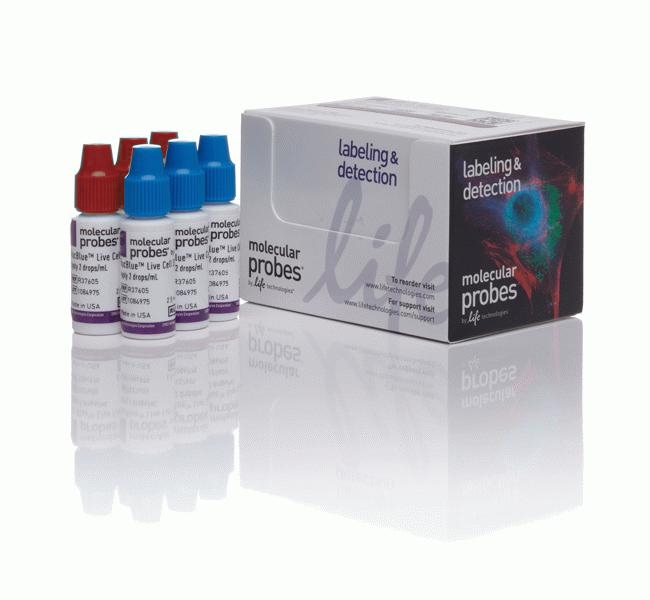
ReadyProbes™ Cell Viability Imaging Kit, Blue/Red
ReadyProbes® Cell Viability Imaging Kit (Blue/Red) is a ready-to-use kit that can quickly and easily determine the viability of cells.Read more
| Catalog Number | Quantity |
|---|---|
| R37610 | 1 kit |
Catalog number R37610
Price (EUR)
343,65
Online exclusive
374,00Save 30,35
Each
Quantity:
1 kit
Price (EUR)
343,65
Online exclusive
374,00Save 30,35
Each
ReadyProbes® Cell Viability Imaging Kit (Blue/Red) is a ready-to-use kit that can quickly and easily determine the viability of cells. Just add 2 drops each of room temperature, stable NucBlue® Live reagent (Hoechst 33342) and propidium iodide to 1 mL of cell growth media, then determine viability by counting total vs dead cells. NucBlue® Live reagent stains the nuclei of all the cells and can be detected using a standard DAPI filter. Propidium iodide stains only the nuclei of cells with compromised plasma membrane integrity and is detected with a standard TRITC/RFP (orange) filter set. This kit is appropriate for fluorescence microscopy, fluorescence micro plate readers, and flow cytometry.
NucBlue® Live reagent: stains the nuclei of all cells; detected with a standard DAPI filter (excitation/emission maxima: 360/460 nm)
Propidium iodide: stains the nuclei of dead cells with compromised plasma membrane; detected with standard TRITC/RFP (orange) filter set (excitation/emission maxima: 535/617 nm)
See other ReadyProbes® reagents for cell staining
Learn more about other assays for cell viability
Suggestions for use
• NucBlue® Live reagent and propidium iodide can be added directly to cells in full growth media or a compatible buffer solution.
• In most cases, 2 drops/mL and an incubation time of 5 to 30 minutes will give bright nuclear staining; however, optimization may be needed for some cell types, conditions, and applications. In such cases, simply add more or fewer drops until the optimal staining intensity is obtained.
NucBlue® Live reagent: stains the nuclei of all cells; detected with a standard DAPI filter (excitation/emission maxima: 360/460 nm)
Propidium iodide: stains the nuclei of dead cells with compromised plasma membrane; detected with standard TRITC/RFP (orange) filter set (excitation/emission maxima: 535/617 nm)
See other ReadyProbes® reagents for cell staining
Learn more about other assays for cell viability
Suggestions for use
• NucBlue® Live reagent and propidium iodide can be added directly to cells in full growth media or a compatible buffer solution.
• In most cases, 2 drops/mL and an incubation time of 5 to 30 minutes will give bright nuclear staining; however, optimization may be needed for some cell types, conditions, and applications. In such cases, simply add more or fewer drops until the optimal staining intensity is obtained.
For Research Use Only. Not for use in diagnostic procedures.
Specifications
Cell TypeMammalian Cells, Eukaryotic Cells
DescriptionReadyProbes Cell Viability Imaging Kit, Blue/Red
Detection MethodFluorescence
Dye Type3 x 2.5 mL NucBlue™ Live; 3 x 2.5 mL propidium iodide
Emission Wavelength460/617
Excitation Wavelength360, 535 nm
FormatDropper bottles
Quantity1 kit
Shipping ConditionRoom Temperature
ColorBlue, Red
For Use With (Application)Viability Assay
For Use With (Equipment)Fluorescence Microscope
Product LineReadyProbes
Product TypeCell Viability Imaging Kit
Unit SizeEach
Contents & Storage
Store at 2° to 8°C, or at room temperature.
Frequently asked questions (FAQs)
Can I use the ReadyProbes reagents for flow cytometry?
Citations & References (9)
Citations & References
Abstract
miR-204-5p and miR-3065-5p exert antitumor effects on melanoma cells.
Journal:Oncol Lett
PubMed ID:29844810
'MicroRNA (miR)-204-5p was previously identified to be downregulated in melanoma compared with melanocytic nevi. This observation prompted a functional study on miR-204-5p and the newly-identified miR-3065-5p, two miRNAs suggested to be tumor-suppressive oncomiRs. Application of miR-204-5p mimics or inhibitors resulted in a decrease or increase, respectively, in melanoma cell proliferation
Notch3 is involved in adipogenesis of human adipose-derived stromal/stem cells.
Journal:Biochimie
PubMed ID:29709509
'Human adipose-derived stromal/stem cells (hASCs) have tremendous therapeutic potential and the ability to offer insight into human development and disease. Here we subject human ASCs to siRNA-mediated knockdown of Notch3 cultured under both self-renewing and adipogenic differentiation conditions. Self-renewal was monitored by assessing viability and proliferation rates through staining and
Schrödinger's microbes: Tools for distinguishing the living from the dead in microbial ecosystems.
Journal:Microbiome
PubMed ID:28810907
'While often obvious for macroscopic organisms, determining whether a microbe is dead or alive is fraught with complications. Fields such as microbial ecology, environmental health, and medical microbiology each determine how best to assess which members of the microbial community are alive, according to their respective scientific and/or regulatory needs.
High-throughput chromatin accessibility profiling at single-cell resolution.
Journal:Nat Commun
PubMed ID:30194434
'Here we develop a high-throughput single-cell ATAC-seq (assay for transposition of accessible chromatin) method to measure physical access to DNA in whole cells. Our approach integrates fluorescence imaging and addressable reagent deposition across a massively parallel (5184) nano-well array, yielding a nearly 20-fold improvement in throughput (up to ~1800 cells/chip,
Beneficial effects of mesenchymal stem cells on adult porcine cardiomyocytes in non-contact co-culture.
Journal:Physiol Res
PubMed ID:30607969
'Mesenchymal stem cells (MSCs) have been reported to improve survival of cardiomyocytes (CMCs) and overall regeneration of cardiac tissue. Despite promising preclinical results, interactions of MSCs and CMCs, both direct and indirect, remain unclear. In this study, porcine bone marrow MSCs and freshly isolated porcine primary adult CMCs were used