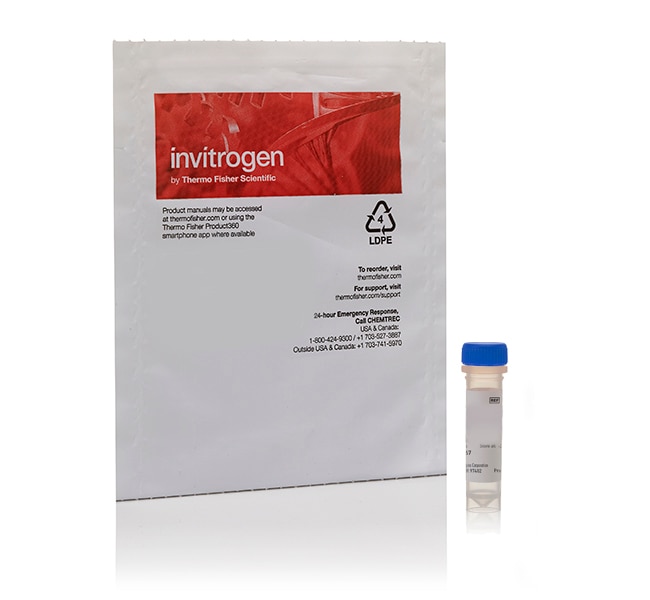
Vybrant™ CM-DiI Cell-Labeling Solution
Invitrogen™

Vybrant™ CM-DiI Cell-Labeling Solution

The Vybrant™ CM-DiI cell-labeling solution is a dye delivery solution that can be added directly to normal culture media toRead more
Have Questions?
Catalog NumberQuantity
V228881 mL
Catalog number V22888
Price (EUR)
377,65
Online Exclusive
424,00
Save 46,35 (11%)
1 mL
Add to cart
Quantity:
1 mL
Price (EUR)
377,65
Online Exclusive
424,00
Save 46,35 (11%)
1 mL
Add to cart
The Vybrant™ CM-DiI cell-labeling solution is a dye delivery solution that can be added directly to normal culture media to uniformly label suspended or attached culture cells for use in cell-cell fusion, cellular adhesion and migration applications.
For Research Use Only. Not for use in diagnostic procedures.
Specifications
ColorYellow
Detection MethodFluorescence
For Use With (Equipment)Fluorescence Microscope, Flow Cytometer
Product LineVybrant
Quantity1 mL
Shipping ConditionRoom Temperature
Label TypeFluorescent Dye
Product TypeCell Labeling
SubCellular LocalizationCell Membranes, Lipids
Unit Size1 mL
Contents & Storage
Store in freezer -5°C to -30°C and protect from light.

Frequently asked questions (FAQs)

I want to perform a cell fusion assay, where one cell line is labeled with one color and the other cell line with another color, and combine with a nucleic acid stain. What do you recommend?

A typical method is to label one cell line with orange fluorescent DiI C18 and the other cell line with green fluorescent DiO C18. These orange and green lipophilic cyanine dyes will stain the membranes of cells. Cells that fuse will then have both dyes, yielding a yellow color (when images are overlaid or cells are imaged in a dual-bandpass filter). These live cells can then be labeled with Hoechst 33342 (a cell-permeant blue DNA stain comparable in wavelength to DAPI), but only as an endpoint just before imaging (since DNA stains can interrupt DNA function).

Find additional tips, troubleshooting help, and resources within our Cell Analysis Support Center.

I need to look at live cell morphology deformation over the course of a few hours. What sort of membrane dye would be useful for this?

Lipophilic cyanine dyes, such as DiI (Cat. No. D282), DiO (Cat. No. D275), DiD (Cat. No. D7757) or DiR (Cat. No. D12731), are commonly used. The longer the alkyl chain on the dye, the better the retention in lipophilic environments.

Find additional tips, troubleshooting help, and resources within our Cell Analysis Support Center.

How do I know which tracer to choose for my experiment?

Factors to consider are size of tracer, method of delivery (injection, direct application to tissue, etc.), and if the tracer needs to be fixable. Here are some links to details about the various classes of neuronal tracers we offer and how to choose between them:

Neuronal Tracing (https://www.thermofisher.com/us/en/home/life-science/cell-analysis/cell-tracing-tracking-and-morphology/neuronal-tracing.html)
Choosing a Tracer (https://www.thermofisher.com/us/en/home/references/molecular-probes-the-handbook/fluorescent-tracers-of-cell-morphology-and-fluid-flow/choosing-a-tracer.html)
Imaging Analysis (http://assets.thermofisher.com/TFS-Assets/BID/Reference-Materials/bioprobes-50-journal.pdf)

Find additional tips, troubleshooting help, and resources within our Cell Analysis Support Center.

I want to track my cells with a nucleic acid stain, like DAPI or Hoechst dye. Do you recommend this?

This is not recommended. When these stains bind to DNA and RNA, they may affect the normal function of the nucleic acids, disrupting transcription, as well as replication. Other reagents, such as CellTracker dyes or Qtracker reagents are more optimized for tracking without disrupting normal activity. If a nuclear label is still desired, though, and the cells are mammalian and non-hematopoietic, CellLight nuclear reagents can transiently transfect cells to express GFP or RFP on a nuclear-expressing protein for up to several days without affecting function.

Find additional tips, troubleshooting help, and resources within our Cell Tracing and Tracking Support Center.

I want to track my cells over time, and you have a lot of options to choose from. How do I pick the right one?

Please see this Web link (http://www.thermofisher.com/us/en/home/life-science/cell-analysis/cell-tracing-tracking-and-morphology/cell-tracking.html) to help you choose the right option for your application. Start by planning how long you want to track your cells, then consider the mechanism of binding. Calcein dyes are very uniform in label and are good for short-term cell migration, but may be rapidly effluxed from some cell types. Lipophilic cyanine dyes, such as DiI, DiO, and similar dyes label cell membranes, don’t disrupt function, and can last longer, but have the potential to cross to other cells if membranes fuse. They are also lost upon permeabilization. CellTracker dyes are better for longer-term labeling, as they possess a mildly reactive chloromethyl moiety that allows covalent binding to cellular components. CFDA SE also covalently binds to cellular components. With all the reagents, their retention within cells is dependent upon the rate of cell division and the inherent properties of the cell (active efflux, membrane and protein turnover rates, etc.) and reagents that allow for covalent attachment exhibit longer retention than those that do not.

The longest-lasting and brightest options are the Qtracker reagents, which are taken up through endocytosis. These are so bright individual quantum dots can be detected, and are also robust enough to survive not only fixation and permeabilization, but even the heat and solvents used in paraffin processing.

Find additional tips, troubleshooting help, and resources within our Cell Tracing and Tracking Support Center.

Citations & References (17)

Citations & References
Abstract
No evidence of transdifferentiation of human endothelial progenitor cells into cardiomyocytes after coculture with neonatal rat cardiomyocytes.
Authors:Gruh I, Beilner J, Blomer U, Schmiedl A, Schmidt-Richter I, Kruse ML, Haverich A, Martin U
Journal:Circulation
PubMed ID:16520414
'BACKGROUND: Recent studies have suggested the differentiation of human endothelial progenitor cells (huEPCs) isolated from peripheral blood into cardiomyocytes. This study investigates whether, when cocultured, neonatal rat cardiomyocytes (NRCMs) can induce transdifferentiation of huEPCs into cardiomyocytes. METHODS AND RESULTS: Coculture experiments with 1,1''-dioctadecyl-3,3,3'',3''-tetramethylindocarbocyanine (DiI)-labeled huEPCs and NRCMs have been performed. ... More
Human mesenchymal stem cells exert potent antitumorigenic effects in a model of Kaposi's sarcoma.
Authors:Khakoo AY, Pati S, Anderson SA, Reid W, Elshal MF, Rovira II, Nguyen AT, Malide D, Combs CA, Hall G, Zhang J, Raffeld M, Rogers TB, Stetler-Stevenson W, Frank JA, Reitz M, Finkel T,
Journal:J Exp Med
PubMed ID:16636132
'Emerging evidence suggests that both human stem cells and mature stromal cells can play an important role in the development and growth of human malignancies. In contrast to these tumor-promoting properties, we observed that in an in vivo model of Kaposi''s sarcoma (KS), intravenously (i.v.) injected human mesenchymal stem cells ... More
Intra-vital fluorescence microscopy for intra-myocardial graft detection following cell transplantation.
Authors:Ruhparwar A, Kofidis T, Ruebesamen N, Karck M, Haverich A, Martin U
Journal:Int J Cardiovasc Imaging
PubMed ID:16175449
'INTRODUCTION: The aim of our study was the development of a potentially clinically applicable approach, which allows for intra-myocardial detection of the transplanted cells without the need for collection of tissue samples. Intra-myocardial transplantation of myocytes and bone marrow derived cells is currently under clinical evaluation as a therapy of ... More
Application and limitations of chloromethyl-benzamidodialkylcarbocyanine for tracing cells used in bone Tissue engineering.
Authors:Kruyt MC, De Bruijn J, Veenhof M, Oner FC, Van Blitterswijk CA, Verbout AJ, Dhert WJ,
Journal:Tissue Eng
PubMed ID:12625959
Bone tissue engineering has the potential to provide us with an autologous bone substitute. Despite extensive research to optimize the technique, little is known about the survival and function of the cells after implantation. To monitor the cells, in vivo labeling is the method of choice. In this study we ... More
Mesenchymal stem cells: isolation, characterisation and in vivo fluorescent dye tracking.
Authors:Weir C, Morel-Kopp MC, Gill A, Tinworth K, Ladd L, Hunyor SN, Ward C,
Journal:Heart Lung Circ
PubMed ID:18396458
Cell therapies have been used to regenerate the heart by direct myocardial delivery, by coronary infusion and by surface attached scaffolds. Multipotent mesenchymal stem cells (MSC) with capacity to differentiate into cardiomyocytes and other cell lines have been predominantly trialled in rodents. However, large animal models are increasingly needed to ... More