Search


Citations & References (6)
Invitrogen™
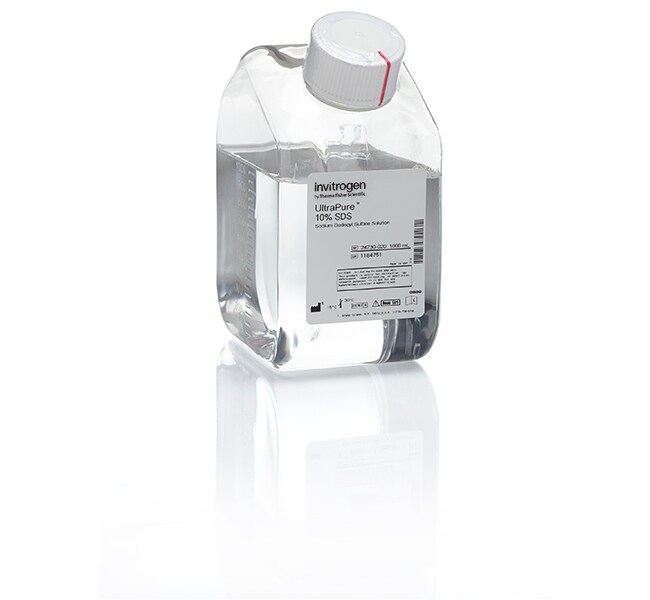
UltraPure™ SDS Solution, 10%
UltraPure™ 10% SDS Solution is a premixed aqueous solution containing 10% sodium dodecyl sulfate (SDS). SDS is a protein denaturantRead more
Have Questions?
Change view

| Catalog Number | Quantity |
|---|---|
| 24730020 | 1 L |
| 15553027 | 4 x 100 mL |
Catalog number 24730020
Price (EUR)
208,00
Each
Quantity:
1 L
Price (EUR)
208,00
Each
UltraPure™ 10% SDS Solution is a premixed aqueous solution containing 10% sodium dodecyl sulfate (SDS). SDS is a protein denaturant used in polyacrylamide gel electrophoresis for molecular weight determinations. It also is used to dissociate nucleic acid-protein complexes in DNA extraction protocols, to disrupt cell membranes, and to prepare prehybridization and hybridization solutions. UltraPure™ 10% SDS Solution is filtered and ready to use.
For Research Use Only. Not for use in diagnostic procedures.
Specifications
Concentration0.1
For Use With (Application)Nucleic Acid Gel Electrophoresis, Blotting
FormLiquid
Quantity1 L
Reagent TypeSDS
Shipping ConditionRoom Temperature
Product LineUltraPure
Product TypeSDS Solution
Unit SizeEach
Contents & Storage
1 bottle containing 1 L of Ultrapure SDS at 10% concentration (w/v). Store at room temperature.
Frequently asked questions (FAQs)
Why do solutions containing SDS form precipitates?
Citations & References (6)
Citations & References
Abstract
Diversity of human small intestinal Streptococcus and Veillonella populations.
Journal:FEMS Microbiol Ecol
PubMed ID:23614882
'Molecular and cultivation approaches were employed to study the phylogenetic richness and temporal dynamics of Streptococcus and Veillonella populations in the small intestine. Microbial profiling of human small intestinal samples collected from four ileostomy subjects at four time points displayed abundant populations of Streptococcus spp. most affiliated with S. salivarius, S. thermophilus,
Determine the effect of p53 on chemosensitivity.
Journal:Methods Mol Biol
PubMed ID:23150441
'The p53 tumor suppressor protein plays a central role in mediating the cellular response to a variety of stresses. Activation of p53 signaling will trigger cell cycle arrest or apoptosis in normal cells, depending on such factors as cell type and genetic context. The ability of a cell to circumvent
Visualization of fas-mediated death-inducing signaling complex formation by immunoprecipitation.
Journal:Methods Mol Biol
PubMed ID:23397387
The prototypical death receptor Fas (also known as CD95 or Apo-1) plays an essential role in the maintenance of lymphocyte homeostasis. Propagation of cell death through Fas relies on the formation of a multiprotein complex at the receptor level known as the death-inducing signaling complex (DISC). Here, we describe an
Collagen I confers gamma radiation resistance.
Journal:Appl Radiat Isot
PubMed ID:22705234
The effect of collagen on the response of somatomammotroph tumor cells (GH3) to gamma, radiation therapy was studied in vitro. After incubating confluent GH3 cell monolayers in a serum-free, maintaining medium, either with or without collagen, the monolayers were irradiated with 137Cs, gamma radiation. Collagen reduces cell mortality via ERK1/2
Microarray-based CGH and copy number analysis of FFPE samples.
Journal:Methods Mol Biol
PubMed ID:21370011
Over the past decade, utilization of microarray technology has flourished in biomedical research. It has evolved rapidly into a revolutionary tool that offers deeper insight into the molecular basis associated with complex diseases, especially in the field of cancer. Specifically, array-based Comparative Genomic Hybridization (aCGH) permits the detection of genome-wide