Search
 Element Search
 Structure Search


Thermo Scientific Chemicals
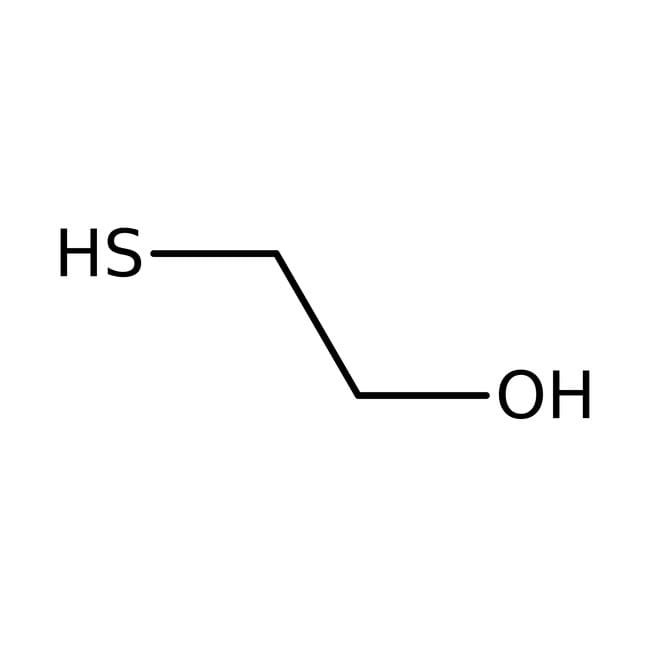
2-Mercaptoethanol, Electrophoresis Grade, 98+%
CAS: 60-24-2 | C2H6OS | 78.13 g/mol
Have Questions?
Change view




Catalog number J66742.0B
also known as J66742-0B
Price (EUR)
-
Quantity:
1000 g
Chemical Identifiers
CAS60-24-2
IUPAC Name2-sulfanylethan-1-ol
Molecular FormulaC2H6OS
InChI KeyDGVVWUTYPXICAM-UHFFFAOYSA-N
SMILESOCCS
View more
Specifications Specification Sheet
Specification SheetFormLiquid
Assay (unspecified)≥ 98 %
Appearance (Color)Clear and colorless
β-Mercaptoethanol can act as an enzyme reactivator in systems necessitating reduction for activation, and has been commonly used to reduce disulfide bonds in order to separate protein subunits for use in electrophoresis. This product can also be used to form o-Phthalaldehyde-beta-mercaptoethanol (OPAME), a fluorogenic reagent shown to detect amino acids based on its reaction with primary amines. More recently OPAME has been used to distinguish between ssDNA/dsDNA and even single base mismatches in the hybridization of DNA. It is widely used for retarding oxidation of biological compounds in solution.
This Thermo Scientific Chemicals brand product was originally part of the Alfa Aesar product portfolio. Some documentation and label information may refer to the legacy brand. The original Alfa Aesar product / item code or SKU reference has not changed as a part of the brand transition to Thermo Scientific Chemicals.
Applications
β-Mercaptoethanol can act as an enzyme reactivator in systems necessitating reduction for activation, and has been commonly used to reduce disulfide bonds in order to separate protein subunits for use in electrophoresis. This product can also be used to form o-Phthalaldehyde-beta-mercaptoethanol (OPAME), a fluorogenic reagent shown to detect amino acids based on its reaction with primary amines. More recently OPAME has been used to distinguish between ssDNA/dsDNA and even single base mismatches in the hybridization of DNA. It is widely used for retarding oxidation of biological compounds in solution.
Solubility
Fully miscible in water. Soluble in alcohol, ether, benzene, and other organic solvents.
Notes
Handle under dry protective gas. Store in cool condition. Incompatible with air, moisture, oxidizing agents.
β-Mercaptoethanol can act as an enzyme reactivator in systems necessitating reduction for activation, and has been commonly used to reduce disulfide bonds in order to separate protein subunits for use in electrophoresis. This product can also be used to form o-Phthalaldehyde-beta-mercaptoethanol (OPAME), a fluorogenic reagent shown to detect amino acids based on its reaction with primary amines. More recently OPAME has been used to distinguish between ssDNA/dsDNA and even single base mismatches in the hybridization of DNA. It is widely used for retarding oxidation of biological compounds in solution.
Solubility
Fully miscible in water. Soluble in alcohol, ether, benzene, and other organic solvents.
Notes
Handle under dry protective gas. Store in cool condition. Incompatible with air, moisture, oxidizing agents.
RUO – Research Use Only
General References:
- Margaret L. Heidrick..; Linda C. Hendricks.; David E. Cook. Effect of dietary 2-mercaptoethanol on the life span, immune system, tumor incidence and lipid peroxidation damage in spleen lymphocytes of aging BC3F1 mice. Mechanisms of Ageing and Development. 1984, 27 (3),341-358 .
- B. Tasheva.; G. Dessev. Artifacts in sodium dodecyl sulfate-polyacrylamide gel electrophoresis due to 2-mercaptoethanol.Anal. Biochem. 1983, 129 (1),98-102 .