Search


Citas y referencias (1122)
Applied Biosystems™
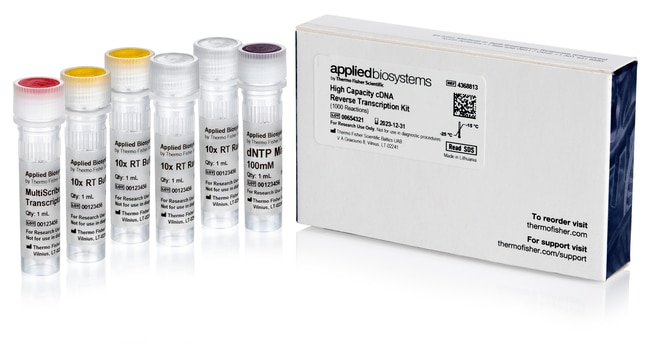
Kit de transcripción inversa de ADNc de gran capacidad
El kit de transcripción inversa de gran capacidad de ADNc contiene todos los componentes necesarios para la conversión cuantitativa deMás información
Have Questions?
Cambiar vista

| Número de catálogo | Incluye | N.º de reacciones |
|---|---|---|
| 4368813 | Kit only | 1.000 reacciones |
| 4368814 | Kit only | 200 reacciones |
| 4374966 | Kit with Rnase Inhibitor | 200 reacciones |
| 4374967 | Kit with Rnase Inhibitor | 1.000 reacciones |
Número de catálogo 4368813
Precio (EUR)
2.110,65
Online exclusive
2.345,00Ahorro 234,35 (10%)
Each
Incluye:
Kit only
N.º de reacciones:
1.000 reacciones
Precio (EUR)
2.110,65
Online exclusive
2.345,00Ahorro 234,35 (10%)
Each
El kit de transcripción inversa de gran capacidad de ADNc contiene todos los componentes necesarios para la conversión cuantitativa de hasta 2 µg de ARN total a ADNc monocatenario en una única reacción de 20 µl. El kit de transcripción inversa de gran capacidad de ADNc ofrece ADNc monocatenario de muy alta calidad, de 0,02 a 2 µg de ARN total. Las reacciones pueden ascender hasta 100 µl para generar 10 µg de ADNc a partir de una única reacción. Las aplicaciones posteriores incluyen PCR en tiempo real, PCR estándar y micromatrices. El kit es ideal para generar archivos de ADNc.
Las características de este kit incluyen:
• Amplificación de objetivo lineal para PCR en tiempo real
• Producción y precisión más elevadas que otros kits de síntesis de ADNc con un coste mucho menor
• 10 veces mayor rango dinámico que otros kits
Ampliamente probado con una gran variedad de moldes
La síntesis cuantitativa de la primera cadena de todas las especies de ARN se logra con el uso de cebadores aleatorios. El kit se ha sometido a comprobaciones exhaustivas con una gran variedad de moldes de ARN, incluidos ARN y objetivos ricos en bases G-C y A-U expresados en niveles bajos. El ARNc también se puede generar de manera eficaz a partir de una transcripción in vitro del ADNc.
Las características de este kit incluyen:
• Amplificación de objetivo lineal para PCR en tiempo real
• Producción y precisión más elevadas que otros kits de síntesis de ADNc con un coste mucho menor
• 10 veces mayor rango dinámico que otros kits
Ampliamente probado con una gran variedad de moldes
La síntesis cuantitativa de la primera cadena de todas las especies de ARN se logra con el uso de cebadores aleatorios. El kit se ha sometido a comprobaciones exhaustivas con una gran variedad de moldes de ARN, incluidos ARN y objetivos ricos en bases G-C y A-U expresados en niveles bajos. El ARNc también se puede generar de manera eficaz a partir de una transcripción in vitro del ADNc.
Para uso exclusivo en investigación. No apto para uso en procedimientos diagnósticos.
Especificaciones
Tipo de producto finalPrimera cadena de ADNc
FormatoKit
IncluyeKit only
N.º de reacciones1.000 reacciones
Cantidad1 Ea.
Formato de reacciónComponentes separados
Tipo de reactivoTranscripción reversa
Transcriptasa inversaMultiScribe
Actividad de la ribonucleasa HSí
Condiciones de envíoHielo seco
Tamaño (producto final)7 kb
Material de partidaARN
TécnicaTranscripción reversa
Concentración50 U/μl
Para utilizar con (aplicación)Real Time PCR (qPCR), RT-PCR
Velocidad de reacción120 min
Unit SizeEach
Contenido y almacenamiento
• Tampón RT 10X, 2 x 1 ml
• Cebadores aleatorios RT 10X, 2 x 1 ml
• Mezcla de dNTP 25X (100 mM), 1 x 1 ml
• Transcriptasa inversa MultiScribe (50 U/μl) 1 x 1 ml
Conservar entre -15 °C y -25 °C.
• Cebadores aleatorios RT 10X, 2 x 1 ml
• Mezcla de dNTP 25X (100 mM), 1 x 1 ml
• Transcriptasa inversa MultiScribe (50 U/μl) 1 x 1 ml
Conservar entre -15 °C y -25 °C.
Preguntas frecuentes
Which kit should I use for the reverse transcription step for TaqMan Pri-miRNA assays (Cat. No. 4427012)?
What is the concentration of the random primers in the High-Capacity cDNA Reverse Transcription Kit (Cat. no. 4368813)?
Is the 25X 100 mM dNTP Mix included in the High Capacity cDNA Reverse Transcription Kit (Cat. No. 4368813, 4368814) 100 mM each or 100 mM combined?
Citations & References (1122)
Citations & References
Abstract
Hyaluronan-CD44-ERK1/2 regulate human aortic smooth muscle cell motility during aging.
Journal:The Journal of biological chemistry
PubMed ID:18077444
Increased hepatobiliary clearance of unconjugated thyroxine determines DMP 904-induced alterations in thyroid hormone homeostasis in rats.
Journal:Toxicological sciences : an official journal of the Society of Toxicology
PubMed ID:15673846
4-(3-pentylamino)-2,7-dimethyl-8-(2-methyl-4-methoxyphenyl)-pyrazolo-[1,5-a]-pyri midine (DMP 904) is a potent and selective antagonist of corticotropin releasing factor receptor-1 (CRF1 receptor) with an efficacious anxiolytic profile in preclinical animal models. In subchronic toxicity studies in Sprague-Dawley rats, DMP 904 produced thyroid follicular cell hypertrophy and hyperplasia, and a low incidence of follicular cell
Somatic cell plasticity and Niemann-Pick type C2 protein: fibroblast activation.
Journal:J Biol Chem
PubMed ID:21084287
A growing body of evidence points toward activated fibroblasts, also known as myofibroblasts, as one of the leading mediators in several major human pathologies including proliferative fibrotic disorders, invasive tumor growth, rheumatoid arthritis, and atherosclerosis. Niemann-Pick Type C2 (NPC2) protein has been recently identified as a product of the second
TGF-beta regulates miR-206 and miR-29 to control myogenic differentiation through regulation of HDAC4.
Journal:J Biol Chem
PubMed ID:21324893
MicroRNAs (miRs) are emerging as prominent players in the regulation of many biological processes, including myogenic commitment and skeletal muscle formation. Members of the TGF-beta family can influence the proliferation and myogenic differentiation of cells, although it is presently not clear what role miRNAs play in the TGF-beta-mediated control of
Disordered macrophage cytokine secretion underlies impaired acute inflammation and bacterial clearance in Crohn's disease.
Journal:J Exp Med
PubMed ID:19652016
The cause of Crohn's disease (CD) remains poorly understood. Counterintuitively, these patients possess an impaired acute inflammatory response, which could result in delayed clearance of bacteria penetrating the lining of the bowel and predispose to granuloma formation and chronicity. We tested this hypothesis in human subjects by monitoring responses to