Search


Citas y referencias (7)
Thermo Scientific™
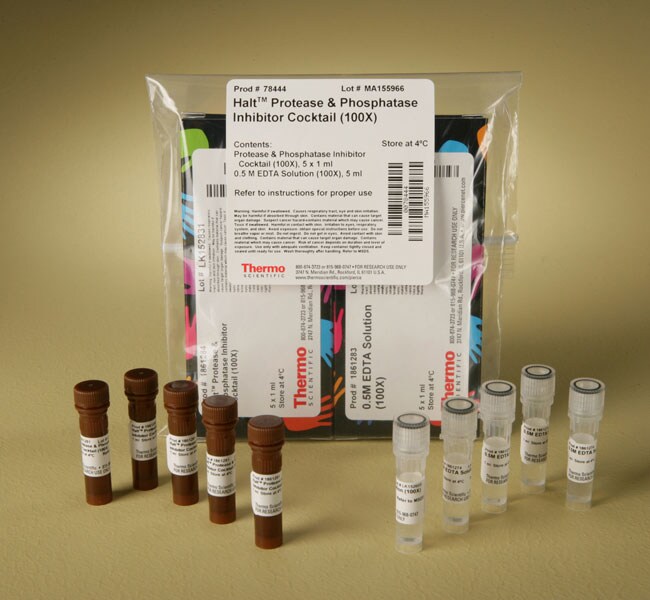
Cóctel inhibidor de proteasas y fosfatasas Halt™ (100X)
El cóctel inhibidor de proteasas y fosfatasas Thermo Scientific Halt (100X) proporciona la comodidad de una solución única con laMás información
Have Questions?
Cambiar vista

| Número de catálogo | Cantidad |
|---|---|
| 78444 | 5 x 1 ml |
| 78442 | 24 × 100 μl |
| 78446 | 10 ml |
| 78440 | 1 ml |
Número de catálogo 78444
Precio (EUR)
729,65
キャンペーン価格
802,00Ahorro 72,35 (9%)
Each
Cantidad:
5 x 1 ml
Precio (EUR)
729,65
キャンペーン価格
802,00Ahorro 72,35 (9%)
Each
El cóctel inhibidor de proteasas y fosfatasas Thermo Scientific Halt (100X) proporciona la comodidad de una solución única con la protección completa de las muestras de proteínas para lisados de células y tejidos.
Características del cóctel inhibidor de proteasas y fosfatasas Halt (100X):
• Protección completa: cóctel todo en uno que contiene inhibidores de proteasas y fosfatasas.
• Envases de varios tamaños: seleccione uno de los cuatro prácticos tamaños de envase que se ajustan a prácticamente todas las necesidades.
• Práctico: la formulación del líquido 100X es mucho más sencilla y eficaz que los inhibidores individuales y otros formatos.
• Fácil almacenamiento: el formato con base acuosa permite un práctico almacenamiento en sala fría sin congelación, a diferencia de los cócteles basados en DMSO
• Compatible: se puede usar en espectrometría de masas (MS) porque no contiene AEBSF, lo cual puede provocar que los picos se desplacen.
• Validado: totalmente compatible con los tampones de lisis celular Thermo Scientific Pierce.
El cóctel de inhibidores de proteasas y fosfatasas Halt está específicamente optimizado para proteger las proteínas de la degradación durante la extracción y purificación. El cóctel contiene inhibidores contra las principales clases de proteasas y fosfatasas, por lo que se ocupa de aminopeptidasas, proteasas de cisteína y serina, y fosfatasas de serina/treonina y proteína tirosina. Para promover la inhibición de las metaloproteasas, el ácido etildiaminotetraacético (EDTA) a 0,5 M se suministra en un tubo independiente.
Productos relacionados
Cóctel inhibidor de proteasa y fosfatasa Halt™, sin EDTA (100X)
Características del cóctel inhibidor de proteasas y fosfatasas Halt (100X):
• Protección completa: cóctel todo en uno que contiene inhibidores de proteasas y fosfatasas.
• Envases de varios tamaños: seleccione uno de los cuatro prácticos tamaños de envase que se ajustan a prácticamente todas las necesidades.
• Práctico: la formulación del líquido 100X es mucho más sencilla y eficaz que los inhibidores individuales y otros formatos.
• Fácil almacenamiento: el formato con base acuosa permite un práctico almacenamiento en sala fría sin congelación, a diferencia de los cócteles basados en DMSO
• Compatible: se puede usar en espectrometría de masas (MS) porque no contiene AEBSF, lo cual puede provocar que los picos se desplacen.
• Validado: totalmente compatible con los tampones de lisis celular Thermo Scientific Pierce.
El cóctel de inhibidores de proteasas y fosfatasas Halt está específicamente optimizado para proteger las proteínas de la degradación durante la extracción y purificación. El cóctel contiene inhibidores contra las principales clases de proteasas y fosfatasas, por lo que se ocupa de aminopeptidasas, proteasas de cisteína y serina, y fosfatasas de serina/treonina y proteína tirosina. Para promover la inhibición de las metaloproteasas, el ácido etildiaminotetraacético (EDTA) a 0,5 M se suministra en un tubo independiente.
Productos relacionados
Cóctel inhibidor de proteasa y fosfatasa Halt™, sin EDTA (100X)
Para uso exclusivo en investigación. No apto para uso en procedimientos diagnósticos.
Especificaciones
TampónTampón de lisis
InhibidoresInhibidor de la proteasa, inhibidor de la fosfatasa
Cantidad5 x 1 ml
Tipo de reactivoInhibidor de la proteasa, inhibidor de la fosfatasa
FormularioLíquido
Línea de productosHalt
Tipo de productoCóctel inhibidor
Unit SizeEach
Contenido y almacenamiento
Tras su recepción, almacenar a 4 °C
Preguntas frecuentes
Can I store the 1X solution of the Halt Protease and Phosphatase Inhbitor Cocktail and if so, for how long?
What are the concentrations of the various components of the combined Halt Protease and Phosphatase Inhibitor Cocktail?
Do you offer the components of the Halt Protease and Phosphatase Cocktail individually?
When do I need to add EDTA when using the Halt Protease and Phosphatase Cocktail?
How much of the Halt Protease and Phosphatase Cocktail do I use for my sample?
Citations & References (7)
Citations & References
Abstract
Host E3 ubiquitin ligase ITCH mediates Toxoplasma gondii effector GRA35-triggered NLRP1 inflammasome activation and cell-autonomous immunity.
Journal:mBio
PubMed ID:38376248
Toxoplasma gondii is an intracellular parasite that can activate the NLRP1 inflammasome leading to macrophage pyroptosis in Lewis rats, but the underlying mechanism is not well understood. In this study, we performed a genome-wide CRISPR screen and identified the dense granule proteins GRA35, GRA42, and GRA43 as the Toxoplasma effectors
LARP1 binds ribosomes and TOP mRNAs in repressed complexes.
Journal:The EMBO journal
PubMed ID:39533057
Terminal oligopyrimidine motif-containing mRNAs (TOPs) encode all ribosomal proteins in mammals and are regulated to tune ribosome synthesis to cell state. Previous studies have implicated LARP1 in 40S- or 80S-ribosome complexes that are thought to repress and stabilize TOPs. However, a molecular understanding of how LARP1 and TOPs interact with
A KIF1C-CNBP motor-adaptor complex for trafficking mRNAs to cell protrusions.
Journal:Cell reports
PubMed ID:39982819
mRNA localization to subcellular compartments is a widely used mechanism that functionally contributes to numerous processes. mRNA targeting can be achieved upon recognition of RNA cargo by molecular motors. However, our molecular understanding of how this is accomplished is limited, especially in higher organisms. We focus on a pathway that
hCLCA1 and mCLCA3 are secreted non-integral membrane proteins and therefore are not ion channels.
Journal:J Biol Chem
PubMed ID:15919655
'Proteins of the CLCA gene family have been proposed to mediate calcium-activated chloride currents. In this study, we used detailed bioinformatics analysis and found that no transmembrane domains are predicted in hCLCA1 or mCLCA3 (Gob-5). Further analysis suggested that they are globular proteins containing domains that are likely to be
Quantitative PCR analysis of DNA, RNAs, and proteins in the same single cell.
Journal:Clin Chem
PubMed ID:23014600
The single cell represents the basic unit of all organisms. Most investigations have been performed on large cell populations, but understanding cell dynamics and heterogeneity requires single-cell analysis. Current methods for single-cell analysis generally can detect only one class of analytes.