Search
 Búsqueda por elementos
 Búsqueda por estructura


Thermo Scientific Chemicals
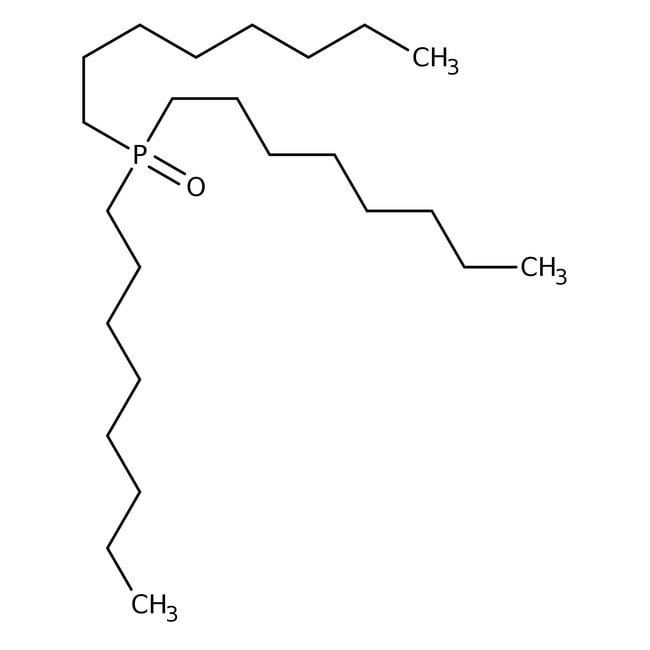
Óxido de tri-n-octilfosfina, 98 %, Thermo Scientific Chemicals
CAS: 78-50-2 | C24H51OP | 386.645 g/mol
Have Questions?
Cambiar vista


Número de catálogo A11062.36
Precio (EUR)
516,65
Online exclusive
574,00Ahorro 57,35 (10%)
Each
Cantidad:
500 g
Precio (EUR)
516,65
Online exclusive
574,00Ahorro 57,35 (10%)
Each
Identificadores químicos
CAS78-50-2
IUPAC Name1-(dioctylphosphoryl)octane
Molecular FormulaC24H51OP
InChI KeyZMBHCYHQLYEYDV-UHFFFAOYSA-N
SMILESCCCCCCCCP(=O)(CCCCCCCC)CCCCCCCC
Ver más
Especificaciones Hoja de especificaciones
Hoja de especificacionesMelting Point (clear melt)50-57?C
Identification (FTIR)Conforms
Appearance (Color)White to cream or pale yellow
Assay (GC)≥97.5%
FormCrystals or powder or crystalline powder or flakes and/or fused solid/chunks
Tri-n-octylphosphine oxide is a solvent used in the extraction of metals, especially uranium, zirconium and hafnium. It is also used as an auxiliary reagent in the solvent extraction of metals. It is also used to extract hydrogen bonding organic compounds. Further, it is useful as a capping ligand for the production of quantum dots, such as those consisting of cadmium selenide.
This Thermo Scientific Chemicals brand product was originally part of the Alfa Aesar product portfolio. Some documentation and label information may refer to the legacy brand. The original Alfa Aesar product / item code or SKU reference has not changed as a part of the brand transition to Thermo Scientific Chemicals.
Aplicaciones
El óxido de tri-n-octilfosfina es un disolvente utilizado en la extracción de metales, especialmente uranio, circonio y hafnio. También se utiliza como reactivo auxiliar en la extracción por solventes de metales. También se utiliza para extraer compuestos orgánicos de enlace de hidrógeno. Además, es útil como ligando de taponamiento para la producción de puntos cuánticos, como los que consisten en seleniuro de cadmio.
Solubilidad
Soluble en cloroformo, tolueno y hexano. Insoluble en agua.
Notas
Incompatibles con agentes oxidantes fuertes.
El óxido de tri-n-octilfosfina es un disolvente utilizado en la extracción de metales, especialmente uranio, circonio y hafnio. También se utiliza como reactivo auxiliar en la extracción por solventes de metales. También se utiliza para extraer compuestos orgánicos de enlace de hidrógeno. Además, es útil como ligando de taponamiento para la producción de puntos cuánticos, como los que consisten en seleniuro de cadmio.
Solubilidad
Soluble en cloroformo, tolueno y hexano. Insoluble en agua.
Notas
Incompatibles con agentes oxidantes fuertes.
RUO – Research Use Only
General References:
- Used in the extraction of various metals into organic solvents.
- Ren, C.; Hao, J.; Chen, H.; Wang, K.; Wu, D. Prepare core-multishell CdSe/ZnS nanocrystals with pure color and controlled emission by tri-n-octylphosphine-assisted method. Appl. Surf. Sci. 2015, 353, 480-488.
- Grimes, T. S.; Zalupski, P. R.; Martin, L. R. Features of the Thermodynamics of Trivalent Lanthanide/Actinide Distribution Reactions by Tri-n-octylphosphine Oxide and Bis(2-ethylhexyl) Phosphoric Acid. J. Phys. Chem. B 2014, 118 (44), 12725-12733.