Search
 Búsqueda por elementos
 Búsqueda por estructura
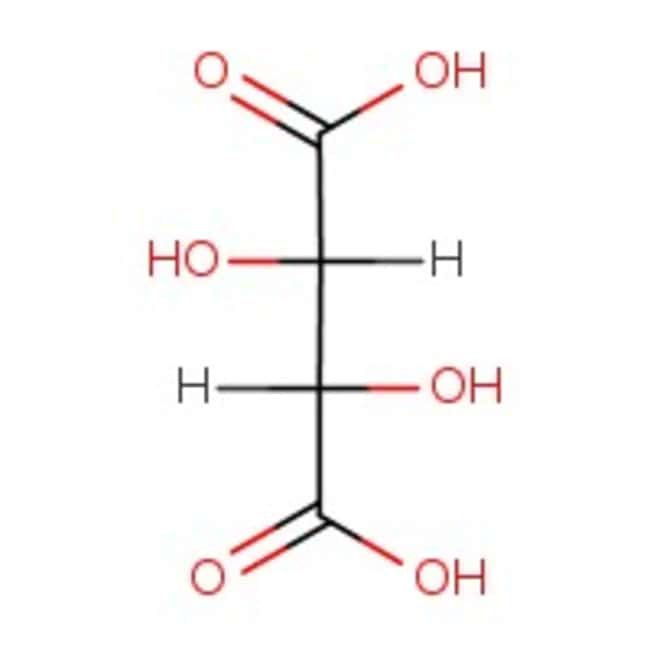

Thermo Scientific Chemicals
D-(-)-ácido tartárico, al 99 %, Thermo Scientific Chemicals
CAS: 147-71-7 | C4H6O6 | 150.09 g/mol
Have Questions?
Cambiar vista


Número de catálogo A11264.14
también denominado A11264-14
Precio (EUR)
46,30
Each
Cantidad:
25 g
Precio (EUR)
46,30
Each
Identificadores químicos
CAS147-71-7
IUPAC Name2,3-dihydroxybutanedioic acid
Molecular FormulaC4H6O6
InChI KeyFEWJPZIEWOKRBE-UHFFFAOYNA-N
SMILESOC(C(O)C(O)=O)C(O)=O
Ver más
Especificaciones Hoja de especificaciones
Hoja de especificacionesMelting Point (clear melt)163.0-172.0?C (UK-sourced material)
Optical Rotation-13.5 ± 0.5? (C=10 in water, UK-sourced material)
Appearance (Color)White
FormCrystals or powder or crystalline powder
Assay (Aqueous acid-base Titration)≥98.5 to ≤101.5% (UK-sourced material)
Ver más
D-(-)-Tartaric acid is used as a resolving agent in organic synthesis. It is used as a precursor for the preparation of its ester derivatives like D-tartaric acid diethyl ester, D-tartaric acid dimethyl ester and D-tartaric acid diiso-propyl ester. It finds application in the synthesis of chiral aziridine derivative, a common intermediate for the preparation of hydroxyethylamine class HIV protease inhibitors viz. as saquinavir, amprenavir and nelfinavir. It is widely used in the food industry as a beer foaming agent, for food acidity regulations and as a flavoring agent.
This Thermo Scientific Chemicals brand product was originally part of the Alfa Aesar product portfolio. Some documentation and label information may refer to the legacy brand. The original Alfa Aesar product / item code or SKU reference has not changed as a part of the brand transition to Thermo Scientific Chemicals.
Aplicaciones
El ácido D-(-)-tartárico se utiliza como agente resolutivo en la síntesis orgánica. Se utiliza como precursor para la preparación de sus derivados ésteres como éster dietílico del ácido D-tartárico, éster dimetílico del ácido D-tartárico y éster diisopropilo del ácido D-tartárico. Tiene aplicaciones en la síntesis de derivados de aziridina quiral, un intermediario común para la preparación de inhibidores viz. de la proteasa VIH de clase hidroxietilamina, como saquinavir, amprenavir y nelfinavir. Se utiliza ampliamente en la industria alimentaria como agente espumante de cerveza, para la regulación de la acidez de los alimentos y como agente aromatizante.
Solubilidad
Soluble en agua y alcohol.
Notas
Sensible a la luz. Incompatible con bases, agentes oxidantes y agentes reductores.
El ácido D-(-)-tartárico se utiliza como agente resolutivo en la síntesis orgánica. Se utiliza como precursor para la preparación de sus derivados ésteres como éster dietílico del ácido D-tartárico, éster dimetílico del ácido D-tartárico y éster diisopropilo del ácido D-tartárico. Tiene aplicaciones en la síntesis de derivados de aziridina quiral, un intermediario común para la preparación de inhibidores viz. de la proteasa VIH de clase hidroxietilamina, como saquinavir, amprenavir y nelfinavir. Se utiliza ampliamente en la industria alimentaria como agente espumante de cerveza, para la regulación de la acidez de los alimentos y como agente aromatizante.
Solubilidad
Soluble en agua y alcohol.
Notas
Sensible a la luz. Incompatible con bases, agentes oxidantes y agentes reductores.
RUO – Research Use Only
General References:
- Mahapatra, M.; Tysoe, W. T. Structure and decomposition pathways of D-(-)-tartaric acid on Pd(111). Surface Science 2014, 629, 132-138.
- Hu, G.; Zhang, H.; Miao, H.; Wang, J.; Xu, Y. Synthesis, structures and properties of two new chiral rare earth-organic frameworks constructed by l/d-tartaric acid. J. Solid State Chem. 2015, 229, 208-212.