Search
 Búsqueda por elementos
 Búsqueda por estructura
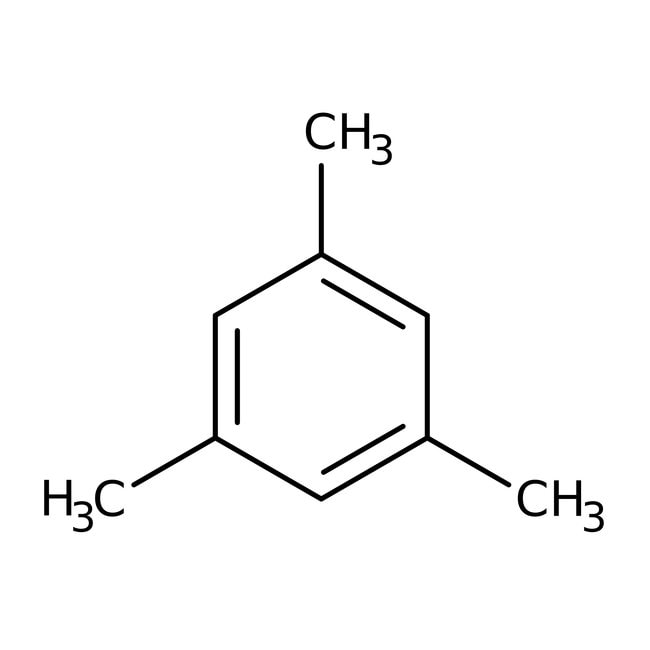

Thermo Scientific Chemicals
Mesitileno, + 98 %, Thermo Scientific Chemicals
CAS: 108-67-8 | C9H12 | 120.195 g/mol
Have Questions?
Cambiar vista


Número de catálogo A11323.AE
también denominado A11323-AE
Precio (EUR)
31,80
Each
Cantidad:
100 mL
Precio (EUR)
31,80
Each
Identificadores químicos
CAS108-67-8
IUPAC Name1,3,5-trimethylbenzene
Molecular FormulaC9H12
InChI KeyAUHZEENZYGFFBQ-UHFFFAOYSA-N
SMILESCC1=CC(C)=CC(C)=C1
Ver más
Especificaciones Hoja de especificaciones
Hoja de especificacionesAppearance (Color)Clear colorless to very pale yellow
FormLiquid
Identification (FTIR)Conforms
Assay (GC)≥98.0%
Refractive Index1.4970-1.5010 @ 20?C
Mesitylene is used to make plastics and dyes. It acts as a solvent, ligand in organometallic chemistry and precursor to 2,4,6-trimethylaniline. It is also used as a developer for photopatternable silicones due to its solvent properties in the electronics industry. It is used as an internal standard in nuclear magnetic resonance (NMR) samples due to the presence of three equivalent protons in it. It is involved in the production of trimesic acid and antioxygen, epoxy firming agent and polyester resin stabilizers. Further, it is used as an additive and component in aviation gasoline blends.
This Thermo Scientific Chemicals brand product was originally part of the Alfa Aesar product portfolio. Some documentation and label information may refer to the legacy brand. The original Alfa Aesar product / item code or SKU reference has not changed as a part of the brand transition to Thermo Scientific Chemicals.
Aplicaciones
El mesitileno se utiliza para fabricar plásticos y colorantes. Actúa como disolvente, como ligando en química organometálica y como precursor de la 2,4,6-trimetilanilina. Debido a sus propiedades solventes, se usa como desarrollador de siliconas fotoeléctricas en el sector de electrónica. También se utiliza como patrón interno en muestras de resonancia magnética nuclear (RMN), ya que posee tres protones equivalentes. Participa en la producción de ácido trimésico y antioxígeno, y es un agente endurecedor de epoxi y un estabilizador de resina de poliéster. Además, se utiliza como aditivo y componente en mezclas de gasolina de aviación.
Solubilidad
Parcialmente miscible con agua.
Notas
Incompatible con agentes oxidantes fuertes.
El mesitileno se utiliza para fabricar plásticos y colorantes. Actúa como disolvente, como ligando en química organometálica y como precursor de la 2,4,6-trimetilanilina. Debido a sus propiedades solventes, se usa como desarrollador de siliconas fotoeléctricas en el sector de electrónica. También se utiliza como patrón interno en muestras de resonancia magnética nuclear (RMN), ya que posee tres protones equivalentes. Participa en la producción de ácido trimésico y antioxígeno, y es un agente endurecedor de epoxi y un estabilizador de resina de poliéster. Además, se utiliza como aditivo y componente en mezclas de gasolina de aviación.
Solubilidad
Parcialmente miscible con agua.
Notas
Incompatible con agentes oxidantes fuertes.
RUO – Research Use Only
General References:
- The Adams modification of the Gattermann reaction for aromatic formylation by reaction with Zinc cyanide, L15836 , and HCl is exemplified: Org. Synth. Coll., 3, 549 (1955). The Vilsmeier formylation (see N,N-Dimethyl formamide, A13547 ), has been extended to less activated substrates, including mesitylene, by use of the combination of DMF and triflic anhydride: J. Chem. Soc., Chem. Commun., 1571 (1990).
- For conversion to mesitoic acid by Friedel-Crafts reaction with oxalyl chloride, and aqueous work-up, see: Org. Synth. Coll., 5, 706 (1973).
- Singh, P. Synthesis of mesitylene-based polyamine dendrimer for functionalisation of single-walled carbon nanotubes. J. Exp. Nanosci. 2015, 10 (6), 429-437.
- Medina, D. D.; Rotter, J. M.; Hu, Y.; Dogru, M.; Werner, V.; Auras, F.; Markiewicz, J. T.; Knochel, P.; Bein, T. Room Temperature Synthesis of Covalent-Organic Framework Films through Vapor-Assisted Conversion. J. Am. Chem. Soc. 2015, 137 (3), 1016-1019.