Search
 Búsqueda por elementos
 Búsqueda por estructura


Thermo Scientific Chemicals
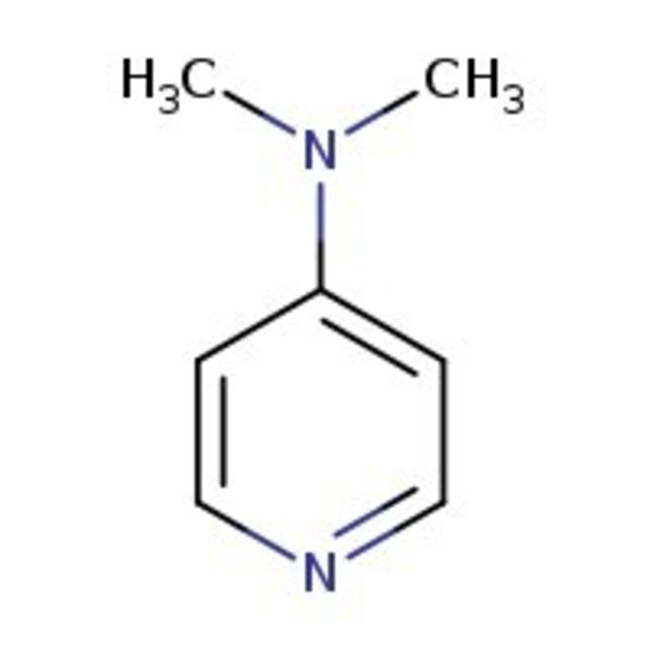
4-(Dimetilamino)piridina, 99 %, Thermo Scientific Chemicals
CAS: 1122-58-3 | C7H10N2 | 122.171 g/mol
Have Questions?
Cambiar vista


Precio (EUR)
49,40
Each
Identificadores químicos
CAS1122-58-3
IUPAC Name4-(dimethylamino)pyridin-1-ium
Molecular FormulaC7H11N2
InChI KeyVHYFNPMBLIVWCW-UHFFFAOYSA-O
SMILESCN(C)C1=CC=[NH+]C=C1
Ver más
Especificaciones Hoja de especificaciones
Hoja de especificacionesAssay (GC)≥98.5%
FormCrystals or powder or crystalline powder
Identification (FTIR)Conforms
Melting Point (clear melt)109.0-116.0?C
Appearance (Color)White to pale cream
4-(Dimethylamino)pyridine is a useful nucleophilic catalyst for various reactions viz. esterifications with anhydrides, the Baylis-Hillman reaction, hydrosilylations, tritylation and Steglich rearrangement. It is also an effective catalyst for transesterification of beta-keto esters and silylation of alcohols.
This Thermo Scientific Chemicals brand product was originally part of the Alfa Aesar product portfolio. Some documentation and label information may refer to the legacy brand. The original Alfa Aesar product / item code or SKU reference has not changed as a part of the brand transition to Thermo Scientific Chemicals.
Aplicaciones
4-(Dimetilamino)piridina es un útil catalizador nucleófilo para diversas reacciones, a saber, esterificaciones con anhídridos, la reacción de Baylis-Hillman, hidrosililaciones, tritilación y la transposición de Steglich. También es un catalizador eficaz para la transesterificación de los betaceto ésteres y la sililación de los alcoholes.
Solubilidad
Soluble en metanol, benceno, acetato de etilo, cloroformo, cloruro de metileno, acetona y ácido acético. Ligeramente soluble en éter, éter diisopropílico, ciclohexano, hexano y agua.
Notas
Incompatible con agentes oxidantes fuertes y ácidos fuertes.
4-(Dimetilamino)piridina es un útil catalizador nucleófilo para diversas reacciones, a saber, esterificaciones con anhídridos, la reacción de Baylis-Hillman, hidrosililaciones, tritilación y la transposición de Steglich. También es un catalizador eficaz para la transesterificación de los betaceto ésteres y la sililación de los alcoholes.
Solubilidad
Soluble en metanol, benceno, acetato de etilo, cloroformo, cloruro de metileno, acetona y ácido acético. Ligeramente soluble en éter, éter diisopropílico, ciclohexano, hexano y agua.
Notas
Incompatible con agentes oxidantes fuertes y ácidos fuertes.
RUO – Research Use Only
General References:
- Hypernucleophilic catalyst. Greatly accelerates the acylation of hindered, including tertiary, alcohols; reviews: Angew. Chem. Int. Ed., 17, 569 (1978). Chem. Soc. Rev., 12, 129 (1983). Catalyst for acylation of alcohols using mixed anhydrides of hindered carboxylic acids with methanesulfonic acid: Synth. Commun., 12, 727 (1982), and with mixed carboxylic anhydrides: J. Org. Chem., 50, 560 (1985). In the Yamaguchi method of macrocyclic lactonization the mixed anhydride formed with 2,4,6-Trichlorobenzoyl chloride, L14159 is cyclized with 2 equiv. of DMAP; high dilution conditions are not required: Bull. Chem. Soc. Jpn., 52, 1989 (1979). For improved method in a high yield synthesis of erythronolide A, see: J. Org. Chem., 55, 7 (1990).
- Greatly increases the rate of ester and thio ester formation in the carbodiimide method of coupling (Steglich esterification): Angew. Chem. Int. Ed., 17, 522 (1978). For similar use in macrolactonizations, see: J. Org. Chem., 50, 2394 (1985), and in carbodiimide peptide coupling reactions: Int. J. Pept. Prot. Res., 18, 459 (1981). For peptide reagents, see Appendix 6.
- Effective catalyst for transesterification of ß-keto esters in toluene: J. Org. Chem., 50, 3618 (1985), and for smooth decarboalkoxylation of enolizable ß-keto esters in toluene containing a small amount of water: J. Org. Chem., 54, 3474 (1989). Under these conditions, other bases (N,N-dimethylaniline, pyridine, tetra-n-pentylammonium bromide) are ineffective.