Search
 Búsqueda por elementos
 Búsqueda por estructura


Thermo Scientific Chemicals
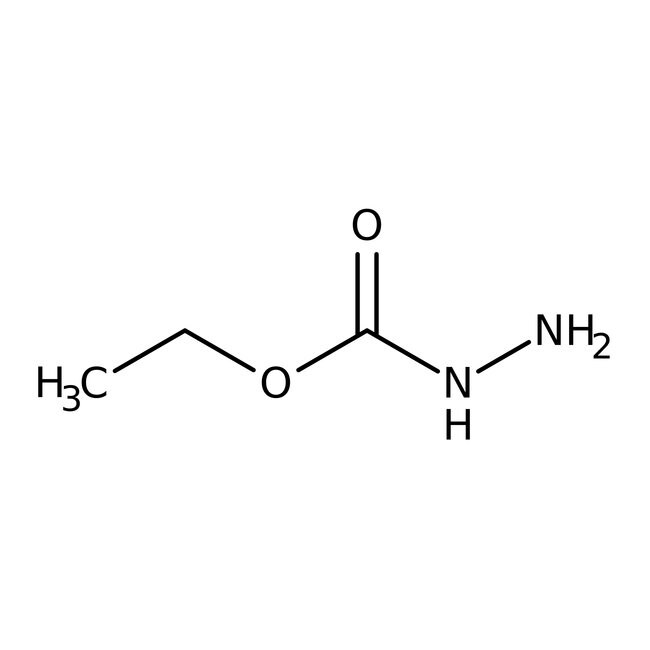
Carbazato de etilo, 97 %, Thermo Scientific Chemicals
CAS: 4114-31-2 | C3H8N2O2 | 104.109 g/mol
Have Questions?
Cambiar vista


Número de catálogo A13860.0B
también denominado A13860-0B
Precio (EUR)
584,00
Each
Cantidad:
1000 g
Precio (EUR)
584,00
Each
Identificadores químicos
CAS4114-31-2
IUPAC Nameethoxycarbohydrazide
Molecular FormulaC3H8N2O2
InChI KeyVYSYZMNJHYOXGN-UHFFFAOYSA-N
SMILESCCOC(=O)NN
Ver más
Especificaciones Hoja de especificaciones
Hoja de especificacionesAppearance (Color)White to pink or white/pink
FormCrystals or powder or crystalline powder or lumps and/or chunks or fused solid
Assay (GC)≥96.0%
Identification (FTIR)Conforms
Melting Point (clear melt)41.0-50.0°C
Prepare 4-phenylurazole from ethyl carbazate and then oxidize the urazole with gaseous dinitrogen tetroxide to yield 4-phenyl-1,2,4-tri- azoline-3,5-dione la. Modification of the ethyl carbazate procedure in which analytically pure monoalkylhydrazine hydrochlorides were isolated in greater than 90% yield, starting from a ketone or aldehyde. Treatment of primary amines is with chloroamine or hydroxylamine-0-sulfonic acid and the condensation of a carbonyl compound with ethyl carbazate. The FeCl 3 -catalyzed reaction of ethyl carbazate (2 b) proceeded readily to give β-hydroxyester 3 b in better yield. A new one-pot neat synthesis of some 5-aryl-2,4-dihydro-3H-1,2,4-triazol-3-ones through cyclocondensation of ethyl carbazate with aryl nitriles catalyzed by DMAP as an efficient and basic nucleophilic catalyst is described.
This Thermo Scientific Chemicals brand product was originally part of the Alfa Aesar product portfolio. Some documentation and label information may refer to the legacy brand. The original Alfa Aesar product / item code or SKU reference has not changed as a part of the brand transition to Thermo Scientific Chemicals.
Aplicaciones
Preparar 4-fenilurazol a partir de carbazato de etilo y, posteriormente, oxidar el urazol con tetróxido de dinitrógeno gaseoso para producir 4-fenil-1,2,4-triazolina-3,5-diona. Modificación del procedimiento de carbazato de etilo en el que se aislaron clorhidratos de monoalquilhidracina analíticamente puros en una producción superior al 90 %, a partir de una cetona o un aldehído. El tratamiento de las aminas primarias se lleva a cabo con ácido hidroxilamina-0-sulfónico y la condensación de un compuesto carbonílico con carbazato de etilo. De la reacción catalizada con FeCl 3 del carbazato de etilo (2 b) surgió fácilmente β-hidroxiéster 3 b en una producción mejor. Se describe una nueva síntesis ordenada en un solo recipiente de algunas 5-aril-2,4-dihidro-3H-1,2,4-triazol-3-onas a través de la ciclocondensación de carbazato de etilo con aril nitrilos catalizados por DMAP como catalizador nucleofílico eficiente y básico.
Solubilidad
Muy soluble en agua.
Notas
Almacenar en un lugar fresco. Mantenga el recipiente bien cerrado en un lugar seco y bien ventilado. Almacenar lejos de los agentes oxidantes fuertes.
Preparar 4-fenilurazol a partir de carbazato de etilo y, posteriormente, oxidar el urazol con tetróxido de dinitrógeno gaseoso para producir 4-fenil-1,2,4-triazolina-3,5-diona. Modificación del procedimiento de carbazato de etilo en el que se aislaron clorhidratos de monoalquilhidracina analíticamente puros en una producción superior al 90 %, a partir de una cetona o un aldehído. El tratamiento de las aminas primarias se lleva a cabo con ácido hidroxilamina-0-sulfónico y la condensación de un compuesto carbonílico con carbazato de etilo. De la reacción catalizada con FeCl 3 del carbazato de etilo (2 b) surgió fácilmente β-hidroxiéster 3 b en una producción mejor. Se describe una nueva síntesis ordenada en un solo recipiente de algunas 5-aril-2,4-dihidro-3H-1,2,4-triazol-3-onas a través de la ciclocondensación de carbazato de etilo con aril nitrilos catalizados por DMAP como catalizador nucleofílico eficiente y básico.
Solubilidad
Muy soluble en agua.
Notas
Almacenar en un lugar fresco. Mantenga el recipiente bien cerrado en un lugar seco y bien ventilado. Almacenar lejos de los agentes oxidantes fuertes.
RUO – Research Use Only
General References:
- A. Davoodnia,; M. Bakavoli,; M. Soleimany,;H. Behm. A new one-pot neat synthesis of 1,2,4-triazol-3-ones through 4-(N,N-dimethylamino) pyridine (DMAP) catalyzed cyclocondensation of ethyl carbazate with aryl nitriles. Chinese Chemical Letters. 2008, 19 (6),685-688.
- N. I. Ghali,; D. L. Venton,; S. C. Hung,; G. C. Le Breton. High-yielding synthesis of monoalkylhydrazines. J. Org. Chem., . 1981, 46 (26), 5413-5414.
- Forms crystalline ethoxycarbonyl hydrazones with aldehydes and ketones. With o-acylphenols, Pb(OAc)4 treatment of the resulting hydrazone results in replacement of the phenolic OH with ethoxycarbonyl, providing a route to ethyl o-acylbenzoates: Tetrahedron Lett ., 31, 6781 (1990).
- Reaction with methyl ketones, followed by treatment with SOCl2, leads to 4-substituted 1,2,3-thiadiazoles: J. Am. Chem. Soc., 77, 5359 (1955). In the presence of base, these readily lose N2 to give alkynethiolates: Can. J. Chem., 46, 1057 (1968):
- More recently, this sequence has been used in the synthesis of dendrimers from 1,3,5-triacetylbenzene: J. Chem. Soc., Perkin 1, 2203 (1994).