Search
 Búsqueda por elementos
 Búsqueda por estructura


Thermo Scientific Chemicals
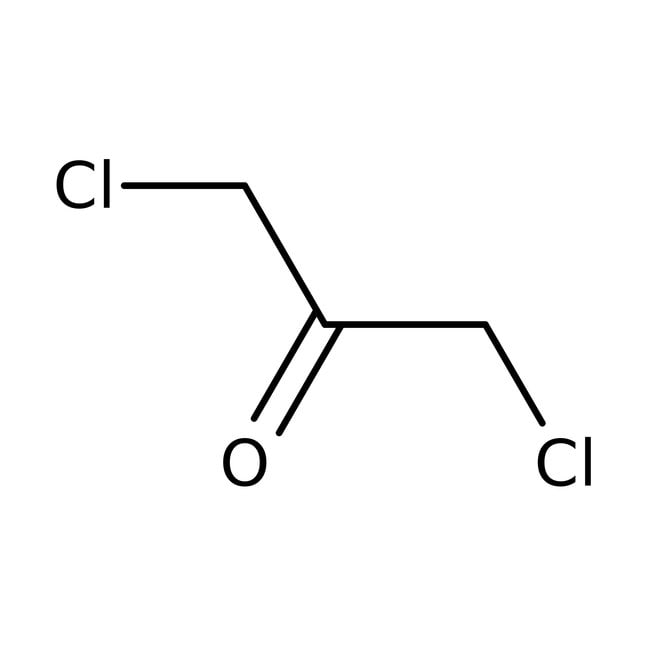
1,3-Dicloroacetona, 96 %, Thermo Scientific Chemicals
CAS: 534-07-6 | C3H4Cl2O | 126.96 g/mol
Have Questions?
Cambiar vista


Número de catálogo A14149.36
también denominado A14149-36
Precio (EUR)
419,65
キャンペーン価格
466,00Ahorro 46,35 (10%)
Each
Cantidad:
500 g
Precio (EUR)
419,65
キャンペーン価格
466,00Ahorro 46,35 (10%)
Each
Identificadores químicos
CAS534-07-6
IUPAC Name1,3-dichloropropan-2-one
Molecular FormulaC3H4Cl2O
InChI KeySUNMBRGCANLOEG-UHFFFAOYSA-N
SMILESClCC(=O)CCl
Ver más
Especificaciones Hoja de especificaciones
Hoja de especificacionesAppearance (Color)White to pale brown
FormCrystals or powder or crystalline powder or lumps or fused solid
Assay (GC)≥95.0%
Melting Point (clear melt)35.0-47.0?C
1,3-Dichloroacetone is used in the synthesis of citric acid. It is used as a solvent and as an intermediate in organic synthesis. Further, it serves as an acceptor substrate in the cross-aldol reaction with donor substrates such as acetone, cyclopentanone and cyclohexanone. It is also used in the preparation of an active pharmaceutical ingredient, famotidine.
This Thermo Scientific Chemicals brand product was originally part of the Alfa Aesar product portfolio. Some documentation and label information may refer to the legacy brand. The original Alfa Aesar product / item code or SKU reference has not changed as a part of the brand transition to Thermo Scientific Chemicals.
Aplicaciones
La 1,3-dicloroacetona se utiliza en la síntesis de ácido cítrico. Se utiliza como disolvente y como intermedio en la síntesis orgánica. Además, funciona como sustrato aceptor en la reacción transaldol con sustratos donantes como acetona, ciclopentanona y ciclohexanona. También se utiliza en la preparación de la famotidina, un ingrediente farmacéutico activo.
Solubilidad
Soluble en agua, etanol y éter dietílico.
Notas
Higroscópico. Almacenar en lugar fresco. Incompatible con agentes oxidantes fuertes, bases fuertes y agentes reductores.
La 1,3-dicloroacetona se utiliza en la síntesis de ácido cítrico. Se utiliza como disolvente y como intermedio en la síntesis orgánica. Además, funciona como sustrato aceptor en la reacción transaldol con sustratos donantes como acetona, ciclopentanona y ciclohexanona. También se utiliza en la preparación de la famotidina, un ingrediente farmacéutico activo.
Solubilidad
Soluble en agua, etanol y éter dietílico.
Notas
Higroscópico. Almacenar en lugar fresco. Incompatible con agentes oxidantes fuertes, bases fuertes y agentes reductores.
RUO – Research Use Only
General References:
- Successive reaction with a Grignard reagent and Li metal leads to 1-substituted cyclopropanols, which rearrange on thermolysis to ethyl ketones: Synthesis, 647 (1983):
- The cyclization can also be induced by ethyl radicals, generated from ethylmagnesium bromide and FeCl3. This method is applicable only to 1-arylcyclopropanols: J. Org. Chem., 29, 2813 (1964); 43, 3602 (1978); Org. Synth. Coll., 5, 1058 (1973).
- Formation of the acetal followed by treatment with NaNH2 provides a route to cyclopropenones: Tetrahedron, 48, 2045 (1992).
- Serrano, M.; Silva, M.; Gallego, M. Determination of 14 haloketones in treated water using solid-phase microextraction and gas chromatography-mass spectrometry. J. Chromatogr. A 2015, 1407, 208-215.
- Deng, J.; Chen, K.; Yao, Z.; Lin, J.; Wei, D. Efficient synthesis of optically active halogenated aryl alcohols at high substrate load using a recombinant carbonyl reductase from Gluconobacter oxydans. J. Mol. Catal. B: Enzym. 2015, 118, 1-7.