Search
 Búsqueda por elementos
 Búsqueda por estructura

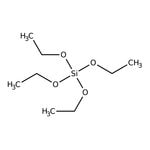

Thermo Scientific Chemicals
Tetraetoxisilano, 98 %, Thermo Scientific Chemicals
CAS: 78-10-4 | C8H20O4Si | 208.329 g/mol
Have Questions?
Cambiar vista


Número de catálogo A14965.AE
también denominado A14965-AE
Precio (EUR)
28,40
Each
Cantidad:
100 mL
Precio (EUR)
28,40
Each
Identificadores químicos
CAS78-10-4
IUPAC Nametetraethyl silicate
Molecular FormulaC8H20O4Si
InChI KeyBOTDANWDWHJENH-UHFFFAOYSA-N
SMILESCCO[Si](OCC)(OCC)OCC
Ver más
Especificaciones Hoja de especificaciones
Hoja de especificacionesIdentification (FTIR)Conforms
Appearance (Color)Clear colorless
Refractive Index1.3810-1.3850 @ 20?C
FormLiquid
Assay (GC)≥97.5%
Tetraethoxysilane is the main precursor material for the synthesis of zeolites and silicon dioxide, which is used in semiconductor industry. It is widely used as cross linking agents in silicon polymers and in aerogel preparations.
This Thermo Scientific Chemicals brand product was originally part of the Alfa Aesar product portfolio. Some documentation and label information may refer to the legacy brand. The original Alfa Aesar product / item code or SKU reference has not changed as a part of the brand transition to Thermo Scientific Chemicals.
Aplicaciones
El tetraetoxisilano es el principal material precursor para la síntesis de zeolitas y dióxido de silicio, que se utiliza en la industria de semiconductores. Se utiliza ampliamente como agentes de entrecruzamiento en polímeros de silicio y en preparaciones de aerogel.
Solubilidad
Soluble en etanol y 2-propanol.
Notas
Se degrada en el agua. Mantenga el recipiente bien cerrado en un lugar seco y bien ventilado.
El tetraetoxisilano es el principal material precursor para la síntesis de zeolitas y dióxido de silicio, que se utiliza en la industria de semiconductores. Se utiliza ampliamente como agentes de entrecruzamiento en polímeros de silicio y en preparaciones de aerogel.
Solubilidad
Soluble en etanol y 2-propanol.
Notas
Se degrada en el agua. Mantenga el recipiente bien cerrado en un lugar seco y bien ventilado.
RUO – Research Use Only
General References:
- Kim, S.; Ando, S.; Wang, X. Ternary composites of linear and hyperbranched polyimides with nanoscale silica for low dielectric constant, high transparency, and high thermal stability. RSC Adv. 2015, 5 (50), 40046-40054.
- Trogadas, P.; Parrondo, J.; Mijangos, F.; Ramani, V. Degradation mitigation in PEM fuel cells using metal nanoparticle additives. J. Mater. Chem. 2011, 21 (48), 19381-19388.