Search
 Búsqueda por elementos
 Búsqueda por estructura


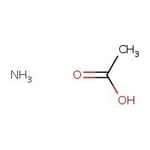


Thermo Scientific Chemicals
Acetato de amonio, 97 %, Thermo Scientific Chemicals
CAS: 631-61-8 | C2H7NO2 | 77.083 g/mol
Have Questions?
Cambiar vista


Número de catálogo A16343.30
también denominado A16343-30
Precio (EUR)
26,50
Each
Cantidad:
250 g
Precio (EUR)
26,50
Each
Identificadores químicos
CAS631-61-8
IUPAC Nameammonium acetate
Molecular FormulaC2H7NO2
InChI KeyUSFZMSVCRYTOJT-UHFFFAOYSA-N
SMILES[NH4+].CC([O-])=O
Ver más
Especificaciones Hoja de especificaciones
FormCrystals or powder or crystalline powder
Identification (FTIR)Conforms
Assay from Supplier's CofAAmmonia as ammonium acetate: ≥96.0% to ≤104.0%
Water Content (Karl Fischer Titration)≤5.0%
Appearance (Color)White
Ammonium acetate is widely utilized as a catalyst in the Knoevenagel condensation. It is the primary source of ammonia in the Borch reaction in organic synthesis. It is used with distilled water to make a protein precipitating reagent. It acts as a buffer for electrospray ionization (ESI) mass spectrometry of proteins and other molecules and as mobile phases for high performance liquid chromatography (HPLC). Sometimes, it is used as a biodegradable de-icing agent and an acidity regulator in food additives.
This Thermo Scientific Chemicals brand product was originally part of the Alfa Aesar product portfolio. Some documentation and label information may refer to the legacy brand. The original Alfa Aesar product / item code or SKU reference has not changed as a part of the brand transition to Thermo Scientific Chemicals.
Aplicaciones
el acetato de amonio se utiliza ampliamente como catalizador en la condensación de Knoevenagel. Es la fuente primaria de amoníaco en la reacción de Borch en la síntesis orgánica. Se utiliza con agua destilada para hacer un reactivo precipitante de proteínas. Actúa como tampón para la espectrometría de masas de ionización por electrospray (ESI) de proteínas y otras moléculas, y como fases móviles para la cromatografía de líquidos de alto rendimiento (HPLC). A veces se utiliza como agente descongelante biodegradable y como regulador de acidez en los aditivos alimentarios.
Solubilidad
soluble en agua, metanol, acetona y amoníaco líquido.
Notas
higroscópico. Incompatible con agentes oxidantes fuertes y ácidos fuertes.
RUO – Research Use Only
General References:
- Xia, S.; Zhang, H. Density Functional Theory Study of Selective Deacylation of Aromatic Acetate in the Presence of Aliphatic Acetate under Ammonium Acetate Mediated Conditions. J. Org. Chem. 2014, 79 (13), 6135-6142.
- Zhang, J.; Yao, J.; Liu, J.; Xue, S.; Li, Y.; Wang, C. Four-component reaction between naphthols, substituted β-nitrostyrenes, substituted benzaldehydes and ammonium acetate in water-PEG-400: an approach to construct polysubstituted naphthofuranamines. RSC Adv. 2015, 5 (60), 48580-48585.