Search
 Búsqueda por elementos
 Búsqueda por estructura

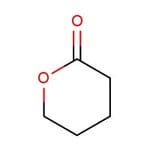

Thermo Scientific Chemicals
delta-Valerolactona, 98 %, puede contener polímero; destilar para eliminar, Thermo Scientific Chemicals
CAS: 542-28-9 | C5H8O2 | 100.12 g/mol
Have Questions?
Cambiar vista


Número de catálogo L04794.14
también denominado L04794-14
Precio (EUR)
50,65
Precio exclusivo compra web
55,70Ahorro 5,05 (9%)
Each
Cantidad:
25 g
Precio (EUR)
50,65
Precio exclusivo compra web
55,70Ahorro 5,05 (9%)
Each
Identificadores químicos
CAS542-28-9
IUPAC Nameoxan-2-one
Molecular FormulaC5H8O2
InChI KeyOZJPLYNZGCXSJM-UHFFFAOYSA-N
SMILESO=C1CCCCO1
Ver más
Especificaciones Hoja de especificaciones
Hoja de especificacionesAppearance (Color)Clear colorless to pale yellow
FormLiquid
Assay (GC)≥97.5%
CommentProduct may contain variable amounts of polymerized product. Depolymerisation is possible by distillation.
Identification (FTIR)Conforms
Ver más
δ-Valerolactone is employed as a chemical intermediate in the synthesis of polymers. It is also used to synthesize the copolyesters by lipase-catalyzed ring opening polymerization.
This Thermo Scientific Chemicals brand product was originally part of the Alfa Aesar product portfolio. Some documentation and label information may refer to the legacy brand. The original Alfa Aesar product / item code or SKU reference has not changed as a part of the brand transition to Thermo Scientific Chemicals.
Aplicaciones
La δ-valerolactona se emplea como producto químico intermedio en la síntesis de polímeros. También se utiliza para sintetizar los copoliésteres mediante la polimerización de apertura de anillo catalizada con lipasa.
Solubilidad
Miscible con agua.
Notas
Almacenar en un recipiente cerrado herméticamente. Evitar respirar el polvo, vapor o gas de este producto.
La δ-valerolactona se emplea como producto químico intermedio en la síntesis de polímeros. También se utiliza para sintetizar los copoliésteres mediante la polimerización de apertura de anillo catalizada con lipasa.
Solubilidad
Miscible con agua.
Notas
Almacenar en un recipiente cerrado herméticamente. Evitar respirar el polvo, vapor o gas de este producto.
RUO – Research Use Only
General References:
- Rajashekhar, B.; Chakraborty, D. Co(II) and Mn(II) catalyzed bulk ring-opening polymerization of cyclic esters. Polym. Bull. 2014, 71 (9), 2185-2203.
- Suess, B.; Brockhoff, A.; Meyerhof, W.; Hofmann, T. Structures, orosensory activity, and T1R1/T1R3 receptor activation of amides generated by lactone aminolysis using food-related processing conditions. Eur Food Res. Technol. 2013, 237 (1), 57-70.