Search
 Búsqueda por elementos
 Búsqueda por estructura


Thermo Scientific Chemicals
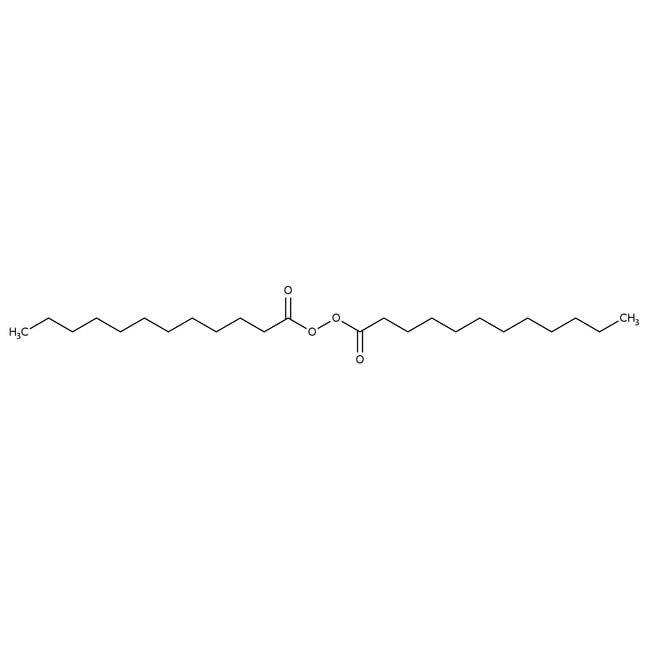
Peróxido de lauroilo, 97 %, Thermo Scientific Chemicals
CAS: 105-74-8 | C24H46O4 | 398.628 g/mol
Have Questions?
Cambiar vista


Número de catálogo L14310.36
también denominado L14310-36
Precio (EUR)
165,00
Each
Cantidad:
500 g
Precio (EUR)
165,00
Each
Identificadores químicos
CAS105-74-8
IUPAC Namedodecanoyl dodecaneperoxoate
Molecular FormulaC24H46O4
InChI KeyYIVJZNGAASQVEM-UHFFFAOYSA-N
SMILESCCCCCCCCCCCC(=O)OOC(=O)CCCCCCCCCCC
Ver más
Especificaciones Hoja de especificaciones
Hoja de especificacionesIdentification (FTIR)Conforms
Appearance (Color)White
Assay from Supplier's CofA≥96.0%
FormPowder or pellets or flakes or granules
Melting Point (clear melt)53-57?C
Lauroyl peroxide acts as a bleaching agent, drying agent for fats, oils and waxes. Further, it serves as a polymerization initiator as well as vulcanizing agent. In addition to this, it plays an important role for high-pressure polyethylene and food used in bleaching agent.
This Thermo Scientific Chemicals brand product was originally part of the Alfa Aesar product portfolio. Some documentation and label information may refer to the legacy brand. The original Alfa Aesar product / item code or SKU reference has not changed as a part of the brand transition to Thermo Scientific Chemicals.
Aplicaciones
El peróxido de lauroilo actúa como agente blanqueador y agente de secado para grasas, aceites y ceras. Además, sirve como iniciador de polimerización, así como agente vulcanizante. Asimismo, desempeña un papel importante para el polietileno de alta presión y los alimentos utilizados en agentes blanqueadores.
Solubilidad
Soluble en aceites y disolventes orgánicos. Ligeramente soluble en alcohol. Insoluble en agua.
Notas
Incompatible con ácidos, bases, metales, agentes reductores, metales en polvo, agentes reductores fuertes y material combustible.
El peróxido de lauroilo actúa como agente blanqueador y agente de secado para grasas, aceites y ceras. Además, sirve como iniciador de polimerización, así como agente vulcanizante. Asimismo, desempeña un papel importante para el polietileno de alta presión y los alimentos utilizados en agentes blanqueadores.
Solubilidad
Soluble en aceites y disolventes orgánicos. Ligeramente soluble en alcohol. Insoluble en agua.
Notas
Incompatible con ácidos, bases, metales, agentes reductores, metales en polvo, agentes reductores fuertes y material combustible.
RUO – Research Use Only
General References:
- Free-radical initiator. Xanthates undergo hydrodesulfurization with the reagent in refluxing isopropanol: Tetrahedron Lett., 37, 5877 (1996). The reaction has been extended to the cyclization of 3-aroylpropyl xanthates to tetralones: Tetrahedron Lett., 38, 1759 (1997); 1,2,3,4-tetrahydroisoquinolin-1-ones can be prepared similarly: Tetrahedron Lett., 39, 7295 (1998).
- Han, S.; Zard, S. Z. A convergent route to substituted azetidines and to Boc-protected 4-aminomethylpyrroles. Tetrahedron 2015, 71 (22), 3680-3689.
- Qiu, W.; Raghavanpillai, A.; Brown, P. A.; Atkinson, W. R.; Vincent, M. F.; Marshall, W. J. Ethylene-tetrafluoroethylene (ETFE) cotelomer iodides and their transformation to surface protection intermediates. J. Fluorine Chem. 2015, 169, 12-23.