Search

Gibco™
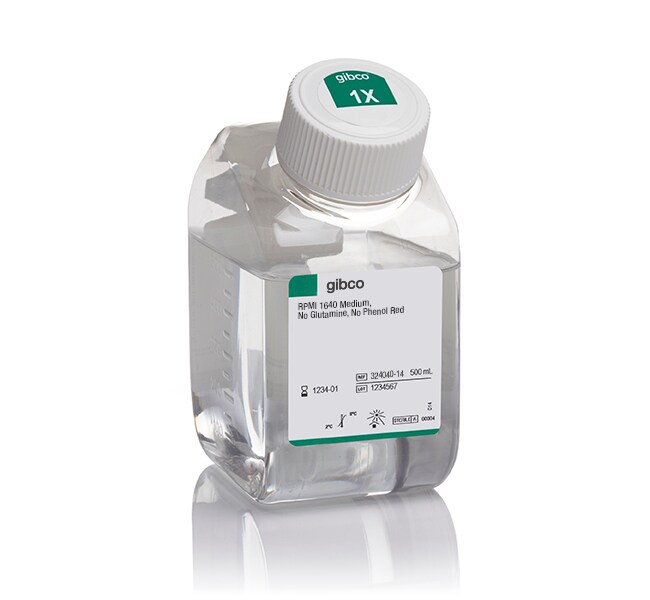
RPMI 1640 Medium, no glutamine, no phenol red
Roswell Park Memorial Institute (RPMI) 1640 medium was originally developed to culture human leukemic cells in suspension and as aRead more
| Catalog Number | Quantity |
|---|---|
| 32404014 | 500 mL |
Catalog number 32404014
Price (EUR)
34,16
Each
Quantity:
500 mL
Price (EUR)
34,16
Each
Roswell Park Memorial Institute (RPMI) 1640 medium was originally developed to culture human leukemic cells in suspension and as a monolayer. RPMI 1640 has since been found suitable for a variety of mammalian cells including HeLa, Jurkat, MCF-7, PC12, PBMC, astrocytes, and carcinomas. We offer a variety of Gibco™ RPMI 1640 modifications for a range of cell culture applications. Find the right formulation using the media selector tool.
This RPMI 1640 is modified as follows:
| Without |
| • L-glutamine |
| • HEPES |
| • Phenol Red |
The complete formulation is available.
Gibco™ RPMI 1640 is unique from other media because it contains the reducing agent glutathione and high concentrations of vitamins. RPMI 1640 contains biotin, vitamin B12, and PABA which are not found in Eagle's Minimal Essential Medium or Dulbecco's Modified Eagle Medium. In addition, the vitamins inositol and choline are present in very high concentrations.
Product Use
For Research Use Only: Not intended for animal or human diagnostic or therapeutic use.
RPMI 1640 contains no proteins, lipids, or growth factors. Therefore, RPMI 1640 requires supplementation, commonly with 10% Fetal Bovine Serum (FBS). RPMI 1640 uses a sodium bicarbonate buffer system (2.0 g/L) and therefore requires a 5-10% CO2 environment to maintain physiological pH.
For Research Use or Further Manufacturing. Not for diagnostic use or direct administration into humans or animals.
Specifications
Cell LineHeLa, Jurkat, MCF-7, PC-12, PBMC, astrocytes, and carcinomas
Cell TypeLeukemic Cells
Concentration1 X
Culture EnvironmentCO2
Manufacturing QualitycGMP-compliant under the ISO 13485 standard
Osmolality260 - 300 mOsm/kg
Product LineGibco
Product TypeRPMI 1640 Medium (Roswell Park Memorial Institute 1640 Medium)
Quantity500 mL
Shelf Life12 Months From Date of Manufacture
Shipping ConditionRoom Temperature
ClassificationAnimal Origin-free
FormLiquid
Serum LevelStandard Serum Supplementation
SterilitySterile-filtered
With AdditivesSodium Bicarbonate
Without AdditivesNo Glutamine, No HEPES, No Phenol Red, No Sodium Pyruvate
Unit SizeEach
Contents & Storage
Storage conditions: 2-8° C. Protect from light.
Shipping conditions: Ambient.
Shelf life: 12 months from date of manufacture.
Shipping conditions: Ambient.
Shelf life: 12 months from date of manufacture.