Search


Citations & References (9)
Invitrogen™
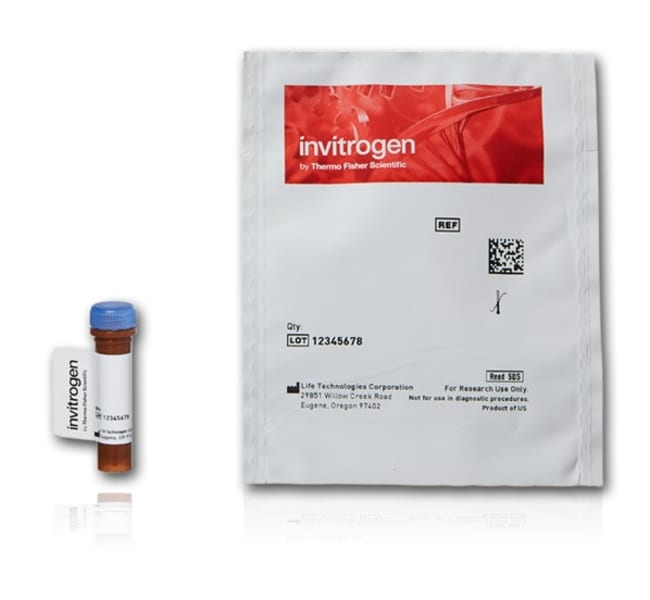
Alexa Fluor™ 647 Azide, Triethylammonium Salt
The far red-fluorescent Alexa Fluor™ 647 azide is reactive with terminal alkynes via a copper-catalyzed click reaction.
| Catalog Number | Quantity |
|---|---|
| A10277 | 0.5 mg |
Catalog number A10277
Price (EUR)
430,65
線上優惠
574,00Save 143,35 (25%)
Each
Quantity:
0.5 mg
Price (EUR)
430,65
線上優惠
574,00Save 143,35 (25%)
Each
The far red-fluorescent Alexa Fluor™ 647 azide is reactive with terminal alkynes via a copper-catalyzed click reaction. The bright and photostable fluorophore can be for used with flow cytometry, microscopy, and HCS
Dissolve in high-quality anhydrous DMSO for stock concentrations of 1 to 10 mM.
For Research Use Only. Not for use in diagnostic procedures.
Specifications
Chemical ReactivityAlkyne
Detection MethodFluorescence
Emission665 nm
Excitation650 nm
FormatSolid
Label or DyeAlexa Fluor™ 647
Molecular Weight (g/mol)∼850 g/mol
Product TypeAzide
Quantity0.5 mg
Reactive MoietyAmine, Azide
Shipping ConditionRoom Temperature
SolubilityDMF (Dimethylformamide), DMSO (Dimethylsulfoxide)
System TypeClick-iT™
ColorFar-red
Label TypeAlexa Fluor
Product LineAlexa Fluor, Molecular Probes
Unit SizeEach
Contents & Storage
Store at ≤-20°C, desiccate, and protect from light.
Frequently asked questions (FAQs)
I have run out of the Alexa Fluor 647 Azide from the Click-iT EdU Cell Proliferation Kit for Imaging, Alexa Fluor 647 dye (Cat. No. C10340). Is it possible to purchase it separately? How would I combine the standalone reagent with the kit?
I am observing no signal or very low specific signal for my click-labeled samples. What can I do to improve the signal?
I am observing high non-specific background when I image my Click-iT EdU TUNEL-labeled samples. What is causing this and what can I do to reduce the background?
I notice that when I post-stain my cells with DAPI after performing the click reaction to detect EdU incorporation, my DAPI signal is lower compared to my no-click reaction control samples. What causes the reduction in DAPI signal?
I am observing no signal or very low signal for my click-labeled samples. What can I do to improve the signal?
Citations & References (9)
Citations & References
Abstract
Toscana virus NSs protein promotes degradation of double-stranded RNA-dependent protein kinase.
Journal:J Virol
PubMed ID:23325696
'Toscana virus (TOSV), which is transmitted by Phlebotomus spp. sandflies, is a major etiologic agent of aseptic meningitis and encephalitis in the Mediterranean. Like other members of the genus Phlebovirus of the family Bunyaviridae, TOSV encodes a nonstructural protein (NSs) in its small RNA segment. Although the NSs of Rift
APC/C-CCS52A complexes control meristem maintenance in the Arabidopsis root.
Journal:Proc Natl Acad Sci U S A
PubMed ID:19553203
'Plant organs originate from meristems where stem cells are maintained to produce continuously daughter cells that are the source of different cell types. The cell cycle switch gene CCS52A, a substrate specific activator of the anaphase promoting complex/cyclosome (APC/C), controls the mitotic arrest and the transition of mitotic cycles to
DNA replication occurs in all lamina positive micronuclei, but never in lamina negative micronuclei.
Journal:Mutagenesis
PubMed ID:22086909
A micronucleus is a small nucleus-like structure found in the cytoplasm of dividing cells that suffered from genotoxic stress. It is generally hypothesised that micronuclei content is eventually lost from cells, though the mechanism of how this occurs is unknown. If DNA located within the micronucleus is not replicated, it
NSs protein of rift valley fever virus promotes posttranslational downregulation of the TFIIH subunit p62.
Journal:J Virol
PubMed ID:21543505
Rift Valley fever virus (RVFV; family Bunyaviridae, genus Phlebovirus) is an important emerging pathogen of humans and ruminants. Its NSs protein has previously been identified as a major virulence factor that suppresses host defense through three distinct mechanisms: it directly inhibits beta interferon (IFN-ß) promoter activity, it promotes the degradation
CD4 and CD8 T cell immune activation during chronic HIV infection: roles of homeostasis, HIV, type I IFN, and IL-7.
Journal:J Immunol
PubMed ID:21257970
Immune activation plays an important role in the pathogenesis of HIV disease. Although the causes are not fully understood, the forces that lead to immune dysfunction differ for CD4 and CD8 T cells. In this study, we report that the molecular pathways that drive immune activation during chronic HIV infection