Search
 Element Search
 Structure Search


Thermo Scientific Chemicals
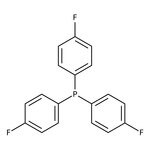
Tris(4-fluorophenyl)phosphine, 98%
CAS: 18437-78-0 | C18H12F3P | 316.26 g/mol
Have Questions?
Change view



Catalog number A14813.03
also known as A14813-03
Price (EUR)
34,70
Each
Quantity:
1 g
Price (EUR)
34,70
Each
Chemical Identifiers
CAS18437-78-0
IUPAC Nametris(4-fluorophenyl)phosphane
Molecular FormulaC18H12F3P
InChI KeyGEPJPYNDFSOARB-UHFFFAOYSA-N
SMILESFC1=CC=C(C=C1)P(C1=CC=C(F)C=C1)C1=CC=C(F)C=C1
View more
Specifications Specification Sheet
Specification SheetFormCrystals or powder or crystalline powder
Assay (GC)≥97.5%
Melting Point (clear melt)77.0-84.0?C
Appearance (Color)White
Tris(4-fluorophenyl)phosphine, is an important raw material and intermediate used in organic Synthesis, pharmaceuticals, agrochemicals and dyestuff.
This Thermo Scientific Chemicals brand product was originally part of the Alfa Aesar product portfolio. Some documentation and label information may refer to the legacy brand. The original Alfa Aesar product / item code or SKU reference has not changed as a part of the brand transition to Thermo Scientific Chemicals.
Applications
Tris(4-fluorophenyl)phosphine, is an important raw material and intermediate used in organic Synthesis, pharmaceuticals, agrochemicals and dyestuff.
Solubility
Insoluble in water.
Notes
Air Sensitive. Store in cool place. Keep container tightly closed in a dry and well-ventilated place. Keep away from strong oxidizing agents.Stable under recommended storage conditions.
Tris(4-fluorophenyl)phosphine, is an important raw material and intermediate used in organic Synthesis, pharmaceuticals, agrochemicals and dyestuff.
Solubility
Insoluble in water.
Notes
Air Sensitive. Store in cool place. Keep container tightly closed in a dry and well-ventilated place. Keep away from strong oxidizing agents.Stable under recommended storage conditions.
RUO – Research Use Only
General References:
- R Kino.; K Daikai.; T Kawanami.; H Furuno. Remarkable effect of tris(4-fluorophenyl)phosphine oxide on the stabilization of chiral lanthanum complex catalysts. A new and practical protocol for the highly enantioselective epoxidation of conjugated enones. Org. Biomol. Chem.20042 (13), 1822-1824.
- LJ Gooßen.; N Rodríguez.; F Manjolinho. Synthesis of Propiolic Acids via Copper-Catalyzed Insertion of Carbon Dioxide into the CH Bond of Terminal Alkynes. Synthesis & Catalysis.201013 (1), 22- 25.